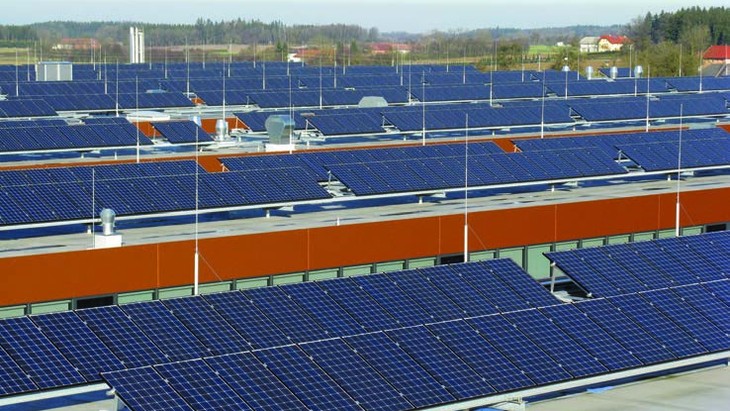
Romania has now passed 8.5 GW of installed solar and could reach its 10 GW target for 2030 as early as 2027, says Walburga Hemetsberger, CEO of SolarPower Europe. Romania added around 1.8 GW in the fi rst six months of 2026, up from 1.5 GW a year earlier. ”Growth was unusually balanced: roughly 1 GW came from utility-scale plants and 800 MW from prosumers. Romania is also projected to become the sixth largest source of new solar capacity in the EU between 2026 and 2030, surpassing the Netherlands, in SolarPower Europe’s medium scenario”, Walburga Hemetsberger tells Energynomics.
How did the solar sector evolve in Europe in 2026, and what are the latest trends? How about the South-Eastern Europe group of countries, including Romania in particular?
The European solar market is in a slightly strange place. As noted in SolarPower Europe’s recent mid-year European Market Outlook for solar power, Europe is still installing a lot of solar. At least 33.6 GW was added in the fi rst half of 2026, 1.1% more than in the same period last year. However, this marginal increase should not be mistaken for a return to strong growth. Europe’s solar growth momentum has stalled. Growth was only around 1% in the fi rst half of 2026, and we currently expect the full-year market to reach 68.1 GW, 2.1% below the revised 2025 result of 69.6 GW. That does not mean rapid growth cannot return. It can, but it will depend on policy choices: more stable support, faster grid development, more storage and stronger electricity demand. The wider context also matters. Renewed fossil fuel crisis has once again strengthened the business case for solar. It has reminded households, businesses and governments that domestic renewable electricity Walburga Hemetsberger, CEO al SolarPower Europe is a source of energy security and protection from volatile fossil fuel prices. However, a sustainable solar market cannot depend on one external crisis after another. Europe needs stable frameworks that allow investment to continue in more normal market conditions.
Behind this overall figure, the picture is very uneven across countries and market segments.
The mix of new projects is changing. Residential solar is slowing in quite a few countries including Belgium, the Netherlands, Czechia, Hungary and Slovenia, partly due to reduced government support. Large projects are now carrying a larger share of the market. Utility-scale solar is expected to account for around 56% of EU installations this year. That is quite a change from the solar boom a few years ago, when rooftop systems were driving much of the growth.
Compared to the average EU country, Romania is doing well, as we can see in the numbers.
The country added around 1.8 GW in the fi rst six months of 2026, up from 1.5 GW a year earlier. Growth was unusually balanced: roughly 1 GW came from utility-scale plants and 800 MW from prosumers. Romania has now passed 8.5 GW of installed solar and could reach its 10 GW target for 2030 as early as 2027. That would put the country three years ahead of its current National Energy and Climate Plan target. Romania entered the EU’s top ten annual markets in 2024 and consolidated its position in 2025 after adding about 2.5 GW, 45% more than in 2024. This was the fastest growth rate among the EU’s ten largest solar markets in 2025. Romania’s strong performance has been supported by relatively short permitting times, public and European funding, contracts for diff erence, growing prosumer activity and the development of its power purchase agreement market. The broader South-East European picture is not as clear, off ering both opportunities and challenges. Greece installed around 1.5 GW in H1 2026, almost as much as in the whole of 2025. But it has already passed its 2030 solar target and now faces rising curtailment. The next test is whether grids, storage and electricity demand can keep pace with new plants.
What is the evolution of the home rooftop segment and the commercial and industrial segment? Why are they reversing? Why is the rooftop segment slowing down? What are the trends in the market in the mid-term?
During the 2022 energy crisis, high power bills drove exceptional demand for household solar. Rooftop systems gave people a direct way to cut their bills and reduce their exposure to volatile fossil fuel prices. Strong public support helped many households cover the upfront cost.
Demand then slowed as the crisis faded from public attention. Several governments reduced subsidies, feed-in tariffs or net-metering benefits, while borrowing costs rose. These changes weakened the business case for some households and contributed to the slowdown in the residential rooftop segment. The commercial and industrial segment has proved more resilient, as businesses continued to invest to lower electricity costs, reduce their exposure to price volatility and support electrification.
Now, once again, Europe is being reminded of the risks that come with its dependence on fossil fuels. These supply disruptions and price spikes shouldn’t be treated as isolated events. Fossil fuel volatility remains a recurring risk to household budgets and Europe’s energy security. Rooftop solar gives citizens a lasting advantage in this new environment. Producing power at home lowers bills, gives households more control over their energy use and reduces their exposure to imported fuels.
Rooftop solar also contributes directly to climate resilience. During periods of high temperatures, solar production broadly corresponds with increased daytime electricity demand for cooling. When combined with batteries, fl exible tariff s and smart energy management, rooftop systems can help households and businesses manage consumption while reducing pressure on the wider electricity system. So, the main arguments for rooftop solar are intact. The segment still has a major role to play in meeting Europe’s energy and climate targets. But reaching those targets will require governments to revive the rooftop solar segment and give households a stable, realistic way to cover the upfront cost. Romania is among the countries that proves growth is very much achievable for residential solar. Its prosumer market added around 800 MW in the rst half of 2026, even as rooftop demand weakened elsewhere in Europe. The medium-term outlook will depend on policy choices. Stable support, faster smart-meter deployment, energy sharing, and fl exible tariff s can bring more households into the market.
What is the required level of investment in the mid-term, in an optimist scenario? What are the predictions?
There is no single fi gure for investment needs. Solar investment cannot be viewed in isolation. The total need will depend on the grids, storage and exible demand required to support further growth. But there is at least one clear answer I can give to this question: Europe does not lack demand for clean power or aff ordable solar technology. It lacks the policy conditions that turn that demand into investable projects. Romania gives an idea of what can happen when policy does move early enough. The country installed around 1.8 GW in the fi rst half of 2026, passed 8.5 GW in total capacity and could reach its 10 GW national target in 2027, three years early. In 2025, its market grew by 45% while growth across much of Europe stalled. Fast permitting, public funding, contracts for diff erence and a growing PPA market helped bring projects forward. Romania is also expected to become the EU’s sixth largest source of new solar capacity between 2026 and 2030, overtaking the Netherlands in SolarPower Europe’s medium scenario. This illustrates the scale of the opportunity, but it also raises the urgency of investing in the infrastructure needed to integrate that capacity.
But panels are only part of the investment needs.
Grids need new connections, stronger substations, and transmission lines. Batteries need to store midday power and release it when demand rises in the evening. Industry, transport and heating must use more electricity when renewable power is abundant. Without that wider build-out, more generation can mean more curtailment, lower project revenues and continued reliance on costly fossil power after sunset.
Romania has started to act before these problems become entrenched. For several years, public support has encouraged households and large developers to pair solar with batteries. The government removed some taxes on electricity storage and directed €76 million of subsidies towards batteries in May of this year. By the first half of this year, around onethird of the country’s roughly 330,000 prosumers had installed storage. Large projects are moving in the same direction, with batteries placed beside generation rather than far away on an already strained grid.
This is where policymakers matter most. They should set stable auction schedules, speed up permits and grid connections, reward storage and fl exible demand, and stop viable projects from being blocked by speculative grid reservations. Clear rules mean lower risk and bring in private capital.
How have the costs, implementation times and profi tability of solar projects evolved, and what factors currently infl uence them the most?
Solar hardware remains cheap by recent standards. SolarPower Europe data shows that wholesale module prices fell by more than 70% from their late-2022 peak of 34 euro cents per watt and were still around 10 euro cents per watt in 2025. This naturally increases solar’s competitiveness, but module prices alone do not determine total project costs or returns. As previously said, grid access and system constraints now matter more. Congestion, connection delays and curtailment can slow projects and weaken their business case. Permitting has improved in some countries, including Romania, but grid availability is increasingly becoming the decisive bottleneck. Revenues are under pressure. Declining capture prices and a growing number of negative price periods are weakening the economics of solar projects. Solar lowers wholesale prices during sunny hours, which benefi ts consumers, but it reduces the income of projects exposed to the market. Curtailment cuts revenues further when the grid cannot absorb the electricity. So there is no single direction for returns. Build times and payback periods vary widely by country and project type. Cheaper modules have improved the situation, while low capture prices, curtailment and grid constraints tend to off set that gain. The uncertainty is a large part of the problem. That is why projects supported by long-term PPAs, selfconsumption, and solar-plus-storage are so valuable. These models can reduce exposure to short-term wholesale market volatility. Solar remains the most competitive electricity technology available. But the discussion has moved beyond the price of the panel. The decision questions are now how quickly a project can connect, how much of its electricity can be used or stored, and how predictable its revenues will be over its lifetime. This is why Europe needs to think of solar, storage, grids, and electrifi cation as one investment agenda.
Simtel announces the signing of the first two projects by Simtel Italia, the subsidiary opened by the Group in Milan in June 2026. The two projects have a cumulative value of approximately 15 million lei and a total installed capacity of over 15 MWp. The projects are located in the Abruzzo and Emilia-Romagna regions and involve the provision of light EPC services for an independent renewable energy producer (Independent Power Producer – IPP), controlled by an American infrastructure investment fund. The works started in August 2026 and their completion is estimated by the end of the year. Simtel Italia is participating in bidding procedures for photovoltaic projects with a cumulative capacity of approximately 300 MWp and for battery energy storage systems (BESS) totaling approximately 90 MWh.
Premier Energy Group reports a solid operational and financial performance for the first half of 2026. Normalized revenues increased by 10% year-on-year to EUR 877 million, while normalized EBITDA reached EUR 79 million, up 27% compared to H1 2025. On a reported basis, according to IFRS, revenues amounted to EUR 871 million, a 4% increase year-on-year, while adjusted EBITDA reached EUR 73 million, and net profit amounted to EUR 22 million, both reflecting the reversal of the previous year’s tariff deviations in the Republic of Moldova.The performance was supported by a 46% increase in its own renewable electricity production.
_____________________________________________
The interview also appeared in the print edition of Energynomics Magazine, Q3 2026 issue.
In order to receive the printed or electronic issue of Energynomics Magazine, we encourage you to write us at office [at] energynomics.ro to include you in our distribution list. All previous editions are available HERE.