

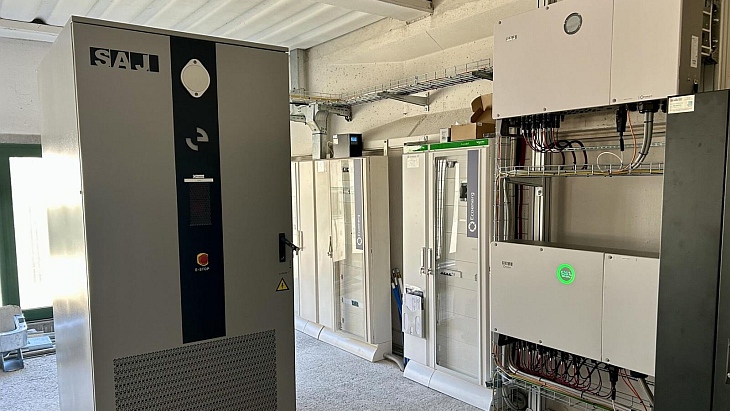
SAJ Electric, a Chinese manufacturer of inverters and energy storage systems, is building its offer for Romania around storage: hybrid systems for commercial and industrial (C&I) consumers, a retrofit solution for solar parks already in operation and integrated systems for household prosumers. The company is building local technical support for developers, EPC firms and design engineers, says Adrian Șușcă, Regional Manager for Balkans Area at SAJ Electric.
The shift in emphasis starts from market conditions. After a cycle in which investment focused on installing solar capacity, price volatility on the day-ahead market (DAM), increasingly frequent negative-price intervals, curtailment risk and constraints in the distribution grids are forcing investors to rework their profitability model, the SAJ representative argues.
“The central question is no longer ‘how much power can we produce?’, but ‘how intelligently can we store, manage, and monetize every single kilowatt-hour?’,” says Adrian Șușcă.
Two solutions for C&I: new projects and existing parks
For new projects, SAJ offers the CHS3 series, which combines the CH3 hybrid inverter with liquid-cooled CB3 battery cabinets of 261 kWh. The system accepts PV strings of up to 1250 V DC and has a factory-integrated static transfer switch (STS), which moves the load from the grid to the battery in no more than 20 milliseconds.
One inverter is rated between 75 and 125 kW, and units are connected in parallel. Grid-connected, a CHS3 system reaches 2.5 MW and 20.8 MWh. In configurations that can also run off-grid, the limit is 1.25 MW and 10.4 MWh, according to company data. The batteries can be sized for durations of 2 to 8 hours.
For existing solar parks equipped with on-grid inverters, SAJ proposes CM2, an all-in-one storage system in modules of 99.9 or 125 kW and 261 kWh. CM2 connects to the AC bus, with no changes to the solar installation. The owner can store energy that would otherwise be curtailed or delivered at negative prices and sell it in the more expensive hours. Adrian Șușcă says the solution is already working in Romania. The most recent project is at a factory in Timișoara, where 20 CM2 units connected in parallel provide about 5 MWh of storage, used for self-consumption and energy trading. He adds that the investment required is lower than in other retrofit configurations.
The software decides when the battery charges
The equipment is run through the elekeeper platform and the AI Saving 3.0 function, which use the weather forecast, the user’s consumption profile and the hourly DAM price curve. On that basis, the algorithm sets the charge and discharge cycles automatically. The battery charges in the cheap hours and discharges in the expensive ones (arbitrage) and covers consumption peaks, to reduce the power drawn from the grid (peak shaving).
The second revenue stream targeted is participation in the balancing and flexibility markets, through virtual power plant (VPP) aggregators. The company says the CHS3 and CM2 systems are ready for such integrations and points to its experience in other European markets. The previous generation, CHS2, was certified in 2024 with CheckWatt’s FFR and FCR qualifications (frequency reserve services), according to SAJ’s company presentation.
In the residential segment, the offer has two directions. HS3 is an all-in-one system 17 cm thick, which brings together the inverter, the battery (modular, from 5 to 40 kWh), the backup power function, energy management and an electric vehicle charger, which is integrated as a module but has to be purchased separately. The low-voltage H3 hybrid inverter is aimed at installers who also want to work with batteries from other manufacturers, according to Adrian Șușcă.
In-house production and a local team
SAJ was founded in 2005, in Guangzhou, as a manufacturer of variable frequency drives. It opened its renewable energy division in 2011 and launched its first residential storage inverter in 2015. The company reports more than 1,200 employees, over a quarter of them in research and development, three research centres and a production capacity of 7.2 GWh of storage systems per year. In Romania, SAJ works through a local team that is still small but growing fast, according to Adrian Șușcă.
Adrian Șușcă stresses that the equipment is designed and manufactured entirely in the company’s own factories, from the electronic boards and power conversion modules to the battery management system (BMS) and the control algorithms. “We do not rely on third-party OEM/ODM contracting or fragmented component assembly,” he says. For partners, the argument is compatibility between hardware and software and security of supply.
In Romania, the stated priority is direct support for developers, EPC companies and design engineers: Romanian-language technical assistance during sizing and commissioning, training sessions through SAJ Academy, a local spare-parts network and a warranty provided directly by the manufacturer. The local projects already in operation will show how much of the DAM price spreads actually turns into revenue for park owners and for industrial consumers.