Adrian Ilie, Managing Director, Enercon Romania
Romania is not just a sales market for Enercon, but a regional hub, says Adrian Ilie, Managing Director, Enercon Romania. The expertise and infrastructure developed locally support both wind farms in Romania and projects in other European markets. “The discussion about wind energy in Romania has focused too much on installed megawatts and too little on what happens to those megawatts over the next 25 years. The fi rst stage lasts two years. The second lasts a quarter of a century,” Adrian Ilie says in an interview with Energynomics.
What are Enercon’s main development directions and target segments, and what are the main projects underway in Romania in 2026?
Enercon has been present in Romania since 2009, and today we have approximately 128 wind turbines under maintenance, representing around 10% of Romania’s wind market. We operate two service stations, in Constanța and Galați County, providing 24/7 coverage for wind farms, with extended-shift teams during the week and intervention teams at weekends. We are proud of our local team: 184 colleagues, including more than 170 fi eld engineers and technicians, and their number continues to grow. Beyond routine maintenance, we have local teams specialising in complex work such as blade inspections and advanced diagnostics. These are skills that cannot be learned in a classroom. They are built through years of fi eldwork, supported by extensive and continuous training programmes. Romania is not just a sales market for Enercon, but a hub. In Constanța, we have the central spare parts warehouse, with a large stock of components, and a regional service centre serving the European market. The expertise built here, with people trained here, supports not only wind farms in Romania but also projects in other European markets. I think this is worth emphasizing in an industry where discussions about “local added value” are too often reduced to how many tonnes of steel are produced domestically. Local added value also means a Romanian engineer travelling to another European country to repair a major component because he is among the besttrained people able to do the job. This type of capital cannot be imported overnight. It has been built over more than a decade and remains in the local economy.
The discussion about wind energy in Romania has focused too much on installed megawatts and too little on what happens to those megawatts over the next 25 years. The first stage lasts two years. The second lasts a quarter of a century.
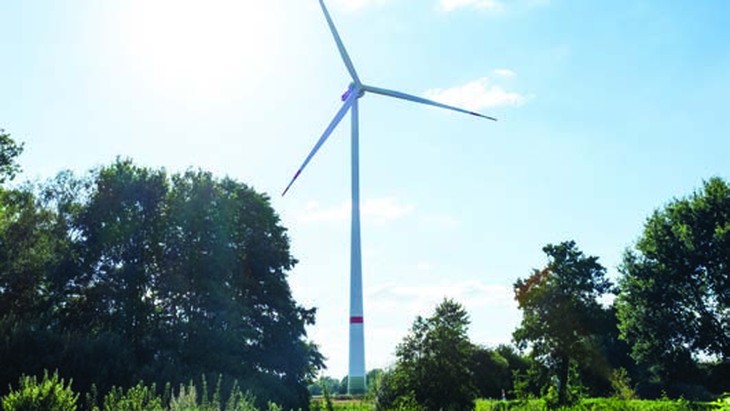
As for new projects, our return to the installation segment took place in Galați County, where we delivered, assembled and commissioned seven E-160 EP5 E2 turbines, with a total capacity of more than 38 MW, on 120-metre modular steel towers. The project validated the entire value chain: logistics, assembly, commissioning and handover to service.
In the short term, we are preparing another step: a new project in Romania equipped with Enercon’s top-of-the-range E-175 EP5 E2 turbine, with a nominal capacity of 7 MW.
Our main focus in Romania remains utility-scale onshore wind. This is where the demand is, where the best wind resource is available and where support schemes are in place. However, we approach the market differently than we did ten years ago. We do not simply sell a turbine. We offer complete solutions: a high-efficiency turbine, a tower adapted to the site, an integrated storage solution where it makes economic sense and long-term service support. Enercon has already developed integrated wind + BESS solutions in Germany, including storage systems integrated into hybrid towers, and we are currently assessing the expansion of these solutions across Europe, including Romania.
How many of these projects also include storage? What are the latest storage trends in Romania and other markets?
In Romania, the fi gures speak for themselves. On 1 August 2026, the National Power System had 989 MW of storage capacity, both stand-alone and integrated into hybrid power plants. Since the beginning of 2026, more than 2,500 MW of new generation and storage capacity has been connected to the grid. The support framework has also changed signifi cantly. The scheme for stand-alone storage facilities, fi nanced through the Modernization Fund and approved in July 2026, has a budget of 150 million euros, with up to 15 million euros available per company and applicability until 2030. Equally important, double taxation of stored energy has been eliminated. It may seem like a minor technical adjustment, but it directly improves project economics. What I see is a shift from treating storage as a separate project to treating it as an integral part of a wind farm. The reason is economic, not ideological. In a market with an increasing share of renewables, the value of a megawatt-hour is no longer determined only by quantity, but also by when it is delivered. A wind farm that can shift several hours of production from a period when prices are close to zero to a peakprice period has a completely diff erent revenue profi from one that cannot. For the system operator, the same batteries provide balancing services and reduce generation lost through curtailment.
How has the renewable energy market evolved in 2026 and what are the medium-term prospects?
Romania entered 2026 with approximately 3.1-3.2 GW of onshore wind connected to the grid, with a fl eet built largely between 2010 and 2014. The second wave is now visible, but the actual pace of development is slower than public announcements suggest. The central issue is the gap between announced portfolios and reality. Not all announced projects will be built, and this is no secret in the industry. Even Transelectrica notes in its 2026-2035 Transmission Grid Development Plan that uncertainty over the evolution of wind and photovoltaic capacity remains one of the main challenges for system planning.
I would make one distinction, however. In Romania, turbine CAPEX is not the factor that determines whether a project succeeds. Grid connection, access roads and time are. A project delayed by two years during permitting loses more value than it would gain through aggressive negotiation of the turbine price.
What role have CfDs and PPAs played in the development of the market?
The CfD mechanism has been the catalyst. Without it, discussion of a second wave of wind development in Romania would have remained largely theoretical.
The first round awarded contracts for 1,096 MW of wind and 432 MW of photovoltaic capacity. The second round, completed in August 2025, allocated a total of 2,751 MW, 37% above the target set under the National Recovery and Resilience Plan. An important asymmetry emerged, however. Solar was oversubscribed, with strike prices between 35.77 and 45.20 euros/MWh, while wind secured only 1,263 MW against a target of 2,000 MW, with strike prices between 65.17 and 79.50 euros/MWh.
This asymmetry deserves careful consideration. The fact that wind failed to meet its target at a ceiling of 80 euros/MWh does not mean developers are asking too much. It means that, given the real costs of grid connection, permitting and infrastructure in Romania, a wind project needs either a better price or a shorter path to commercial operation. I would prefer the second option. It costs the state less and brings more value to the market.
PPAs are the other half of the equation and should be seen as complementary mechanisms, not alternatives.
Some real challenges remain. Developers need contracts that are sufficiently long and well priced to be bankable, while industrial consumers are still reluctant to commit for periods of 10-15 years. There are also profile risk, negative prices, grid congestion and balancing costs.
The combination that will finance the next wave of projects is a CfD as the bankable foundation, a PPA for upside potential and, increasingly, storage to improve price capture. None of these elements is sufficient on its own.
What are the main barriers to the rapid development of renewable energy in Romania and how can they be overcome?
The fi rst is grid connection. Demand for evacuation capacity signifi cantly exceeds what the grid can absorb in the short term. Although Transelectrica’s development plan foresees investments of more than 2 billion euros in the grid over the next decade, the problem is not only one of scale, but also of timing. The solution is transparent capacity allocation based on the “use it or lose it” principle, backed by meaningful guarantees to discourage speculative projects, together with a CfD auction calendar explicitly aligned with the grid investment timetable. The second is permitting. The time required to move from a project concept to a construction permit remains too long and too unpredictable. Investors are not asking for environmental standards to be relaxed. They want fi rm deadlines and a digital one-stop shop providing visibility over the status of each application. The third, which is discussed far less often, is oversized transport infrastructure. Modern turbines have blades more than 85 metres long and components requiring roads, bridges and turning radii that many promising sites in Romania simply do not have today. At Enercon, we address this challenge through design solutions such as modular steel towers and generators transported in two sections and assembled on site, together with state-of-the-art transport equipment. The industry, however, needs a national plan for oversized transport corridors aligned with areas of high wind potential. The fourth is fl exibility. As the share of renewables increases, periods of very low or negative prices become more frequent, while generation curtailment becomes an economic reality. The answer is not to build less, but to build differently: co-located storage, participation in balancing markets and contractual structures that reward delivery when energy is actually needed.
From a personal perspective, how should the current energy crisis be addressed?
I think we are using the word “crisis” incorrectly. Romania does not have a resource crisis. It has wind, solar, hydro and natural gas, and in the future it will also have off shore production. What it still lacks is the capacity to deliver energy where it is needed and when it is needed. This is most clearly visible in the evening. At noon, energy is abundant and cheap, sometimes almost free. A few hours later, when the sun sets and consumption rises, we import at high prices, while the final market price is set by the most expensive generating unit operating at that moment.
This is not a generation problem. It is a problem of flexibility, grid infrastructure and contracting.
That is why my solution has three components, in this order: cheap local generation, flexibility to move energy through time and infrastructure to move it across space.
Renewables solve the first challenge. Storage solves the second. Investment in grids and interconnections solves the third.
I would add one more point, one that is discussed far too rarely. The cheapest megawatt-hour in the system is not the one produced by a new project. It is the one produced by an already installed turbine that operates as it should.
The difference between 96% and 99% availability across a national fleet of more than 3,000 MW amounts to tens of thousands of megawatt-hours every year. This is energy from assets that have already been paid for, connected and permitted.
Through quality service, predictive maintenance, retrofitting and lifetime-extension programs, this energy can be recovered without a single new permit.
The energy transition should not be measured only in megawatts installed. It should be measured in megawatts that actually produce energy.
_____________________________________________
The interview also appeared in the print edition of Energynomics Magazine, Q3 2026 issue.
In order to receive the printed or electronic issue of Energynomics Magazine, we encourage you to write us at office [at] energynomics.ro to include you in our distribution list. All previous editions are available HERE.