

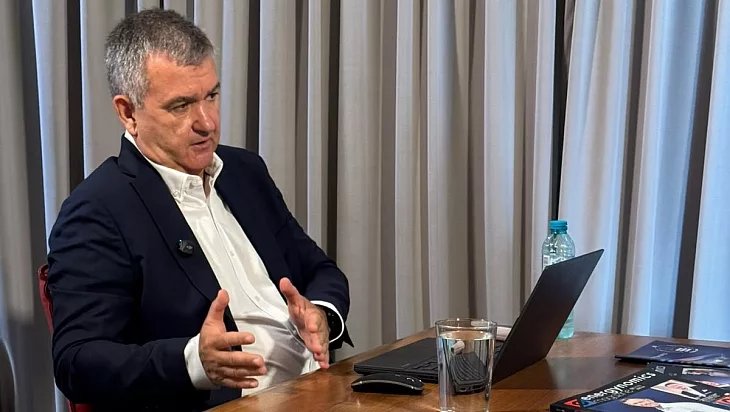
Grid connection has become one of the decisive assets of an energy project, while investment value is no longer determined exclusively by installed capacity or the technology selected. In a market where tens of thousands of MW are at different stages of development, the competitive advantage belongs to projects capable of using the same grid interface capacity more efficiently. “We are seeing more and more of this hybridisation,” explains Valeriu Binig, Chairman of the Board of Directors of Eximprod Engineering, in an edition of Energynomics Talks.
A typical example is a wind farm with 50 MW approved for grid connection, behind which the developer adds a photovoltaic park and a battery without exceeding the power injected into the grid. “There is a wind farm that had, let us say, a grid connection approval and an approved capacity of 50 MW, and suddenly it says: ‘OK, the wind was blowing at night, what if I also put a solar park behind the same transformer?’ So I am still injecting 50 MW into the grid. Why not add a battery as well, and suddenly have solar, wind and battery all behind the same 50 MW transformer?” The project logic therefore shifts from maximising a single asset to optimising the grid connection point and the delivery profile.
The battery is not merely a commercial asset added alongside renewables. It can reduce imbalance penalties, shift generation towards higher-value periods and enable delivery of a profile closer to baseload, which can be useful for bilateral contracts. At the same time, storage can provide synthetic inertia and help inverter-based installations meet future grid-forming requirements. The difficulty lies in clearly separating the battery’s installed capacity, the grid interface capacity and the portion reserved for technical obligations, so that compliance with grid codes does not unnecessarily restrict the commercial use of the asset.
Pressure on grid connection, however, goes beyond optimisation at individual project level. A development queue that has reached approximately 89,000 MW requires operators and authorities to distinguish between speculative and executable projects and to develop regional connection studies in which all approved or developing capacities are assessed simultaneously. “There needs to be a certain discipline, and the biggest challenge is carrying out that solution study, let us call it regional, in which all projects that have received approvals, have been authorised or are under development are taken into account in order to identify what capacity is available to be put up for auction,” Binig says.
Under these conditions, the cost of grid connection becomes a central element of bankability. The shallow model transfers a significant part of grid reinforcement costs into tariffs, while the deep model assigns the investor the full cost of the impact caused by the project. Romania operates between the two extremes, in a context where the investment needs estimated by distribution system operators far exceed the resources recoverable through tariffs or available from public funding. For developers, the risk is no longer only the level of the cost, but also the lack of predictability regarding reinforcement works, their timetable and the contribution required in both the distribution and transmission grids.
Flexibility can reduce some of the investment pressure, but not every market mechanism is automatically efficient. Binig distinguishes between system flexibility, associated mainly with frequency and the balancing market, and grid flexibility, required for voltage, congestion and reactive power. Organising a local market for each grid area can become disproportionately expensive because of participant qualification, dispatch instructions, metering and penalties. More pragmatic alternatives include predefined technical rules, flexible connection agreements and dynamic grid-use tariffs.
In conclusion, the bankable project of the next investment cycle will not necessarily be the one with the most MW, but the one that combines permitting maturity, credible grid access, complementary technologies and a revenue model compatible with the system’s technical requirements. Hybridisation, battery storage and flexibility do not eliminate the need for grid investment, but they can turn a constrained grid connection point into a more efficiently used asset and reduce the gap between an approved project and the energy actually delivered to the market.
ALSO READ Valeriu Binig: To understand your energy bill, you need to break it down into its individual components
About Schneider Electric
Schneider Electric creates impact by maximising the value of energy and resources, connecting progress with sustainability. We are a global leader in electrification, automation and digitalization, providing AI-driven IoT solutions for smart industries, infrastructure, data centres and buildings.
With 150,000 employees in over 100 countries we promote diversity and innovation. Schneider Electric România, with 27 years in business and more than 300 employees, runs operations in Armenia and Moldova and provides support in 17 languages for 26 countries through the Bucharest Hub.