

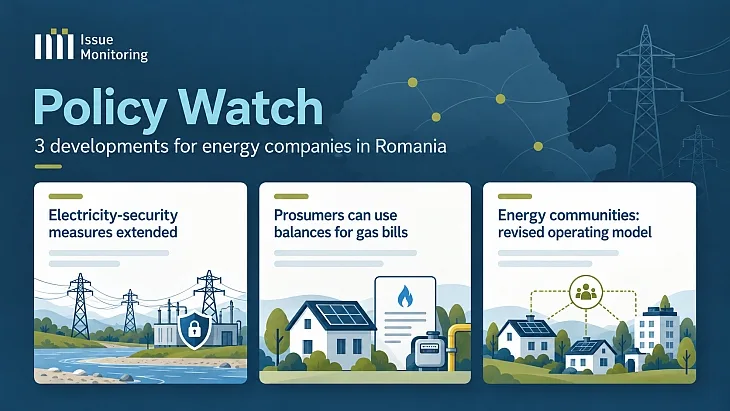
This week’s Policy Watch focuses on extended electricity-security measures, new rules allowing some prosumers to use electricity compensation balances for gas bills, and a revised operating model for energy communities. This is the fast signal “Romania’s energy policy and regulatory week, 28 September-5 October 2026” by Eusebiu Stamate, Senior Public Policy Analyst, Energy & Environment, Issue Monitoring.
Romania keeps electricity-security measures in place as Danube flows remain critically low
Romania has extended its temporary electricity-market security framework through October, maintaining Transelectrica’s ability to intervene if a crisis situation threatens the security of the national power system.
The extension comes as hydrological conditions remain weak. The Ministry of Energy says low Danube flows and water levels continue to affect the Cernavodă area, after Unit 1 was disconnected on 28 July and Unit 2 on 13 August amid insufficient cooling-water conditions. The authorities do not currently see a sufficiently reliable improvement in Danube flows to ensure the restart of at least one nuclear unit during October.
The Ministry’s assessment points to a sensitive period later in the month. Danube inflows at Baziaș are projected to fall from around 1,450 m³/s at the end of September to roughly 1,185-1,200 m³/s around 10-13 October in the median scenario, with a potentially critical window for Cernavodă between 15 and 22 October.
Against this background, Transelectrica retains a sequence of emergency options, starting with additional reserves and technical-reserve generation. If those measures are insufficient, it may reduce or cancel available interconnection capacity and notified exchanges in the export direction.
As a last resort, consumption may be reduced temporarily and in stages for customers included in the applicable limitation plan, with at least 24 hours’ notice. The annex identifying those customers and the applicable reductions is not public. The key question for October is whether low Danube flows continue to constrain nuclear and hydro production while evening demand rises and renewable output becomes less predictable.
ANRE sets out how prosumer electricity balances could be used to pay gas bills
ANRE published a draft order amending the rules on natural gas supply and access to distribution systems, primarily to implement new rights introduced for prosumers by Law no. 160/2026.
The law had already overhauled the prosumer compensation mechanism, introducing monthly value settlement and allowing surplus electricity values to be used across multiple consumption points. For eligible individual prosumers, it also introduced the option of using those values to pay natural gas bills when electricity and gas are supplied by the same supplier.
The new ANRE draft sets out how this gas-bill option would work in practice. Under the proposed rules, eligible prosumers would be able to use the value resulting from the electricity quantitative compensation mechanism to pay part or all of their natural gas bills.
For suppliers active in both electricity and gas, this creates an additional connection between the two billing systems. They will need to identify the amounts generated through electricity compensation, keep track of their use and apply them correctly against gas payment obligations.
The same draft also gives gas distribution operators more time to implement a separate billing requirement. A rule requiring estimated quantities used for distribution-service billing to be aligned with quantities allocated under the Network Code would apply from 1 April 2027 instead of 1 October 2026.
Distribution operators had requested a delay until October 2027, citing the need to modify and test IT systems and internal procedures. ANRE has proposed only six additional months.
The consultation remains open until 16 October. The practical test will be how easily suppliers can integrate the electricity and gas settlement flows without adding unnecessary complexity for customers.
ANRE revises the commercial framework for energy communities
Energy communities return to Policy Watch this week, but on a different part of the regulatory framework. The previous edition covered ANRE’s newly adopted cost-benefit methodology. This time, the regulator has published a third consultation version of the separate rules intended to operationalise the energy-community framework introduced by Emergency Ordinance no. 59/2025, which transposed the relevant RED III provisions into national law. Almost a year after the ordinance was adopted, ANRE is still revising the secondary rules needed to make supply, balancing, allocation and billing work in practice.
The most significant new changes concern the commercial structure of energy communities. ANRE has dropped the previous concept of a main supplier and introduced two alternatives: a residual supplier, which supplies electricity consumed from the grid beyond the amount allocated by the community, and a single supplier, which may cover the member’s entire electricity demand. A community could itself act as the single supplier if it holds a supply licence.
The draft also clarifies contractual arrangements, balancing responsibilities and billing. Communities would have to purchase electricity produced by members owning generation or storage installations, while balancing responsibilities would differ depending on whether electricity comes from the community or from the residual supplier.
The proposal also retains several broader obligations for suppliers introduced in previous versions, including free online customer accounts, optional consumption alerts and revised rules on early-termination fees. Distribution operators would have until 31 December 2026 to implement the IT functions needed for shared-energy allocation.
The consultation remains open until 16 October, with the final rules particularly relevant for suppliers and distribution operators that will have to integrate community-level allocation, settlement and billing into their existing systems.