

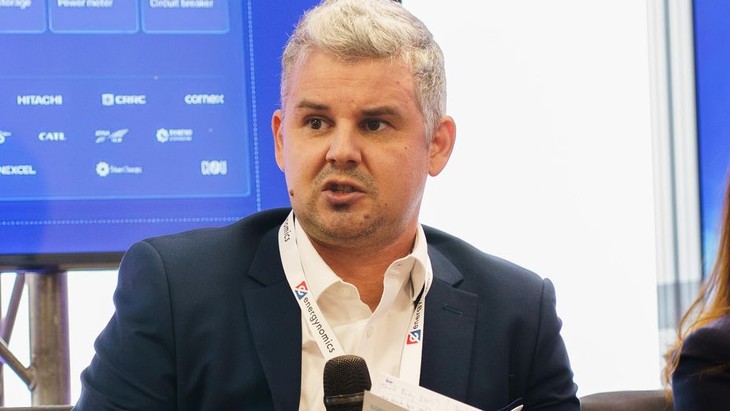
Battery owners should decide before construction which markets the asset will serve and who will optimize it, keep the right to change both optimizer and trader, and own the data the asset produces, said Mihai Necula, Country Manager Romania at ADEX Energy, at Romanian BESS on the Fast Track, a workshop organised by Energynomics. Otherwise, he warned, they risk an underperforming battery locked into a closed control system that limits their commercial flexibility.
“The data should be owned by you,” Necula said.
The industry’s attention is moving from development, acquisitions and construction to what the asset does once it is built. “You need to decide from the very first moment which are the markets, which is the optimizer. You need to have the right to switch your optimizer and your trader,” he said. The asset’s required response speed and intended markets need to be defined before construction. Owners who overlook these requirements risk limiting their asset’s capabilities and becoming dependent on a control system that is difficult to replace, a mistake he sees being repeated in Romania following Bulgaria’s experience.
Metering, cybersecurity and more hours in the battery
Day-ahead and intraday trading, with partial cycles, dominate battery revenues today, Necula said, and the trading tools have to support the full range of revenue streams. A practical lesson from Bulgaria is the need for a proper metering device at the point of connection, able to read active and reactive power. Its absence is becoming a pain point there.
Cybersecurity has to be designed in from the start. With an energy management system (EMS) or a SCADA system enabled by the equipment vendor, the owner controls neither the data nor access to all revenue streams, he argued. Given geopolitical risks, systems should be able to operate independently of external connections for a few days, following an agreed schedule until control is restored.
Necula expects the opportunities for moving production between hours to increase, as more variable capacity enters the grid and consumers become active participants. “Shifting the production and having more hours on the battery is where you will make the revenue,” he said. More renewables create more opportunities for batteries, while greater battery deployment could, in turn, improve the economics of standalone solar, in what he described as a self-balancing market.
Balancing as a revenue leak
On balancing, Necula offered what he called a personal and deliberately provocative view. “I’m not a big believer in a business model based on the system services market, on the balancing market. I don’t think that will be your revenue stack. I think that will become your revenue leak,” he said.
The balancing and system services markets are shallow and become shallower as renewables grow, he argued. Reserves were designed around nuclear and large baseload plants, and the chance to be paid for staying in reserve shrinks as baseload declines.
He also warned about growing and less predictable imbalances. Imbalance exposure is distinct from revenue earned by providing balancing services, but a limited number of difficult days can materially affect an asset’s overall returns. His advice was therefore to be cautious about building the investment case around balancing-related revenues.
ADEX Energy is a technology company founded in Sofia that develops an EMS and SCADA platform on open protocols, independent of equipment makers and traders. It supplied the control system for the Nova Zagora battery project in Bulgaria and is now entering Romania.
Romanian BESS on the Fast Track was organised by Energynomics, with the support of our partners: Elektra Renewable Support, ADEX Energy, Adrem Asset Management, BLU Capital, Dongfang Electric, Electroalfa, Enery, Enexus, Gotion, ING Bank, Marsh Romania, Softenerg WEBUS 4 ENERGY.