

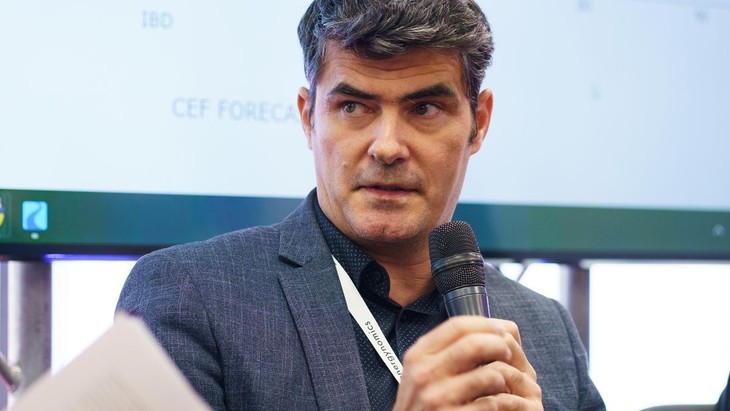
Battery owners in Romania have to move beyond arbitrage and sell energy directly to the consumers who need it, because within five years neither merchant revenues nor fixed contracts will offer certainty, said Răzvan Rădulescu, CEO of Softenerg / WEBUS 4 ENERGY, at Romanian BESS on the Fast Track, a workshop organised by Energynomics.
“We need to move from arbitrage and selling energy to the market to selling energy directly to the people that need it,” Rădulescu said.
The structural problem, in his reading, is that solar output of about 3.3 GW meets a consumption of only about 4 GW in the same hours, so producers will compete for the four or five hours of peak revenues. Softenerg already works with industrial clients that combine rooftop and ground-mounted solar, batteries and electric delivery fleets. A fixed contract is worth little if the counterparty goes bankrupt, he argued, which leaves the end consumer as the only reliable payer.
One cycle in summer, two in the other seasons
Selling energy from a battery changes every month. “In summertime we have only one cycle, because you get €200 and you’re happy with it, while during night time you only get €10 out of it,” Rădulescu said. In the other seasons two cycles make sense, and an operator who simply charges and discharges on a fixed pattern earns less.
Operating choices also affect the battery itself. At two power plants, Softenerg stopped using the battery to balance the solar output, after measuring a decline in the cells’ overall state of health (SOH) of about two and a half percent within two months, well above what the manufacturers’ documentation suggested.
The batteries are now charged only when the price is lowest and discharged only when it is highest, while the solar plant is balanced through the company’s own control system.
A battery is not a bucket
“The battery is not a bucket. It’s a collection of 4,196 little buckets, and they have their own personality,” Rădulescu said. The energy management system checks every cell every couple of seconds, and Softenerg gets involved from construction and factory acceptance testing, signing annexes that define when the warranty is triggered and how the battery may be used.
One overlooked parameter is how the battery is managed at rest, the level at which a battery is kept while idle. “If you don’t treat the battery right when it sleeps, you are going to lose the warranty,” he said.
Batteries also create imbalances of their own: the energy is sold, and then a safety alarm prevents the discharge. For banks, he said, a battery that does not work at the right moment is a bigger risk than merchant exposure.
Who has access to the customers
By Softenerg’s calculation, Romania needs at least 12 GW of batteries before competition and cannibalisation set in. Rădulescu expects every business to own a battery eventually, starting with retailers that have already invested in solar panels.
“The question is who has access to the customers, who has the most market share, because you will need to have the possibility to supply energy directly to those,” he said.
In four to five years he sees islands of portfolios, with their own solar plants and batteries, supplying end consumers directly, while the wholesale market becomes marginal.
Romanian BESS on the Fast Track was organised by Energynomics, with the support of our partners: Elektra Renewable Support, ADEX Energy, Adrem Asset Management, BLU Capital, Dongfang Electric, Electroalfa, Enery, Enexus, Gotion, ING Bank, Marsh Romania, Softenerg WEBUS 4 ENERGY.