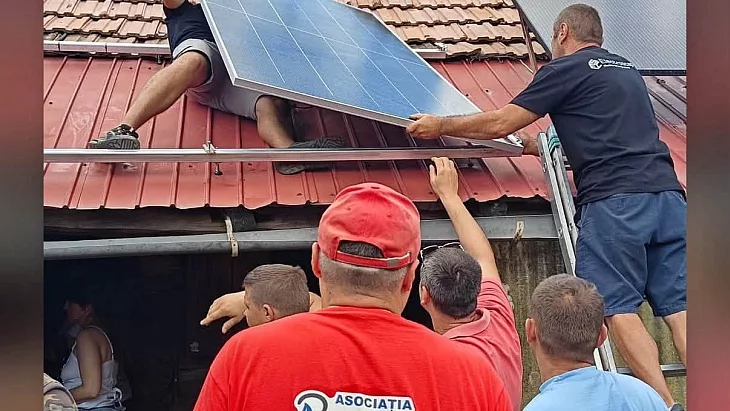
The Smart Energy Association, together with its partner, ENGIE Romania, is implementing the 11th edition of the “Energy for Life” project, which will provide access to electricity for 26 isolated households located in 9 hamlets in Gorj, Mehedinți and Vâlcea counties, by installing photovoltaic systems. The first phase of the project has already been completed, with the electrification of 10 households in Gorj county. The beneficiary homes have never been connected to the electricity grid and had no real chance of being connected in the near future, according to AEI.


According to the “National Electronic Registry of Households Without Electricity in Romania” (RENGEER), drawn up in April 2024, which includes the inventory of homes not connected to the electricity grid in Romania, in Gorj county there are 47 permanently inhabited households without electricity, in Mehedinți county their number is 32, and for Vâlcea county 7 such houses were identified.
The National Electronic Registry of Households Without Electricity in Romania was developed, with the support of the Ministry of Energy, as a tool for measuring the degree of extreme energy poverty in our country and represents an important step towards eradicating this phenomenon because it constitutes the starting point both for the development of public policies regarding the reduction of extreme energy poverty in our country, and for the undertaking of actions to effectively reduce this phenomenon such as the “Energy for Life” project. RENGEER revealed a number of 5,494 households without electricity, inhabited by 11,611 people, of which 4,777 are under the age of 18. It is worrying that 87% of houses without electricity do not have a cadastre, which makes it difficult to approach the institutional solution to this problem. Moreover, 64% of people living in houses without electricity have estimated incomes below the minimum income per person and household in Romania, which would make it difficult to pay for the electricity consumed. Also, in 53% of cases, access to buildings without electricity is difficult, and for 10% there are no access roads.
“Access to electricity should not be a privilege, but a normality for every home in Romania. Behind the 26 houses included in this edition of the Energy for Life project are just as many life stories, of people for whom electricity means more than light; it means safety, health, education, dignity and the chance for a normal life. Sometimes, this intervention can change the future of a family and even an entire community. We are happy to support a project that demonstrates that energy can change lives and restore hope where it is needed most”, said Nicolas Richard, CEO of ENGIE Romania.
The European Union treats access to energy not only as an economic issue, but as a fundamental right of citizens. In the European vision, the fight against energy poverty is a priority, and member states have the obligation to adopt policies that ensure social equity, so that the benefits of the green transition reach even the most vulnerable. The Brussels executive emphasizes that “a just energy transition involves and supports all citizens, regardless of where they live or how much they earn.” Moreover, “Leave no one behind” is the central principle of the United Nations 2030 Agenda for Sustainable Development. It expresses the commitment of all UN member states, including Romania, to end extreme poverty, eliminate discrimination and exclusion, and reduce inequalities, ensuring that development efforts reach all people – especially the most vulnerable and marginalized.
“In Romania, several important steps have been taken in combating extreme energy poverty: the electrification of homes not connected to the electricity grid, with a time horizon of 10 years, was included in the Energy Strategy of Romania 2025 – 2035, with a perspective of 2050, of which I was part of the working group, and the Smart Energy Association created, together with the Ministry of Energy, the National Electronic Register of Households without Electricity, within the Partnership for Combating Energy Poverty concluded between the aforementioned entities. All of this represents a solid starting point for eradicating the phenomenon of extreme energy poverty, but there are still many steps to be taken until the desired goal of “zero homes without electricity” is achieved. The Smart Energy Association will continue to bring to the forefront the situation of unelectrified households in Romania and to intervene punctually where we are most needed.
About Schneider Electric
Schneider Electric creates impact by maximising the value of energy and resources, connecting progress with sustainability. We are a global leader in electrification, automation and digitalization, providing AI-driven IoT solutions for smart industries, infrastructure, data centres and buildings.
With 150,000 employees in over 100 countries we promote diversity and innovation. Schneider Electric România, with 27 years in business and more than 300 employees, runs operations in Armenia and Moldova and provides support in 17 languages for 26 countries through the Bucharest Hub.