


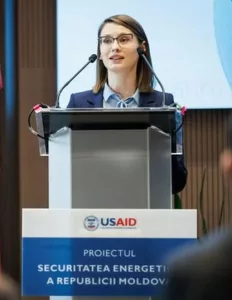
Energynomics‘ Energy Visionaries competition brought together brave ideas and unconventional proposals from young people who see the future of energy with vision and enthusiasm. Among the many valuable contributions, one idea stood out for its simplicity, applicability and transformational potential. Livia Cebotari is the winner of the 2025 edition. She convinced us with a proposal that combines circular economy, technology and community involvement: converting food waste into biogas to power urban transportation.
Today’s global challenges, such as climate change and energy crises, require a profound rethink of how we act. In this context, ad hoc interventions and isolated approaches are ineffective. What is needed is a paradigm shift towards integrated solutions that address multiple community needs simultaneously. The green transition is not just about gradually shifting away from fossil fuels to renewable energy sources. It plays a key role in preventing and combating pollution, conserving natural resources and protecting biodiversity. The energy transition involves reconfiguring the way we produce and consume energy.
The efficiency of energy and environmental solutions can be compared to the evolution of the telephone. While classic telephones had a single function, smartphones have revolutionized the way we interact with technology. A single device includes several applications, which allow us to communicate, access information quickly and manage time. Similarly, solutions that bring together multiple functions in a single strategy become the “smartphone” of the energy transition. Integrated mechanisms create synergies that allow multiple challenges in various fields to be solved simultaneously.
Beyond technology and digitalization, sustainability requires a courageous vision, capable of going beyond classic approaches and harmoniously integrating seemingly incompatible elements, but which together can generate sustainable results.
Have you ever wondered what potato peelings, public transport and environmental care have in common? Imagine a town where leftovers from dinner power the city’s public transport. Thus, food waste becomes fuel for the buses that take children to school, parents to work and grandparents to shop. This scenario is not just an exercise in imagination, but a direction to follow for a sustainable future. Implementing an integrated food waste conversion program involves the inclusion of several interdependent elements: developing the necessary infrastructure, collecting and sorting waste, establishing partnerships with local authorities, and, last but not least, conducting information and education campaigns.
Every day, huge amounts of food waste are thrown away. Collecting it directly from households, restaurants, supermarkets and markets can contribute to the production of clean energy.
Obtaining biogas from food waste is an example of a circular economy, where nothing is lost, but everything is transformed. Composed of methane and carbon dioxide, this gas can be used to generate electricity, heat or fuel vehicles. Producing biogas involves building anaerobic fermentation plants.
Adapting the transport network is a natural step in this direction. Partnerships with local authorities can facilitate the gradual replacement of diesel buses with biogas-powered vehicles.
Another important aspect is community involvement in the energy transition. Education plays a key role in this process. Launching public education campaigns and creating reward systems for citizens who collect and sort food waste are essential measures. Awareness of the impact of their own actions motivates people to contribute to change.
The benefits of this idea include a significant reduction in CO₂ emissions and the costs of purchasing fossil fuels. Waste disposal costs are also significantly reduced and the pestilential odors near landfills disappear.
At first glance, the idea of converting waste into enough biogas to power a city’s public transport may seem like an impossible scenario. However, the city of Växjö in Sweden is proving that this concept is perfectly feasible. By adopting ambitious environmental policies and constantly investing in technology, the Scandinavian city has become a model for sustainability and a pioneer in the fight against climate change. It is therefore not surprising that it has been named “the greenest city in Europe” by the international press.
The future does not belong to technologies, but to people who choose to use these technologies intelligently. In a world where leftovers from dinner can become energy, the solution is a simple change of perspective. Food waste can be transformed into clean energy, and challenges into opportunities. Great changes begin with an ambitious vision accompanied by bold decisions!
About the author
Livia Cebotari is a graduate of the Faculty of International Economic Relations of the Bucharest Academy of Economic Studies, as well as the Faculty of Law of the University of Bucharest.
She began to flirt with the energy field during her university studies. Her interest was reflected in the choice of topics for her bachelor’s and dissertation papers. Later, she developed several specialized articles in which she researched the economic effects of energy crises and the impact of international sanctions on the energy sectors of the European Union member countries. She also participated in the internship program “Today’s Youth – Tomorrow’s Energy Future”, part of the “Energy Security of the Republic of Moldova” project.
Currently, Livia is a legal advisor at Banca Comercială Română.
.