

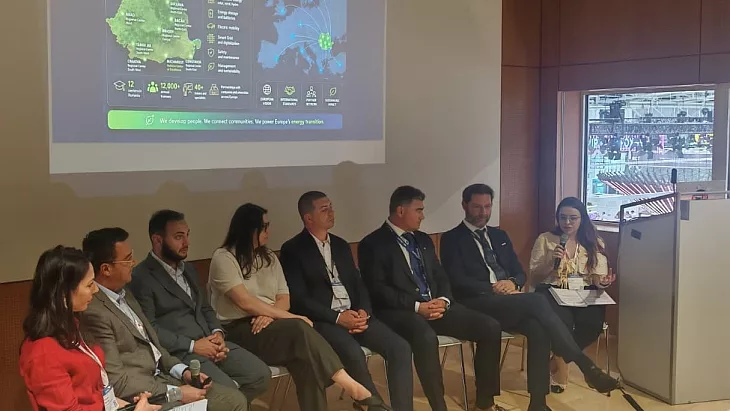
Romania’s solar energy market can no longer be seen as an early-stage promise, but as an ecosystem that has grown rapidly and is beginning to define its own standards of maturity. This was the idea that ran through the workshop organized by the Romanian Photovoltaic Industry Association (RPIA) at Intersolar 2026. Romania has become a visible market in Europe, and its development is increasingly based on local expertise, large-scale projects, storage integration and the ability of Romanian companies to work internationally.
The discussion began with the role of partnerships and market connectivity. Mariana Ciotău, Senior Consultant, Team Leader GreenTech & Tax and Legal at the Romanian-German Chamber of Commerce, described AHK Romania as a bridge between German companies interested in Romania and Romanian companies looking to enter the German market. At the same time, the Chamber also acts as the official representative of Intersolar in Romania. “We promote the trade fair and connect Romanian companies with the exhibitors here at Intersolar,” she said, summarizing the idea that market development is not only about investment, but also about networks, trust and access to partners.
To understand the scale of this evolution, one of SolarPower Europe’s analysts placed Romania in the broader context of the European market. The figures presented showed a clear change in status: after years of uneven growth, Romania has become one of Europe’s most dynamic photovoltaic markets. “Romania is no longer an outsider,” was his conclusion, as the country is already among the leading European markets in terms of annually installed photovoltaic capacity. The main idea of the intervention was that Romania still has significant room for growth, but can no longer be treated as a marginal market.
From there, the conversation naturally moved toward those building this market. Introducing Răzvan Copoiu, Deputy CEO of Enevo, Irene Mihai, Policy Officer at RPIA, opened the topic of the evolution of local EPC contractors. Răzvan Copoiu emphasized a competitive advantage that repeatedly emerges when compared with other European markets: speed. Romania, he said, is a benchmark for “the speed at which projects are delivered.” His main message was that foreign investors need local partners not only for construction, but especially for understanding procedures, permitting, regulations and the relationship with public authorities.
The same idea was taken further by Christian Leonte, CEO of WALDEVAR HOLDING, who spoke about the transition of local contractors from subcontractor status to fully bankable EPC partners. For him, the decisive advantage is not only technical capacity, but a concrete understanding of the market. “What matters most is the reality on the ground,” he said, stressing that local protocols, timelines, risks and mechanisms cannot be learned from manuals. His conclusion was that a solid local EPC can reduce project risk precisely because it remains present throughout the entire lifecycle of the investment.
The international experience of Romanian companies added an important nuance to this discussion. Paul Moldovan, founder of Parapet, explained that, for his company, “being local” no longer means simply coming from Romania, but building local teams in every market where the company operates. “Being local means working with the local teams,” he said. The central idea of his intervention was that Romanian companies in the solar sector have accumulated enough experience to export know-how and adapt to different markets, from Germany to Italy.
As projects grow in size, the discussion about execution inevitably becomes a discussion about quality, operation and lifetime performance. Răzvan Copoiu returned to this topic by speaking about projects that must be designed from the outset for 30 years of operation. “You have to build quality,” he said, showing that a modern EPC no longer delivers only the construction itself, but integrates equipment, digital systems, cybersecurity, EMS and operational solutions. In the same logic of maximizing value, Christian Leonte presented the role of floating PV projects. If the first stage of the market was dominated by the question “how many megawatts can we install?”, the next stage is about how more value can be extracted from existing surfaces, connections and resources. He described the shift toward the “more efficient megawatt,” explaining that floating photovoltaics can reduce pressure on land, increase yield by cooling the panels and use infrastructure already available around hydropower plants.
In the area of repowering and agrivoltaics, Paul Moldovan completed this perspective with Parapet’s experience in Germany, Italy and Romania. In the case of older solar parks, the issue is not only replacing equipment, but technically reconfiguring the project so that it becomes attractive to investors again. The goal, he said, is to bring the project “back in green bankable.” His main idea was that the next wave of the market will not only mean new projects, but also the optimization of existing assets.
If photovoltaics was the first major wave, storage now appears as the next chapter. Vicențiu Ciobanu, CEO of Prime Batteries Technology, formulated the role of batteries in relation to developers and EPC contractors simply: “We provide energy to EPC contractors; that is what the battery does.” Beyond the direct wording, his message was that storage must be introduced early in the design phase, because technology, safety rules, permitting requirements and insurers’ demands can significantly change a project’s architecture. He also connected this evolution with the need for European content, local production capacities and recycling.
After construction and storage, attention shifted to operations. Elena Popescu, CEO of Elektra Renewable Support, explained one of Romania’s particularities: the role of the local dispatch center, which functions as a 24/7 monitoring and control structure. “Only in Romania you will find the local dispatch center,” she said, showing that investors coming from other markets need to understand this specific operational responsibility. The main idea of her intervention was that the technical operation of renewable assets is becoming increasingly important in a system with large projects, batteries, flexibility and more complex control requirements.
None of these projects can exist, however, without skilled people. On behalf of RenewAcad, Sebastian Enache, Head of M&A at Monsson, shifted the discussion toward skills, training and workforce transition. “We provide what everybody else needs,” he said, referring to the technicians and specialists required for wind, photovoltaic and storage projects. His main message was that the energy transition must be supported by a professional transition: people from local communities, mining areas or other industries can be trained for the new jobs created by renewables.
Taken together, the interventions outlined the image of a market moving from accelerated growth to consolidation. Romania has large projects, local companies that can deliver internationally, battery production, operational experience, solutions for floating PV, repowering and agrivoltaics, but also a massive need for new skills. The first stage was about speed. The next will be about quality, flexibility, maximization and the ability to turn local expertise into a European advantage.