

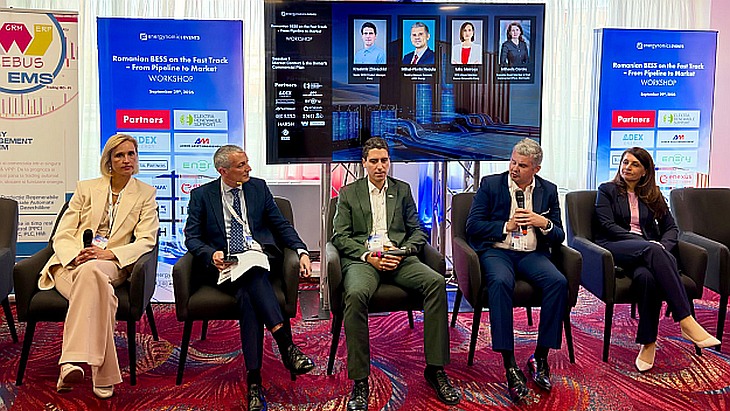
Arbitrage on the day-ahead and intraday markets ranked first among revenue sources in the responses of the 26 participants who voted at the Energynomics workshop on 29 September. Beyond revenues, the results suggest the same tension in several forms: projects need commercial flexibility, while some investors and lenders are looking for greater predictability in a context where rules, costs and market conditions continue to change.
Energynomics organised the Romanian BESS on the Fast Track workshop in Bucharest, structured around three sessions covering the market context and the owner’s commercial plan, market access and optimisation, financing, contracts and risk. The format included contributions from the audience and Slido polls integrated into the discussion. A total of 63 participants took part in the polls, submitting 290 votes and answers. The number of respondents varied from one question to another, and the results describe the group attending the workshop, not the Romanian market as a whole.
Arbitrage remains the starting point
In the first session, 26 respondents ranked day-ahead and intraday arbitrage first among revenue sources, with a weighted score of 4.31. Tolling or fixed-price contracts followed with 3.38, while shifting output from their own renewable energy assets and balancing services such as aFRR, mFRR and FCR ranked lower.
The open answers showed how quickly commercial assumptions are changing. Participants pointed to costs and prices that are not falling as expected, financing that has proved more difficult than anticipated, competition and the risk of market saturation, as well as changes related to rules, auctions and implementation timelines.
The need for predictability also emerged when participants were asked what share of revenues should be contracted before investment. Among the 22 respondents who make such decisions, the largest group, seven people, selected 75-100%, while five respondents chose each of the other three ranges. The answers therefore do not point to a dominant commercial model among the workshop participants.
Optimisation features in most market access scenarios
In the session dedicated to market access, 12 of the 20 respondents said they expected to reach the market through an optimisation services provider: seven through a revenue-share model and five through a floor-plus-share structure. Three responses each went to in-house trading through their own BRP/BSP structures and to a tolling agreement.
Expectations around optimisation, however, go beyond trade execution. Of the five open answers, three called for greater revenue certainty through guaranteed minimum spreads or revenues, tolling, or improved revenue visibility and risk management. The other two focused on automated trading with a fair share of the additional profit, and on managing the energy consumed to heat the battery during winter.
Among operational bottlenecks, skills and workforce received 44% of the 18 responses, ahead of grid connection and limitations at 22%, and operator or TSO procedures at 17%. No respondent selected prequalification for balancing services as the main problem.
Financing cannot be reduced to a contracted revenue threshold
Asked what minimum share of revenues should be contracted for a BESS project to be bankable, four of the nine respondents said the answer depends on the sponsor rather than the percentage, while no one selected the option above 75%. The respondent groups were different and small, but the result indicates that, for a substantial share of participants, the percentage of contracted revenue is not the only criterion.
The discussion then moved to scenarios that could undermine the business plan. Participants proposed eight situations, five of which went to a vote on how likely they were to occur over the next three years. Regulatory changes ranked first, with a score of 3.67, followed closely by a scenario in which the battery pipeline is built faster than demand grows, causing arbitrage spreads and aFRR prices to fall, with a score of 3.42. A jump in financing costs ranked third.
In the final ranking, answered by seven participants, market rules and balancing products came first among the changes considered necessary to accelerate BESS deployment in Romania. Permitting and the grid connection process followed, while bankable contract models and skills received the same score.
The responses from the room do not identify a single commercial model for BESS projects. Energynomics will continue to publish articles dedicated to the perspectives presented across the three sessions: commercial planning and technology, optimisation and market access, financing, risk insurance and the structures needed for storage projects to move from pipeline to actual revenues.
The Romanian BESS on the Fast Track workshop was organised with the support of Elektra Renewable Support, ADEX Energy, Adrem Asset Management, BESCA, BLU Capital, Dongfang Electric, Electroalfa, Enery, Enexus, Gotion, ING Bank, Marsh Romania and Softenerg WEBUS.