

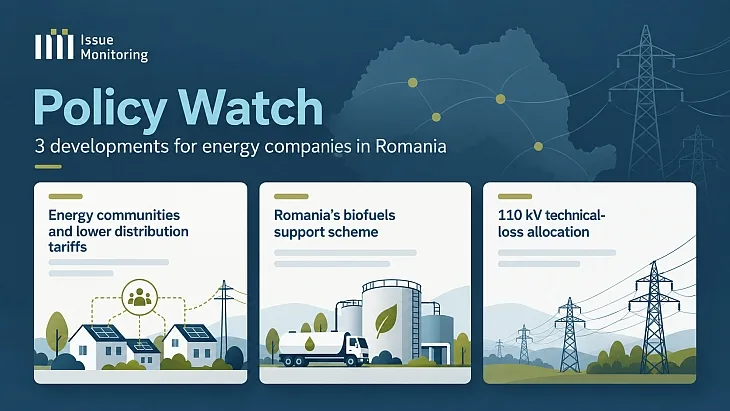
This week’s Policy Watch focuses on with new rules that could cut distribution tariffs for energy communities, easier access to Romania’s 500 million euros biofuels scheme, and a more granular way of sharing 110 kV technical-loss costs. This is the fast signal “Romania’s energy policy and regulatory week, 21-28 September 2026” by Eusebiu Stamate, Senior Public Policy Analyst, Energy & Environment, Issue Monitoring.
Energy communities get a route to lower distribution tariffs – benefits must be proven
Renewable energy communities can now seek reductions in distribution tariffs under a new ANRE methodology, but access to the benefit will depend on their ability to demonstrate measurable benefits for the distribution system.
Eligible electricity must be produced within the community, or stored from its own renewable production, and consumed within the same settlement interval. The methodology also sets physical network boundaries: at low voltage, relevant flows must use feeders supplied from the same transformer station, while at medium voltage they must use feeders from the same substation.
Communities will estimate the electricity produced or stored and consumed internally, while distribution operators will provide data on network losses and costs, congestion, power quality and expected or avoided investments.
If the assessment identifies net benefits, ANRE may approve a reduction of the distribution tariff for up to five years.
The first applications will be the real test. They will show how difficult it is for communities to demonstrate net benefits and whether the tariff reductions approved by ANRE are significant enough to improve project economics.
Romania lowers entry barriers for its 500 million euros biofuels scheme
Romania has revised its planned 500 million euros state aid scheme for new biofuel production capacity, opening it to a wider range of companies and projects while adding new technical requirements.
The minimum capacity for bioethanol projects has been reduced from 50,000 to 20,000 tonnes per year. Newly established companies can also qualify, provided they have subscribed and paid-up capital of at least 200,000 lei, with financial capacity also demonstrable through a comfort letter from an eligible financial institution.
The revised scheme also removes the previous general restriction on combining support with other state aid, de minimis support or EU funding, subject to applicable aid limits.
At the same time, projects must use technologies with a Technology Readiness Level of at least 8 and eligible feedstocks must be certified under voluntary schemes recognised by the European Commission. Investments must be commissioned by the end of 2030.
The changes widen formal access to funding, particularly for smaller bioethanol projects. The next test is whether financing, technology and certified feedstock availability allow that broader pool of eligible projects to translate into actual production capacity.
ANRE ties 110 kV technical-loss allocation more closely to actual injections
ANRE has changed how additional technical losses in public 110 kV electricity networks are allocated between producers and the transmission system operator.
Under the new rules, the allocation is calculated separately for each settlement interval, based on the electricity injected into the 110 kV network by producers and the transmission system operator during that interval. The quantities attributed to each participant are subsequently aggregated across the relevant period.
The change therefore links exposure to additional technical-loss costs directly to actual injections during individual settlement periods, rather than relying on an aggregated allocation approach.
For producers connected to 110 kV networks and the transmission system operator, this means their share of these costs will depend more directly on when and how much electricity they inject. Distribution operators will also need to perform the calculation at settlement-interval level, increasing the importance of accurate metering, settlement and data processing.
The practical impact will become clearer as operators apply the new methodology and the resulting cost allocations can be compared with those produced under the previous approach.