

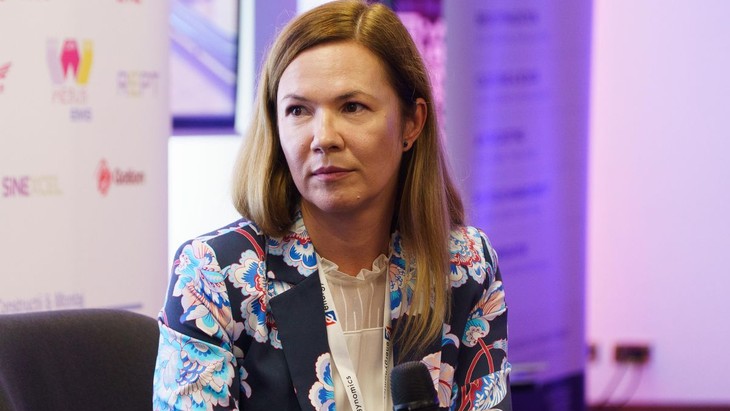
Banks lend to renewable energy projects for up to 20 years without knowing what energy markets will look like in a few years, which is why lenders ask for prudent assumptions, independent validation and sufficient buffers, said Oana Mogoi, Sector Head Energy at ING Bank Romania, at Romanian BESS on the Fast Track, a workshop organised by Energynomics.
“The assumptions that we consider must be validated by third-party consultants,” Mogoi said.
ING began financing storage in mature energy markets and scaled up in other countries on the lessons learned there. In those markets, she said, saturation is pushing batteries from one or two cycles a day towards four, some projects run into problems because the ancillary services market is not always fully understood, appetite is growing for contracted rather than merchant revenues, and some small, early-stage optimizers have failed to deliver what they promised.
The risks lenders watch
Grid access is a high-impact risk, because without a connection there is no project, but its probability is low for lenders: financing is granted at the ready-to-build stage, with the connection contract and the related guarantees in place and confirmed by third-party advisers.
Market saturation, curtailment and merchant risk weigh more. Merchant revenues are hard to predict, and the consultants’ forecasts change every quarter, Mogoi said. “We really don’t know how energy markets will look in a couple of years from now, and we are granting money for 20 years.”
Fifteen years ago, when renewables were first financed in Romania, the concern was estimated production, which proved quite predictable. Nobody was projecting negative prices, capture prices well below the market average or regulatory changes, she recalled. Without sufficient buffers or a common understanding with the sponsor, a bank and an investor are unlikely to find middle ground.
A prudent plan and how much debt it carries
A prudent approach starts with the sponsor’s own business plan, which should not rely on optimistic assumptions. The financing structure is then tailored to the market, the project and the share of contracted revenues, and the model has to carry the debt under several sensitivity scenarios.
Asked how much debt a project can raise, Mogoi said that a tolling agreement can support up to 80% in the Netherlands. “In Romania we may not be able to reach this level, but I would say that 70-75 could be possible if the tolling covers everything and if the toller is bankable and investment grade,” she said. With a floor or a revenue-sharing arrangement, the level is closer to 60%.
ING prefers co-located assets. The solar or wind part needs at least 70% of production contracted, while the battery can remain merchant, with a shorter tenor and gearing of 60% at most.
“At the end of the day, almost all investors will find a way to finance their projects, if the projects are good,” Mogoi said.
Romanian BESS on the Fast Track was organised by Energynomics, with the support of our partners: Elektra Renewable Support, ADEX Energy, Adrem Asset Management, BLU Capital, Dongfang Electric, Electroalfa, Enery, Enexus, Gotion, ING Bank, Marsh Romania, Softenerg WEBUS 4 ENERGY.