

For wind and photovoltaic operators, climate data are not simply background information for designing an asset. Rising temperatures, changing precipitation patterns, shifts in seasonality and intensifying extremes can affect generation, maintenance and operational risks, while the tools already available allow these factors to be analysed across horizons ranging from a few weeks to several decades, explained Mihaela Caian, head of the Monthly and Seasonal Weather Forecasting Division at the National Meteorological Administration.
Caian spoke during the workshop “Power system adequacy in a changing climate”, held to mark the launch of the Code of Good Practice in Renewables, 2026 edition, organised by RWEA and RPIA. The ANM presentation covered both changes already observed in Romania and climate projections and tools that can turn data into usable information for sectors such as energy.
Climate is becoming increasingly unpredictable
One important implication for the energy sector is that the future performance of an asset can no longer be assessed solely through historical series and multiannual averages. Caian emphasised increasing variability, the frequency of extremes and shifts in seasonality. Romania lies in a region exposed to rising temperatures, drought, heat stress and sharper alternations between periods with very different weather characteristics.
For a wind or photovoltaic farm, the difference is relevant both at the investment stage and during operation. The annual average alone does not show how the resource will be distributed throughout the year, how frequent extremes may become or when conditions may arise that limit generation or complicate access and maintenance.
The ANM presentation showed rising temperatures under all the scenarios analysed and differing precipitation trends across seasons. For wind, the projections presented identify the south and west of the country among the areas vulnerable to an intensification of extreme winds.
Weather forecasts and climate projections are different tools
Caian also highlighted an important distinction for companies. Weather forecasting estimates how weather conditions will evolve based on the current state of the atmosphere, while climate projections use scenarios for how the climate system may evolve over much longer periods.
For a renewable energy company, the two types of information answer different questions. Climate projections can support site selection, risk assessment or the design of an asset for the next 20-30 years. Forecasts covering weeks and months can feed into operational planning, maintenance scheduling and anticipation of periods when the resource differs from normal.
Uncertainty does not disappear. “The further we look into the future, the greater the uncertainty becomes,” Caian explained. This is precisely why climate analysis uses model ensembles and probabilistic results rather than a single trajectory treated as certain.
Two tools already available to operators
The first tool presented by Caian is PrepClim, an interface that allows users to explore regionalised climate projections for Romania. In the example shown in the presentation, users can select the area, variable, month and climate scenario and track developments through to around the end of the century. The indicators illustrated include temperature and soil moisture at the level of administrative-territorial units.
For a developer or operator, the value is primarily strategic: the projections can help test the assumption that the climate parameters used today for design or generation assessment will remain valid throughout the asset’s lifetime.
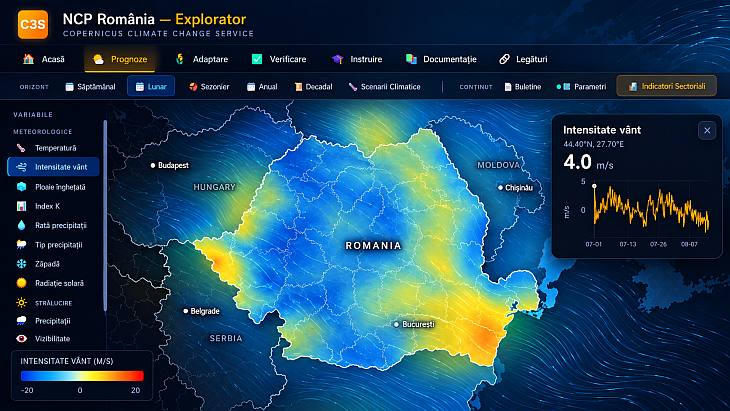
The second tool is the ANM C3S Explorer platform, presented as support for extended-range forecasting. The material indicates horizons ranging from about six weeks to three, six and 12 months, and up to predictive information over multiannual periods.
Caian showed that, for the nearer time horizons, the information can provide relevant signals for operational decision-making.
For the wind and photovoltaic industries, the objective is not to find a perfect forecast, but to integrate probabilistic information into their own processes. Temperature, wind, precipitation and, where relevant, solar radiation need to be analysed at the temporal and spatial scales at which they actually affect an asset.
The message for operators is therefore more practical than simply acknowledging that the climate is changing: data and tools that can be incorporated into planning are already available. The difference will come from choosing the right time horizon, understanding uncertainty and connecting weather and climate information with concrete investment and operational decisions.
The Code of Good Practice in Renewables is an initiative of RWEA and RPIA. The third edition, produced in 2026 with the involvement of Energynomics, benefited from the contribution of partners AI Clearing, Alerion, CMS, DLA Piper, Enercon, Enery, Enevo, Eximprod, GE Vernova, Monsson, Nordex, Nyerges and Partners, OX2, Parapet, Raiffeisen, REIB, Scatec, TDP, Vestas and Waldevar. The Code was launched on October 1 at a conference held in Bucharest and is available free of charge, including in electronic format.2