

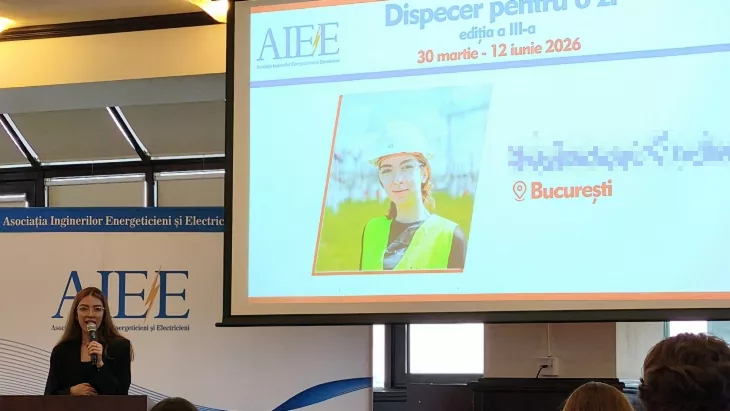
The “Dispatcher for a Day” program can be described in terms of the organizers, the partner companies, and the industry’s need to train new specialists. The students’ testimonials round out the picture of the project with their firsthand experience: meeting the people in the control rooms, working with diagrams, SCADA systems, switching operations, outages, phones ringing simultaneously, and the concrete responsibility behind the electricity supply.
For the participants, the project was not just a technical visit, nor merely a confirmation of concepts learned in college. It was, in the words of one of the students, “more than just a project”: an opportunity to observe up close “the invisible work of dispatchers” and to see how theoretical concepts become decisions applied in real time.
The “Dispatcher for a Day” program, organized by the Association of Energy and Electrical Engineers – AIEE, reached its third edition in 2026 and involved 15 students and young engineers in hands-on experiences at local power plant control rooms, distribution control rooms, regional control rooms, and the national energy control room.
„I went in with great curiosity”
One of the first things the young people involved in the project had in common was their curiosity. Some had been following the project since its very first edition and were eager to join the program. Others had already heard about it from peers who had participated in previous editions. However, everyone quickly realized that no account could replace the actual experience. “I joined this project with great curiosity,” said one of the participants. She knew a little from her peers, but noticed that “every day is unique and the experience is unique.”
Entering the dispatch center meant more than just sitting next to a specialist on duty. In some cases, the day began with introductory explanations about what a dispatcher is, the different types of dispatch centers, who reports to whom, and how the various levels of operational management are connected. Only then did the control room, the screens, the diagrams, the phones, and the decisions follow.
The training paid off. Faced with a control room full of screens and a constant stream of information, the first experience can be overwhelming. “When I got there and walked into the control room for the first time, I didn’t know exactly where to look,” says a student, describing her first visit to Transelectrica.
A “quiet” day can be a lesson
Not all experiences involved breakdowns or dramatic maneuvers. Some students had quieter days at the distribution control centers. But these too were valuable: they provided time for questions, explanations, details, and a deeper understanding of the complexities involved.
One participant said that at Rețele Electrice she had “a fairly quiet day,” but it was precisely this lull that allowed her to ask all her questions. She also noted that “quiet” is relative in a dispatch center: the phones kept ringing “two or three at a time,” yet the dispatchers still managed to answer and explain.
Another participant described a similar day as an opportunity to better understand the diagrams and the complexity of the network, especially in the Bucharest area. She tried to connect the points in the diagrams to the mental map she had of the city and to understand how each technical element corresponds to a location, a facility, a consumer, or a possible decision.
Participating in the project also served as a way to translate the abstract into the concrete. Single-line diagrams, SCADA systems, controls, operating procedures, and data flows were no longer just technical concepts or tools, but parts of a real-world operation, driven by people who must make quick and accurate decisions.
Failures, start-ups, and maneuvers viewed from the inside
Other participants experienced days marked by significant operational events. Some witnessed commissioning, work on storage systems, or the decommissioning of part of the facilities. Others observed outages and how dispatchers manage critical situations.
One of the participants recounted witnessing a “major failure” in the medium-voltage grid, which left over 4,000 customers without power due to a tripping fault at a supply point. The experience was later complemented by a visit to the National Energy Dispatch Center, where she observed how the balance between production and consumption, voltage and frequency regulation, and the optimal parameters of the National Power System are maintained.
For the students, these moments highlighted the difference between theoretical knowledge and operational responsibility. Seeing a fault on a diagram is one thing; seeing how it is discussed, how decisions are made, how teams are coordinated, and how the restoration of power to consumers is managed is quite another.
The day spent at the national dispatch center allowed one student to discover “just how much responsibility lies behind this profession” and how well-prepared the people working there must be.
The balance between production and consumption, as seen on the big screen
Another aspect that impressed the participants was the understanding of the constant balance between production and consumption. For those who study energy, this is a fundamental relationship, well known in theory. In the control room, however, it becomes a visible reality, monitored on screens and managed through continuous decision-making.
One of the participants said that the most important part of her experience was seeing how much it matters “to have a balance between what is produced and what is consumed.” She also noted that what is managed within Romania is not enough: connections with neighboring systems also matter, because the National Energy System is part of a larger system.
The system does not stop at the border of a facility, a company, or a country. Operational decisions are part of an interconnected whole, in which frequency control, consumption, production, imports, exports, maneuvers, and outages are all parts of the same reality.
Beyond the technology are the people
Although the students talked a lot about diagrams, SCADA, switching operations, adjustments, and malfunctions, almost all of their discussions ultimately came back to people. For some, this was actually the most important part of the project.
“Beyond all of this – the maneuver sheets, the single-line diagrams, the SCADA system – I think that for me, the greatest satisfaction […] came from the people I met,” said one of the participants.
The students spoke about the dispatchers’ patience, their willingness to explain, and how, despite an “extremely dynamic” and “certainly stressful” environment, they made time to answer questions. One of the participants said she has “deep admiration” for the dispatchers, because they helped her understand what it means “to be responsible” and to act calmly in the face of critical and unforeseen situations.
This human dimension was echoed in various ways. One student emphasized that the dispatchers and specialists she spoke with spoke “with such passion” that they convinced her she had made the right choice in pursuing a career in the energy sector. Another noted the welcoming atmosphere, the explanations provided “with great patience,” and the specialists’ willingness to answer every question.
One participant observed that, at no point during the program, was it conveyed to her – either directly or indirectly – that dispatching is an activity less suited for a woman. On the contrary, the experience confirmed that what matters in the control room are training, attention, composure, the ability to understand the system, and to act responsibly. For a young woman just starting out in the energy sector, this sense of normality can be just as important as access to diagrams, screens, or technical explanations: the profession is presented to her as a demanding field, yet one that is open to those willing to learn and take on responsibility.
Theory and practical reality
For many participants, the program served as a bridge between academia and the real world. They saw how the concepts learned in college are applied and, at the same time, discovered things that school cannot fully replicate. “It was unique to experience the work of a dispatcher firsthand,” said one of the students, adding that this work could not be learned in college. His conclusion was that he was leaving the program with “a clearer direction” for the future.
Another participant said she was able to “go through the entire operational management hierarchy,” from the local power plant dispatch center to distribution, then to the regional and national levels. This sequence helped her see the connection between the levels, not just each point separately.
The program also offered the opportunity to revisit, in a more practical context, places or companies that some students were already familiar with from their university internships. One participant who had previously completed an internship at Rețele Electrice said that returning to the dispatch center allowed her to learn information she hadn’t had time to understand during her internship. She noted that the SCADA system and the diagrams seemed much more complex to her, a sign that repeated exposure to operational reality deepens understanding.
An experience that brings the craft to life
Perhaps the most important contribution of the “Dispatcher for a Day” program is that it gives young people access to an aspect of the energy sector that is essential to the system’s operation yet usually remains invisible. For the students who entered the control rooms, it became a tangible space.
Energynomics was a media partner for the program.And through the young people’s experiences, we too have built a kaleidoscopic picture: curiosity, the visual impact upon entering the control room, understanding complexity through diagrams and screens, the excitement generated by outages or system startups, respect for the dispatchers on duty, and a clearer professional motivation.