

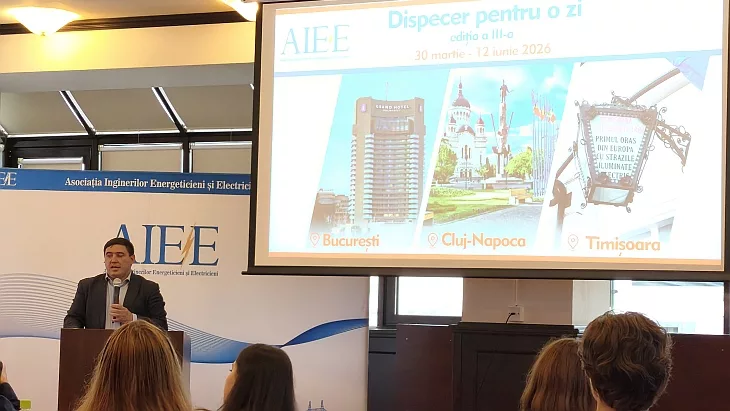
The third edition of the “Dispatcher for a Day” program, organized by the Association of Energy and Electrical Engineers, brought 15 students and young engineers into direct contact with the operational management of power systems. Held in Bucharest, Cluj-Napoca, and Timișoara, the project connected the academic community, energy sector operators, and young professionals at the start of their careers in a program that emphasized responsibility, technical discipline, collaboration, and operational continuity. Energynomics was a media partner for the program.
The third edition of the “Dispatcher for a Day” program took place from March 30 to June 12, 2026, with activities held over an eight-week period from April 13 to June 5. According to information published by AIEE, participants had the opportunity to spend one day each in four types of dispatch centers: Local Power Plant Dispatcher, Hydroelectric Dispatcher, Distribution Dispatcher, and Regional Energy Dispatcher. The partners for this edition were Transelectrica, Rețele Electrice, Distribuție Energie Electrică România, Hidroelectrica, Enevo Group, and NOVA Power & Gas.
The program served as an intensive introductory experience to one of the least visible yet most important activities in the energy sector: dispatch. AIEE President Mircea Bițoiu noted that the project emerged “in response to market needs,” to demonstrate that the profession of energy dispatcher can be pursued by “any serious young person who desires it.”
A day in the dispatch center: A comprehensive overview
Compared to the first two editions, the third expanded the program’s geographic scope. Following a pilot edition focused on Bucharest and a second edition that expanded to a second city, the 2026 edition included Timișoara alongside Bucharest and Cluj-Napoca. In total, 15 participants were selected, and what made this edition unique was that they did not merely “work a shift” but were also involved in other activities, technical visits, and events in the energy sector.
This expansion was presented as a necessary step, given that in the energy sector, a strictly technical understanding of a facility or an operating shift is not sufficient. Young people must also see “the other side”—that is, the network of relationships, processes, rules, decisions, and collaborations that make the energy system’s operation possible. “We’re talking about a system, a place where we need to collaborate,” said the AIEE representative, a message that was echoed in a phrase that captures the operational culture of the field well: “We are a community that finds solutions.”
In Cluj, NOVA Power & Gas facilitated young people’s access to the power plant in Câmpia Turzii, and in Timișoara, solutions were found to allow participants to begin their experience at a local dispatch center. For the organizers, these practical adjustments became part of the project’s message: in the energy sector, continuity is not an abstract concept, but a professional obligation. “In the energy sector, there is no ‘I can’t do it anymore,’ ‘I don’t know what to do,’ or ‘I’m leaving.’ We stay on the front lines and find solutions,” was one of the event’s key messages.
„We have to keep the light on”
One of the most powerful messages came from a representative of Transelectrica, who described the work of the dispatch center as a responsibility that cannot be suspended. Drawing a comparison with the instability of political life, one of the speakers told the young people that energy workers cannot go “into opposition”: they must remain at their posts and ensure the system continues to function. “Energy workers must carry on and keep the lights on,” he said. “We have no way of stepping aside. No matter what problems we’re facing, we have to be at work.”
The message was illustrated with concrete examples: schools, kindergartens, hospitals, and economic and social activities that depend on the electricity supply. From this perspective, the control center is not merely a technical function, but a position of public responsibility.
The dispatcher must be able to handle pressure, remain calm, and make the right decisions in situations where time, information, and responsibility converge. “One of the qualities that must define this job is resilience: to cope, to not let the pressure and effort you’re under get you down,” said the speaker.
More than just one day, a career for life
The idea of continuity was also echoed by representatives of distribution companies. The representative from Rețele Electrice spoke of the energy sector as “one big family” and of dispatch operations as a profession in which young people can learn a great deal, regardless of which area of the energy sector they will eventually work in.
The representative from Distribuție Energie Electrică România addressed the need for human resources directly. In a brief speech, he emphasized that DEER has a “great need for dispatchers” and invited the students to participate in internships and, subsequently, to join the workforce. “We look forward to […] hiring you,” he said: “All in all, it’s a wonderful profession.”
Dispatching is evolving along with the energy mix
The Hidroelectrica representative welcomed the initiative and expressed hope that the program would lead to future job opportunities. The young people had the opportunity to learn about hydroelectric dispatch operations, and Hidroelectrica hosted the participants at its Bucharest headquarters to give them a more comprehensive overview of dispatch activities.
The message conveyed by Hidroelectrica also highlighted the evolution of the field: hydro dispatch no longer concerns only hydroelectric plants and flow rates, but will increasingly include renewable energy parks and storage facilities, illustrating how the energy transition is changing not only the technologies in the field but also the skills required of those who operate the systems. The dispatcher of the future will need to simultaneously understand conventional generation, hydro, renewables, storage, distribution, transmission, automation, and operational rules.
In Cluj, NOVA Power & Gas played a key role in organizing the experience for participants, including a technical visit to the combined-cycle power plant in Câmpia Turzii. The NOVA Power & Gas representative emphasized that the young people were able to see “the responsibility behind the energy system.” He described the system as a network of elements that require coordination: generation facilities, thermal engines, photovoltaic systems, and storage facilities. He also noted the participants’ level of preparation. “I was pleasantly surprised that most of them were very well prepared,” he said, expressing his hope that they would join the energy sector.
Some of the participants experienced days filled with maneuvers and malfunctions, while others stayed late into the evening to witness the completion of operations and to experience firsthand some of the traits that characterize the work of a dispatcher: “calmness, thoroughness, dedication, and responsibility,” according to Corina Popescu.
The dispatcher is also responsible for the safety of the field teams, which they coordinate during maneuvers. At the same time, the job involves dedication and sacrifice: shifts, holidays spent at work, decisions made at moments when the system must remain operational regardless of the circumstances. The image Corina Popescu painted was that of the dispatcher as the conductor of the energy system. “If you view the energy system as an orchestra, you up there are the conductors of that orchestra,” she said.
From college to the workplace
One of the professors involved in career projects and the “Dispatcher for a Day” program since its earliest editions spoke about the university’s role in this equation. Putting it bluntly, he said that the university provides the “raw material” for companies in the sector. He welcomed companies’ involvement in training students through internships and access to operational spaces that are otherwise hard to reach. “I don’t know how many have the opportunity to go into the control room to see what happens there,” he said, calling the dispatcher’s job “very elite.”
Even if not all participants will become dispatchers, the experience helps them understand how a critical part of the energy system works. For students, such a program bridges the gap between classroom, lab, practical training, and the reality of operations.
“Discreet, yet essential”—the human element retains ultimate responsibility, emphasized Associate Professor Attila Simó, PhD (Eng.), Dean of the Faculty of Electrical and Energy Engineering in Timișoara. He also formulated the most concise definition of a dispatcher: “the professional who, discreetly yet essential, transforms data into information, information into decisions, and decisions into safety.”
“Dispatcher for a Day” is a career orientation program, but it is more than that. For companies, it is a tool for recruitment, training, and conveying professional culture. For universities, it is a bridge to the real world. For young people, it is an introduction to a career that may begin with a day in the control room but, as several speakers noted, can become a “lifelong” profession.
And for the general public, including through the contribution of media partners such as Energynomics, the program sheds light on one of the least accessible areas of the energy sector: the place where data becomes decisions, and decisions become safety.