

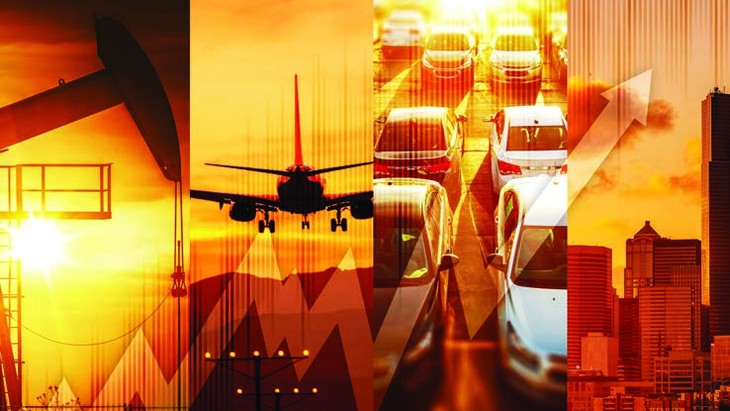
For years, the European Union measured the success of the energy transition exclusively in tons of carbon dioxide eliminated. Today, under the pressure of border warfare, energy blackmail and fierce global competition, priorities have been brutally rearranged. Without security and strategic autonomy, sustainability remains only a theoretical concept. The analysis below explains why pragmatism and resilience are becoming the new pillars of European energy policy and what this transformation means for Romania’s future on the Black Sea. Energy policies do not change through pompous declarations in the halls of Parliament. They change when reality forces them to. And the reality of recent years has been ruthless. First, war. Then energy blackmail. After that, attacks on infrastructure. Now, the risks in the Middle East.
FROM SPEED RACE TO ENDURANCE TEST: ANATOMY OF A SYSTEMIC CRISIS
Every crisis has said the same thing: “Energy is not just economics; it is no longer just a commodity. It is security.” For a long time, Europeans were convinced that the energy transition was a speed race, but today they are finding that it is, in fact, an endurance test. The difference changes everything. For years, “European success” was measured in tons of CO₂ avoided. Now it is measured mainly in the ability of the EU economy to function during a crisis.
The world has changed faster than the legislative framework in Brussels. The illusion of a fully integrated global market, where resources flow unhindered according to supply and demand, has crumbled in the face of geostrategic realities. Successive shocks have shown how fragile a system designed strictly on the principles of short-term cost efficiency, without safety margins, is. When supply lines become instruments of political pressure, theoretical efficiency loses its value in the face of the physical unavailability of the resource.
Daniel Apostol Directorul general al Federației Patronale a Energiei (FPE, fosta FPPG) / This shift from the “just-in-time” logic to the “just- in-case” logic is fundamentally transforming business models in the energy sector. It is no longer enough to produce cheaply or cleanly if you cannot guarantee the continuity of supply in times of maximum tension.
THE NEW DOCTRINE FROM BRUSSELS: ABANDONING STRATEGIC NAIVETY?
Without security, there is no sustainability. This is the paradigm shift. And it explains why the vocabulary of Brussels has changed discreetly, almost without us noticing. Today we hear more and more often about resilience. About strategic autonomy. About critical infrastructure. About security of supply. These are not just new words. It is a new doctrine. Europe is not giving up on decarbonization. They are abandoning -or at least trying to do so their naivety. The institutional language refl ects a belated but profound awareness: critical dependencies cannot be eliminated simply by decrees or ambitious percentage targets set on paper. Replacing a dependency on fossil resources from an autocratic supplier with a dependency on critical raw materials or technologies from another global actor is not a democratization of energy, but a simple shift of vulnerability. Strategic autonomy requires the development of one’s own value chains, the consolidation of transport networks and the real diversifi cation of sources. The energy transition thus ceases to be just an environmental project and becomes the backbone of the European Union’s new collective security policy.
NATURAL GAS AND LNG: FROM TEMPORARY SOLUTION TO SAFETY NET
Natural gas is the perfect example. For years it was treated as a temporary solution. Today it is treated as a safety net. Not because it has become greener when the world map has become redder. But precisely because the world has become more uncertain. Gas does not win a rematch. Realism does. The same is happening with LNG (liquefi ed natural gas). Terminals are no longer just energy investments. Storage facilities are no longer just commercial facilities. Pipelines are no longer just infrastructure. They are all becoming strategic assets. The reassessment of the role of natural gas clearly shows that the energy matrix of the future cannot exclude fl exible transition fuels. In an electricity system that increasingly integrates intermittent renewable sources – such as wind and solar energy – gas remains the main technology capable of ensuring balancing during peak periods or prolonged periods without wind and sun (the so-called Dunkelfl aute). Gas and liquefi ed natural gas (LNG) infrastructure off ers a geographical and operational fl exibility that interconnected electricity grids cannot yet fully replace. Massive investments in regasifi cation terminals in northern and southern Europe, as well as the modernization of underground storage facilities, are not a step backwards in the fi ght against climate change, but pillars on which the stability of the entire European industrial system rests.
REDUNDANCY AS INSURANCE: THE MARKET AND THE REINSTATEMENT OF LONG-TERM CONTRACTS
In energy, redundancy is not waste. It is insurance.
And the market understood this before politics. Investors do not just buy capacity. They buy options. They buy flexibility. They buy continuity. When the world has fragmented, these are worth more than marginal efficiency. The same logic explains the return of long-term contracts. They are not a step backwards. They are a response to risk. And risk has changed, it no longer comes only from the market. It comes from geopolitics.
The evolution of financial and energy markets shows a radical change in the perception of risk. Trading on the spot market, which theoretically guaranteed the lowest price in times of global peace and stability, has proven to be an extremely dangerous mechanism in times of geo-economic imbalance. Prices have experienced extreme fluctuations, generating shock waves throughout the real economy.
Long-term contracts are making a comeback because they provide the necessary predictability for large industrial consumers and project financiers. Excess storage capacity, additional transmission lines and alternative backup sources – concepts once seen as costly and inefficient – are now correctly assessed as protective measures against major volatility and unforeseen supply disruptions.
THE RETURN OF GEOGRAPHY: MAPS AS ECONOMIC DOCUMENTS
Geography has regained its influence in economics.
Straits matter again. Pipelines matter again. Ports matter again. Maps have become economic documents again. This is the great European paradox. The greener the economy becomes, the more stability it needs. Renewable energy needs flexibility. Industry needs predictability. Investors need confidence. None of this works without security of supply.
Critical maritime crossing points, such as the Bab el-Mandeb, Hormuz or Malacca straits and even the Turkish Straits, along with major land routes for transporting resources, have once again become determining factors in the global economic calculus. A blockage on a key maritime route can destabilize the supply chains of components for the wind industry or double the price of LNG transport overnight.
In this new context, the proximity of resources and the physical security of transport routes become major competitive advantages. Europe must rethink its energy corridors and invest heavily in protecting its critical infrastructure – from undersea data and energy cables to gas pipelines and cross-border interconnectors.
THE REAL STAKES OF COMPETITIVENESS: THE ALARM SIGNAL OF THE DRAGHI REPORT
Months ago, the Draghi report clearly stated that energy has become the problem of European competitiveness. The rest are eff ects. Capital does not wait. Industry does not vote. Investments are impatient. They leave, and with them competitiveness leaves. You cannot decarbonize an industry that no longer exists. The gap between the energy prices paid by European industry and those paid by competitors in the United States or Asia has widened dangerously. The chemical, steel, aluminum and chemical fertilizer sectors in Europe are facing massive structural costs, which are eroding their ability to compete on the global market. Without a strong and profi table manufacturing industry, Europe risks not only losing skilled jobs and decreasing budget revenues, but also undermining its own ability to fi nancially support the green transition. Closing or relocating production capacities to other regions of the world with more permissive environmental standards does not reduce global CO2 emissions, it only shifts pollution elsewhere, impoverishing the European continent at the same time. This is the question that the leaders of the European Commission must ask themselves. Not how quickly we eliminate the gas. But how intelligently we eliminate the vulnerabilities. The diff erence is huge.
ROMANIA’S STRATEGIC ROLE: THE BLACK SEA AND THE NEPTUN DEEP PROJECT
For Romania, the stakes are even higher. The Black Sea is not just an energy “province”. It is a strategic frontier. Neptune Deep is not just about production. It means infl uence. It means regional stability. It means the ability to count. Through the development of off shore deposits in the Black Sea, Romania becomes the largest producer of natural gas in the European Union. This status provides a historic opportunity that goes beyond the strictly economic framework of revenues collected from royalties and taxes. The Neptun Deep project transforms the country into a pillar of energy security for the entire Central and Eastern European region, reducing the dependence of our neighbors on unreliable external sources.
But gas production must be doubled by a clear strategy for the reindustrialization and internal valorization of this resource. The use of Romanian gas in petrochemicals, in the production of electricity with low emissions and in supporting the transition of heavy industry is the key through which natural resources can be transformed into sustainable economic development.
ENERGY TRANSITION AS A GOVERNANCE EXERCISE
Resources provide opportunities. Infrastructure creates power. Strategy makes the difference. Ultimately, the real lesson of the last few years is simple: the energy transition is not an exercise in idealism, it is an exercise in governance. And governance always begins with the same obligation: to reduce vulnerabilities. Not to replace them. Decarbonization is only sustainable when it remains compatible with security of supply, industrial competitiveness and strategic resilience. The energy of the future will be cleaner, but it will, above all, have to be safe.
The EU will not lose the energy transition race due to climate change. He can lose it if he forgets that before it is green, the energy must be available.
_____________________________________________
The article also appeared in the print edition of Energynomics Magazine, Q3 2026 issue.
In order to receive the printed or electronic issue of Energynomics Magazine, we encourage you to write us at office [at] energynomics.ro to include you in our distribution list. All previous editions are available HERE.