

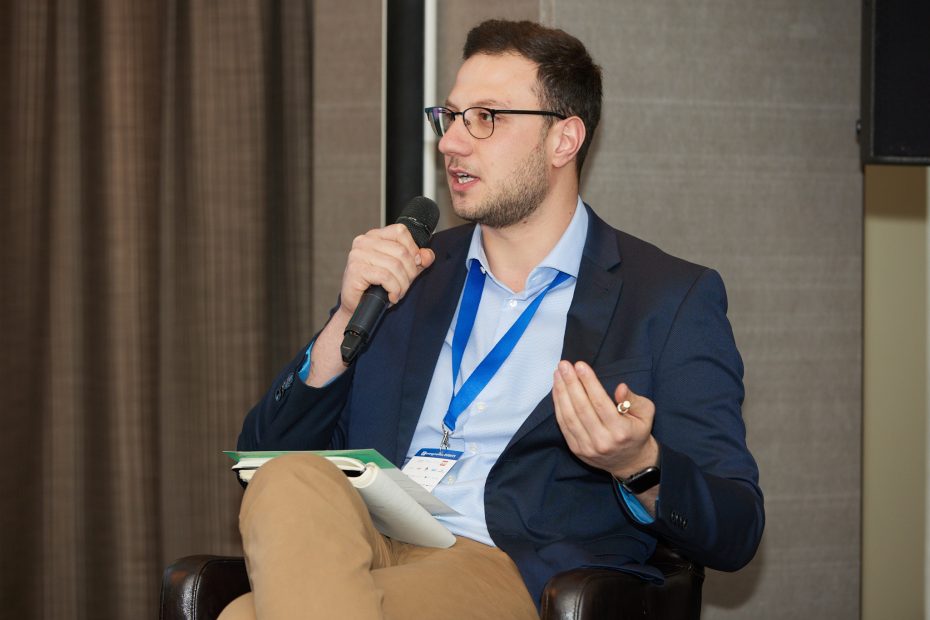
The average electricity price for consumers is unlikely to decrease in the near future, and in Europe, prospects for a reduction exist—at best—only in the medium term, stated Mihnea Cătuți, Executive Director of the Energy Policy Group (EPG).
“I would like to point out, however, that the general environment is not conducive to this electrification of the economy. Why? Romania is one of the few European Union states where the electricity price paid by household consumers is similar to that paid by industrial consumers. In countries investing heavily in their industries right now—such as the Nordic countries or Spain—the ratio is three-to-one or four-to-one. The impulse to try and subsidize household consumers is laudable and necessary, but only for those who are truly vulnerable. As long as we operate under the illusion that we can please everyone at once, we will remain stuck, and the business case for electrification and increased consumption simply won’t be there. There is also another important point to make: we talk a lot and constantly hear news about rising or falling energy prices. Yet, there is a hard truth here that is difficult to state publicly. The average electricity price for consumers is unlikely to drop in the near future. We need only look at each component of the price… Regarding the energy price itself, we can already see what is happening: the pressure is upward,” noted Mihnea Cătuți, as cited by Agerpres. In the view of the EPG specialist, there are no prospects for a reduction in energy prices at the European level—except in the medium term—and the goal should not be a universal price cut, but rather a targeted approach regarding who benefits from such measures.
“There is no prospect of energy prices dropping in Europe—at least not until the medium term, and even that is an optimistic scenario—because it will take time for significant generation investments to materialize into actual price changes. We need to invest more in grid infrastructure, so tariffs cannot decrease; furthermore, regarding taxes, excise duties, and the like, we have subsidy obligations included in this cost component, as well as budgetary constraints that currently prevent us from lowering prices. I would venture to say that the objective shouldn’t be a universal price reduction, but rather a question of who receives it. That is the decision we need to make. We cannot remain stuck in a paradigm where everyone pays the same rate. It is about what Romania wants to achieve with its economy and how it manages the various components of energy pricing to facilitate lower final prices for specific categories of consumers,” stated the EPG Director General.
According to him, electricity accounts for 16% of Romania’s final energy consumption, placing the country second to last in Europe in this regard. “I would say we still aren’t paying enough attention to the consumption side—even though I’ve repeatedly noted that, not just in Romania but across Europe, electricity consumption hasn’t kept pace with the expansion of electricity generation capacities, particularly renewable ones. At the same time, prices haven’t dropped either… I would also look here at the measures Romania is adopting for electrification. In Europe, electricity accounts for 23% of final energy consumption, whereas in Romania, it is only 16%. We rank second to last in Europe in this regard, yet we are already discussing an extremely ambitious target of 46% by 2040. We are a long way off from that. This is where we need to increasingly focus on heavy industry, which will remain a pillar of the Romanian economy,” explained Mihnea Cătuți.
He pointed out that, in Romania, the industrial sector’s gross value added represents a larger share of GDP than it does in Germany.
“It sounds odd to say that the Romanian economy is more industrialized than Germany’s, but given our output, it is crucial to look closely at this sector. The current revision of the EU ETS (EU Emissions Trading System – Ed.) introduces additional pressure-relief mechanisms for industry, as well as increased funding through the Industrial Decarbonisation Bank and the extension of the Modernisation Fund; Romania needs to be very active in the upcoming negotiations to ensure we secure sufficient allocations for the region,” Cătuți added.