

Alex Teșeleanu, Managing Partner, EastShip
The increasing size of energy equipment is turning logistics from an executionstage activity into a factor that can influence the cost, schedule and even the feasibility of an investment from the design phase. From wind turbines and transformers weighing hundreds of tonnes to hydropower and oil & gas projects, infrastructure constraints are becoming increasingly important. Alex Teșeleanu, Managing Partner, EastShip explains to Energynomics where the main bottlenecks arise and why the logistics operator should be involved before the equipment selection is finalised.
EastShip has evolved from a shipping agency into an integrated heavy transport and project logistics operator. What was your role in this evolution, and how important has the energy sector become to EastShip’s business?
EastShip has become what it is today through the contribution of each of its founders, but also through the development of a team that has grown together with the company. From the beginning, each of us focused on a specific area of responsibility, and we trusted the others to do their part well. The energy sector has been and remains an important part of our business. At the same time, it has accelerated the development of our On-site Logistics division, which provides tailored solutions ranging from transformer positioning using jacking & skidding techniques to technical solutions adapted to the specific requirements of each project.
EastShip’s portfolio today includes wind projects, transformer transport, power plants, hydropower and, through a specialised joint venture, the Neptun Deep project. What does this evolution say about the dynamics of energy investment in Romania and the region?
The geopolitical context in the region has accelerated the need to reduce dependence on certain energy sources and diversify the energy mix. In parallel, technological progress has made a number of alternatives more accessible and easier to deploy at industrial scale.
I believe these two factors have contributed to accelerating investment and to the emergence of a more diversified energy portfolio, both in Romania and across the region. The pace of investment is very different from what we were seeing only a few years ago, and it is creating the conditions for significant projects in the years ahead as well.
At what stage should a logistics operator become involved in an energy project? What does a developer risk if routes, bridges, port access or handling conditions are analysed only after the equipment has been selected and supply contracts have been signed?
Our view is that the logistics operator should be involved from the concept phase, before the technical solution and equipment configuration are definitively established. That is the sound approach, and experienced investors do not skip essential stages.
If the route, infrastructure, port access or handling conditions are analysed only after supply contracts have been signed, the developer’s room for manoeuvre is significantly reduced. Infrastructure works may become necessary, special handling solutions may be required, or the selected equipment may even prove incompatible with the available route.
automatically mean additional costs. On the contrary, it creates the opportunity to identify a feasible solution early and avoid the costs and delays caused by later changes.
Wind turbines are getting taller, while blades and main components are becoming longer and heavier. What are the most difficult logistics obstacles facing wind projects in Romania today?
To answer simply: road infrastructure, bridges, permitting, port capacity, institutional coordination and the availability of specialised equipment are all relevant obstacles.
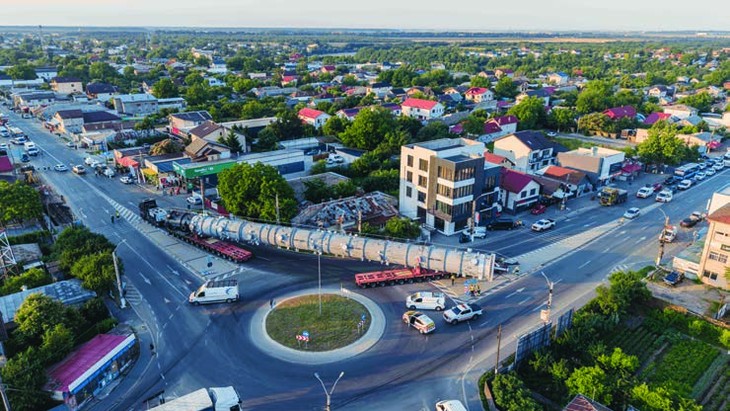
As far as specialised equipment is concerned, we have invested and continue to invest in order to keep pace with market requirements. The other factors are equally important to the feasibility of the operation. Road infrastructure, the load-bearing capacity and geometry of bridges, permitting, port capacity and coordination among all the parties involved can simultaneously affect the execution of a transport operation. With wind components becoming increasingly large, there is rarely a single critical point. The logistics solution has to be designed as an integrated whole, starting from the characteristics of the equipment and extending to an analysis of the entire transport corridor through to the final site.
You have worked on projects involving the transport of blades more than 75-80 metres long, transformers weighing several hundred tonnes, and the lowering of equipment into the underground facilities of the Vidraru hydropower plant. What has been EastShip’s most difficult operation, and what technical solution made it possible?
It is difficult to rank them, because every operation comes with its own technical challenges. This year alone, we have had two particularly difficult projects, at Vidraru and Petrobrazi, but for very different reasons.
At Vidraru, the main challenge was moving the components on a 52-degree slope. The access roads at the base of the dam are effectively bridge structures, and their load-bearing capacity did not allow a crane of the required capacity to access the site. To overcome this limitation, we designed and manufactured a dedicated trolley and a specialised pulling and load-control system, which allowed the components to be transferred and moved uphill on rails without using cranes.
At Petrobrazi, transporting the approximately 300-tonne fractionator to the refinery was a complex operation in itself. The transport assembly was 5.8 metres high, while access to the final position required passing two obstacles with clearances of 4.8 and 4.5 metres respectively. At the first obstacle, the fractionator was transferred from the trailer onto the rail system, moved underneath the obstacle by skidding, and then transferred back onto the trailer. The same sequence was repeated at the second obstacle, after which the transport continued to the final position.
In both cases, the solution was designed around the actual constraints on site and involved integrating transport with specialised transfer, pulling and skidding operations.
What are the most common situations in which logistics delays an energy project or increases its cost? Can you give us an example where a logistics solution identified early reduced risks, costs or implementation time?
It is difficult to quantify what a project would have cost under a different logistics solution, because cost is influenced primarily by the characteristics of the equipment, which are established by the client and supplier. We can, however, identify very clearly the situations in which a particular technical choice later creates logistics constraints, additional costs and delays.
One example is the transport of wind turbine components. On one project, the route required crossing a city where trolleybus lines were installed at a height of approximately 5.5 metres. Selecting a turbine configuration with a tower diameter greater than 5.5 metres would have required dismantling approximately 5 kilometres of the network and reinstalling it for each transport operation. Such a solution would have generated additional costs in the hundreds of thousands of euros and significant delays to the delivery schedule. Analysing the route before finalising the equipment configuration made it possible to avoid this constraint. It is a relevant example of the role logistics analysis can play in the design phase. It should not be limited to finding a solution for equipment that has already been selected, but can provide technical input before the equipment specification is finalised.
EastShip is investing in equipment dedicated to wind components and developing specialised partnerships for energy and oil & gas. How do you see the next five years from the perspective of Romania’s energy sector?
Each project comes with its own variables: the weight and dimensions of the equipment, the length and characteristics of the route, access conditions and site-specific challenges. For this reason, it is difficult to quantify in general terms the volume of projects that the current infrastructure can support. The same applies to specialised equipment. The capacity required depends on the types of projects and on the equipment needed for operations taking place simultaneously. As for the main bottlenecks, I would point to Romania’s national road infrastructure and the capacity of the Traffic Police to manage the growing number of oversized transports. All these projects involve heavy haulage, placing significant pressure on road infrastructure that is already in poor condition in many areas. Even though substantial investment has been made in recent years, we still encounter routes that cross very old bridges. At the same time, most projects involve components that leave from the same port and follow, at least in part, the same routes. During the summer months, some of these roads are closed to heavy vehicles for substantial periods because of high tourist traffic. In this context, the Traffic Police’s capacity to escort and manage an increasing number of oversized transports can become a factor limiting the pace at which projects can be carried out.
_____________________________________________
The interview also appeared in the print edition of Energynomics Magazine, Q3 2026 issue.
In order to receive the printed or electronic issue of Energynomics Magazine, we encourage you to write us at office [at] energynomics.ro to include you in our distribution list. All previous editions are available HERE.