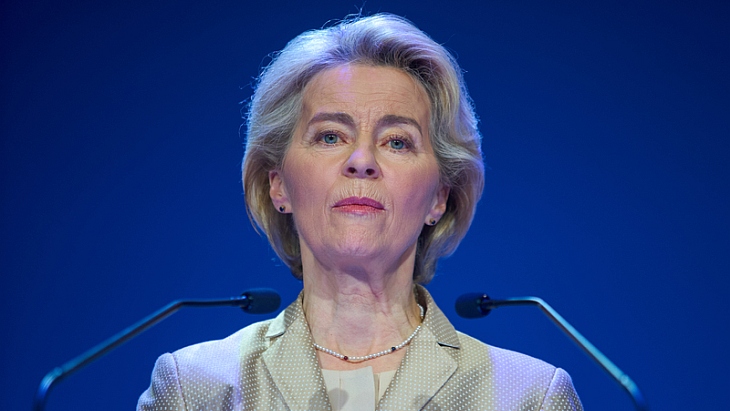
Europe cannot remain an industrial powerhouse if its energy prices are structurally too high. When Russia cut off the gas we fought back. Our supplies are now more diversified. And we have invested in our homegrown clean energies – renewables and nuclear. But then came the closure of the Strait of Hormuz. And again we bitterly felt the cost of our general dependence on imported fossil fuels. Since the start of the conflict, imported fossil fuels have cost us an additional €90 billion, without a single molecule of energy added, said today Commission President Ursula von der Leyen. She gave her 2026 State of the Union (SOTEU) address in the European Parliament plenary session in Strasbourg on Wednesday morning.
”So, we need to double down on our affordable, homegrown, clean energy. Be it renewables and nuclear, or biomethane and others. Technologically neutral. But they must give us independence. For this independence, we need to electrify Europe. Our goal is to double the share of electricity by 2040. With this, Europe could cut its fossil-fuel import bill by €260 billion a year. But we also need to ensure that the electricity we generate is available. Last year, we installed more than 80 gigawatts renewable capacity. But six times more capacity is still waiting to be connected. This is why we need the grids package so urgently. We must invest faster. Speed up grid connections. Develop storage. In short, let’s make Europe’s future electric”, she said.
”We can bring down energy prices, invest and innovate more, reform our economies. But all this is undermined if our companies do not compete on a level playing field. We still have too many dangerous dependencies. We are more than 80% dependent on China for many critical raw materials. 90% for some rare earths. We have done a lot. But we are not the only ones trying to diversify. We need to urgently procure and build up our reserves. No country can do this alone. So we need to think differently. This is why we will establish a new European Corporation on Critical Raw Materials. It will help us obtain and stockpile what we need. For electric cars, chips and batteries, clean tech and defence. And so much more. Not only our industry depends on this, but also our independence and security”, she added.
She added that Europe is warming at double the global rateand announced that a Climate Insurance Alliance will be formed. Also, an European Heatwave Plan will be drafted.
”Of course, the transition is complex. And we will need to adjust and learn along the way. But there is no doubt: Europe can, must and will stay the course on its climate targets. This is not about mitigation or adaptation. We need both. And they need to strengthen each other. This is the only way to reach climate resilience. But we need to step up dramatically on preparedness. We will present a new framework for climate resilience next month. We will identify 100 of the most vulnerable territories in Europe. And we will assess the risks – and at which level they should be managed. This will give us a whole of society approach – all the way through to the local level where adaptation matters most. And it will aim to make Europe the champion in adaptation technologies – a huge emerging market. Whether drought-resistant crops, flood prevention or energy-efficient cooling, Europe is already a leader. And we must capture this market. Today, only around 25 % of catastrophe losses in Europe are covered by private insurance. This means that, far too often, national budgets become the insurer of last resort. We need to take action to close this gap. This is why the Commission will set up a Climate Insurance Alliance.
There can be no repeat of this summer. This is why we will also soon present a European Heatwave Plan. We need better early warning systems and better health preparedness. We need urban adaptation and cooling. And we need to support the most vulnerable. We know the risks of water scarcity for our farmers, energy and supply chains. Yet, European pipes lose almost one in every four litres Mostly through leakage. What a waste. So we will put forward a new European Water initiative. Because water is precious. For our industry – and for our food security. Crops need water to grow, while livestock need it to survive. Entire harvests depend on it. This is why we will make proposals to improve risk management [in agriculture] and address the insurance gap”, she concluded.