

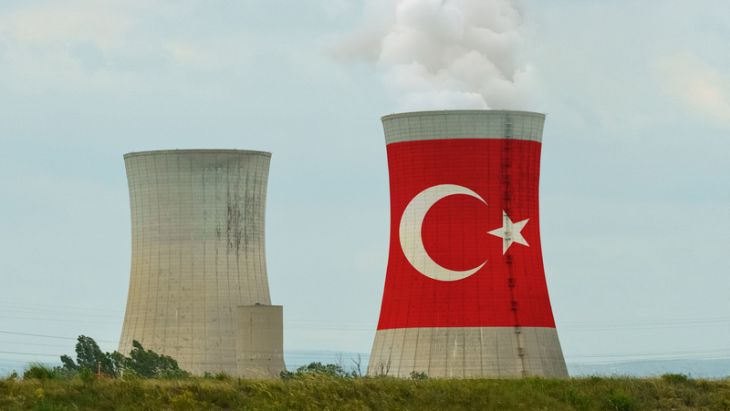
The reactor of Turkey’s first nuclear power plant is undergoing intensive tests and will soon be operational, Energy Minister Alparslan Bayraktar was quoted by the Turkish Anadolu news agency as saying, DPA reported, according to Agerpres.
Bayraktar presented an analysis of Turkey’s energy policy, prepared together with the International Energy Agency (IEA). This month, Turkish President Recep Tayyip Erdogan discussed expanding joint nuclear energy projects with his Russian counterpart Vladimir Putin.
Rosatom, a Russian state-controlled company, is building Turkey’s first nuclear power plant at Akkuyu, in the Mediterranean province of Mersin, under a 2010 deal worth $20 billion. The 4,800-megawatt plant was due to become operational this year, but its inauguration has been postponed.
The first of the four reactors was originally scheduled to become operational in 2025. Once completed, the plant would cover about 10% of Turkey’s electricity needs, equivalent to the consumption of the Istanbul metropolitan area.
Last week, Erdogan announced that steps would be taken to build new nuclear power plants after the Akkuyu unit becomes operational.
Turkey is expanding nuclear power projects to reduce its dependence on energy imports and decarbonize its energy production.
The Turkish news agency Anka also reported, citing Energy Ministry officials, that a storage facility for the resulting nuclear waste would be built by 2035 in the Polatl area near Ankara. The government has not yet confirmed the construction plans.
Turkey’s plans aim to build nuclear capacity of over 20 GW by 2050. In addition to the Akkuyu plant, a second plant is planned to be built on the Black Sea coast, in the Sinope region, and a third nuclear power plant would be built in the Thrace region of northwestern Turkey.