

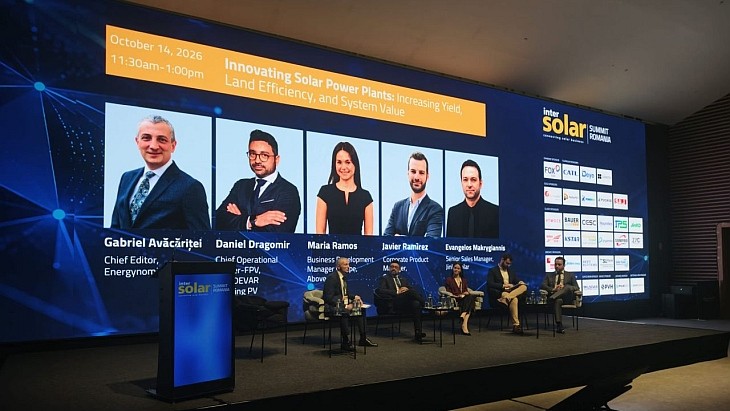
For years, solar efficiency was counted in watts per module and megawatts per hectare. The next percentage points of yield, however, will come less from bigger hardware and more from how intelligently a plant reads its surroundings, controls its equipment and keeps track of its own data. This was the common thread of the session on innovating solar power plants at Intersolar Summit Romania 2026, in Bucharest, moderated by Gabriel Avăcăriței, Editor-in-Chief of Energynomics, media partner of the event.
“The modern tracker is not just a structure anymore. It’s a smart system,” said Javier Egea Ramírez, Corporate Product Manager at Soltec Energías Renovables. In his view, the market is moving away from the question of how many watts can be installed towards the yield of every module, the land efficiency of every square metre and the value of the system as a whole.
A structure that reads the weather
A smart tracker does not simply follow the sun. On a cloudy day, Egea Ramírez explained, the best position is not facing the sun at all, but close to zero degrees, and the same logic applies to extreme weather: by changing the tracker’s position according to the hail, a plant can dramatically reduce the damage to its modules during a hail event.
The gain is not automatic, though. A tracker is not always the solution, and the decision depends on parameters that can be measured and studied for each site; at low latitudes it becomes essential. Where it fits, it raises the production of a project without the need to buy more modules, but only if it is designed as part of the whole plant rather than as a separate piece of steel.
The module makers tell a similar story. Evangelos Makrygiannis, Senior Sales Manager at Jinko, said that panels keep growing from one power class to the next, but the rule that matters is to find the module size and performance that deliver the most energy over time, not only a peak of power. The improvements in cells are “small changes, but very critical to increase the final energy yield,” he said.
Automation, not the AI buzzword
Looking at the next step for solar plants, Makrygiannis deliberately avoided the fashionable term. “That’s why I didn’t want to use the word AI, because it’s just a marketing word nowadays,” he said. “You just need to put automation, control and sensors in the system, all the tools you need to produce the best and deliver the energy when it’s needed, where it’s needed.”
Control also means knowing early what goes wrong. Maria Ramos de la Flor, Business Development Manager Europe at Above, argued that maximising yield depends on identifying anomalies as soon and as accurately as possible. Some defects escape the usual monitoring: “All of them can be seen in a thermography inspection, not always in a SCADA inspection, because they are very small sometimes.” Some companies run such inspections systematically because their contracts require them, she noted, while others do not make the most of them.
The same logic applies to who controls the project. Daniel Dragomir, Chief Operational Officer FPV at WALDEVAR Floating PV, said that floating plants are dynamic, not static systems, and that EPC companies usually stay in a safe area to avoid the risk. With a single player responsible for the whole process, he argued, the results of the project can be controlled from end to end; the system his company is deploying on a Hidroelectrica reservoir is calculated for water currents.
Data that does not get lost
The intelligence of a plant starts before it produces its first kilowatt-hour. According to Ramos de la Flor, performance can be improved from construction onwards: with drones and a large team of analysts, problems are detected while the plant is still being built. The drones only collect the data; the value lies in the analysis, which also works with the flights that owners run with their own drones.
The bigger risk is fragmentation. “If you’re not able to link this information, information gets completely lost, and information that is lost is unusable,” Ramos de la Flor said. Her answer is a digital twin, a platform that stores all the information about a plant from the beginning of the project until the end, because energy yield, efficiency and value cannot be treated as separate topics.
For Romania, the argument has a practical edge. The projects Above works on in the country bring together Spanish, German and Romanian partners, and a common quality standard makes a plant in Romania directly comparable with one in Germany. As the market moves from building capacity to operating it, the developers that link their data, control and equipment into a single system will be the ones that turn the same megawatts into more energy.