

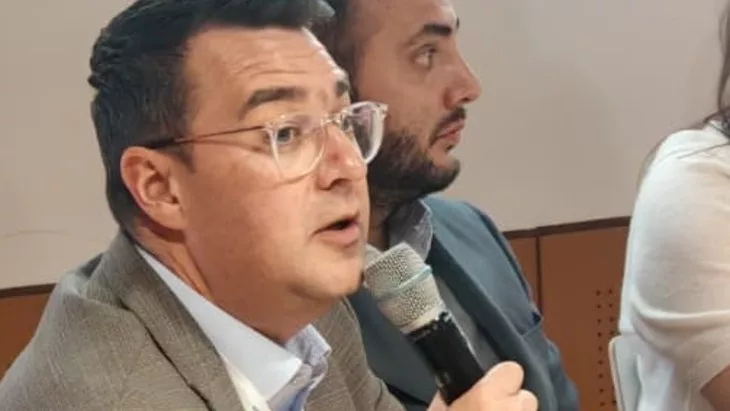
The renewable energy market in Romania is no longer constrained solely by projects, technology, or capital. As investments in solar, wind, and batteries accelerate, one of the critical questions becomes whether the industry can prepare enough people, quickly enough, without compromising quality and safety. This was the main message conveyed by Sebastian Enache, head of mergers and acquisitions at Monsson, representing RenewAcad, during the workshop dedicated to the Romanian market organized by RPIA at Intersolar Europe 2026.
Enache placed human resources at the center of the next stage of renewable development. Large-scale projects cannot be built solely with equipment, financing, and permits. They require qualified installers, technicians, O&M teams, HSE-trained workers, and specialists capable of operating in solar, wind, and battery technologies. “We provide what everyone is looking for: qualified people, trained workforce,” he said.
RenewAcad has been presented as a practical response to this growing demand. According to Enache, over the past ten years, the academy has trained a significant proportion of the workforce in Romania active in wind, PV, and battery projects. The goal is not only to supply people for current parks but also to support the long-term development of the industry in Romania and, increasingly, in Europe.
The need is particularly acute as the renewables sector in Romania has grown rapidly and continues to attract large projects. Enache described RenewAcad’s role as part of the energy transition itself: identifying individuals from local communities, understanding the type of project being developed in that area, and preparing them to be employed close to where the investment is being made.
The local dimension is crucial
Renewable projects are often developed near villages, small towns, or former industrial areas. Training people from these communities can transform an energy project into a long-term source of employment rather than just a temporary construction site. Enache also mentioned programs aimed at helping workers from declining industries, including coal mining, to transition to renewables.
The model is adapted according to needs. Some courses are short and focused, intended for individuals who already have relevant experience and require additional training in safety or technical matters. These can last from one day to a week. Other programs are more extensive, lasting from one to five months to transform, for example, a carpenter into a PV installer. College-type courses can last about six months and create a new career path for individuals entering the sector.
Energy transition programs have a more exploratory component. Workers from other industries are evaluated, familiarized with renewable technologies, and helped to visit wind farms, PV plants, and battery centers before choosing a specific career path. This approach provides people with a concrete understanding of the sector before committing to retraining.
RenewAcad has also developed mobile training centers that can be deployed directly on-site. Enache described them as a way to help EPCs, investors, and project owners prepare workers faster and more safely during the construction phase. These mobile centers can offer intensive courses in PV, battery, or wind installation, as well as safety checks and HSE training.
Enache stated that RenewAcad trains around 50 people daily through over 12 training centers, with about 40 trainers. Starting this year, the organization is expanding its use of mobile training centers and preparing to bring its energy transition programs to Europe. Training is already being conducted in several languages, including Romanian, German, and English.
The Romanian workforce becomes visible beyond borders
The Romanian workforce is already making its presence felt outside the domestic market. Enache noted that many Romanian specialists are now constructing wind, PV, and battery projects across Europe. On some construction sites, he said, Romanian is the second or even the first language spoken. This reflects not only workforce mobility but also the export of practical know-how accumulated in Romania’s rapidly expanding renewable sector.
For the market, this creates both an opportunity and a responsibility. Romania can become a source of qualified people and operational knowledge for Europe, but it must continue to train enough workers for its own needs. Enache estimated that a reasonable training capacity is about 10,000 to 15,000 people per year; at the same time, quality remains the most important aspect.
His message integrated workforce development into Romania’s broader positioning, a country that has already hosted some of the largest renewable projects in Europe and is becoming a place where new solutions are developed, tested, and scaled. From his perspective, Romania is not just an investment destination but also a region from which other markets can learn.