

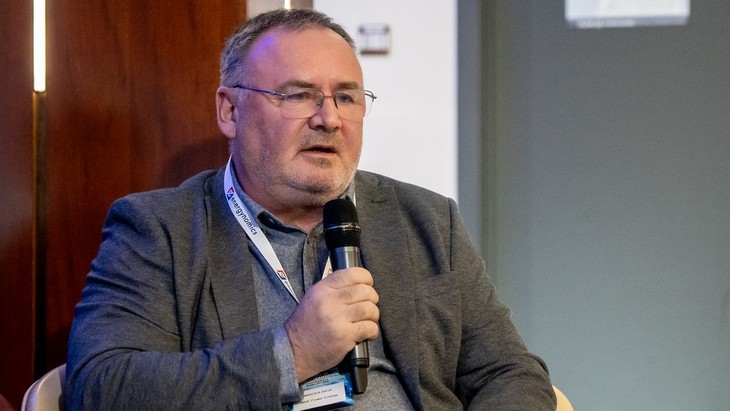
Romania’s power grid was designed for sources other than today’s, and in this context the quality of projects and equipment becomes a matter of system stability, not just of cost, warned Mircea Bica, CEO of MBK Power Energy, at the Leaders in Energy Transition North-West Region conference, an event organised by Energynomics.
“The cheapest is not always the best, especially in energy, where equipment is very expensive and its lifespan is extremely important,” said Mircea Bica. The advice comes from his observation of what the energy construction market looks like today.
A system built around other sources
Bica started from how the system was conceived: the grid was designed around large power plants, Oltenia’s coal and hydropower plants. Now the situation has changed. “Sources no longer take coal into account, no longer take water into account, they have spread out across the system. In some parts of the system it holds up, it copes, in others it does not.”
Beyond equipment that is physically and morally worn out, which calls for retrofitting and reconductoring (necessary, but not sufficient), Bica pointed to a technical vulnerability: renewables connected through inverters do not provide enough inertia. The consequences, in his description, concern frequency stability, short-circuit power, protection selectivity and voltage stability. Distribution and transmission operators know the problem, he said, but now it is the turn of those who own parks: “Producers, those who own parks, will at some point have to think about compensation solutions.”
The same kind of message, with an emphasis on facts, came regarding prices. According to Mircea Bica, Romania must move from stories to execution, and prices can fall only with domestic production that covers the load curve: “We can lower prices if we truly have generation capacity that covers the load curve, domestic capacity.”
Amateurs, batteries and cheap equipment
The market is developing fast, and that also brings people without experience. “There are certainly many amateurs in the market. After the peak of IT, a new perspective appears and many people are heading towards another challenging industry.” The result, Bica said, is projects that are not always what they should be.
The most sensitive example is storage. Reference standards cover only minimum requirements, and some investors stop at them, while others ensure full protection. “Batteries are very vulnerable to fire,” he warned, adding that a battery that has caught fire can no longer be extinguished.
The same pattern appears in primary equipment. Transformers and circuit breakers come from all over the world, and investors look for cheap products, not necessarily the best ones.
Mircea Bica runs two companies that work together, one in energy infrastructure, which is now building 110 kV substations, and MBK Power Energy, specialised in engineering and design, with a local energy dispatcher and energy trading for new capacities.
Leaders in Energy Transition North-West Region was organised by Energynomics, with the support of our partners: Elektra Renewable Support, Big Store, Electroalfa, ELNOS, EnergoBit, KSTAR, MBK Power Energy, SAJ Electric. Strategic partners ALEA, FREE, SAMER.
