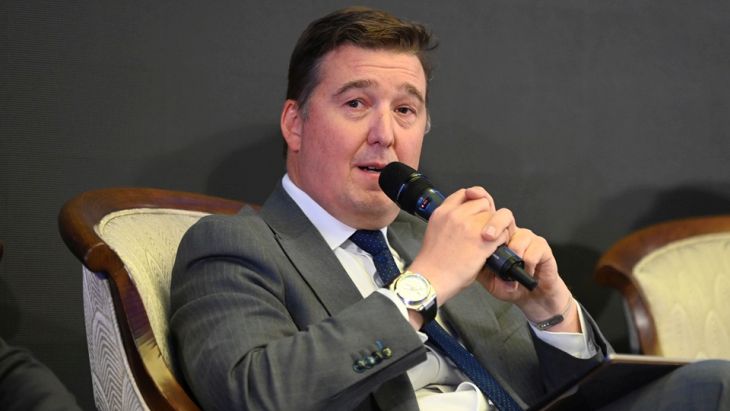
Traders have an important role in the energy sector and bring liquidity, and liquidity means predictability, and I don’t think they have anything to do with price increases, says Ondrej Safar, Chairman of the Board and CEO of Oltenia Distribution.
He says that the lack of investment in energy in Romania and the Balkan region in the mid-2000s contributed to the increase in energy prices in most states in the area, unlike Spain, the Scandinavian countries and those of Central Europe, said Ondrej Safar, president of the Board and CEO of Oltenia Distribution.
“If we are to compare the energy prices in Romania with those of its neighbors, because the markets are interconnected, they are almost the same. There are tariff differences in certain periods, when the energy price in Romania is slightly higher than in Bulgaria and vice versa. The biggest price difference is between the Balkan region and Spain, the Scandinavian countries and those in Central Europe, the explanation being the lack of investment. In Romania, Bulgaria, Serbia and Greece, the objective was to make energy cheaper, but that meant avoiding investments because every investment is translated into prices. In the period 2005-2007, in Romania and in the region, energy prices were significantly lower than in Central Europe, in Scandinavia and in Spain due to the production from capacities without investments, and the regimes benefited from these cheaper rates”, explained the head of Distribution Oltenia, quoted by Agerpres.
According to him, Romania is currently paying a higher price for energy due to the “lack of investment over a very long period”.
Safar believes that the increase in the price of energy this summer was not only due to the hydrological problems, because “in Romania and in the entire region it is more expensive even in periods with normal hydrology”.
“In Romania and in the region, last year the price of energy was around 100 euros on average, in Spain it was 50-60 euros, and in Scandinavia it was 40 euros,” stated the director of Oltenia Distribution.
He stated that investments should not only be made in battery storage, but especially in networks and energy production.
“Investments are also needed in decarbonization, because coal production in Romania is not the same as in Poland, where investments in decarbonization have been made, which are significantly more efficient, and that makes the difference,” Ondrej Safar emphasized.
Asked if the increased price of energy in Romania is also influenced by energy traders, Safar stated that their role is extremely important in the market because they bring liquidity, which means predictability.
“I don’t think it has anything to do with it. For example, in Germany, each megawatt is sold through the market ten times. If we compare consumption with trading volume, in the market, on the European Energy Exchange, there is trading ten times more than consumption. In Germany, this is not reflected in prices, which are lower than in Romania. Traders have an important role in the energy sector. They bring liquidity, and liquidity means predictability. But these are real traders, not someone who it buys power from a state producer and then reaches a state consumer with the higher price,” he added.
In his opinion, the real traders are those who buy energy, following some analysis, and sell it in another region, “because they know that energy can be more expensive there.”
Distributie Oltenia ensures the supply of electricity to 1.512 million users in seven counties in the Oltenia region: Dolj, Argeș, Olt, Gorj, Vâlcea, Mehedinți and Teleorman.
About Schneider Electric
Schneider Electric creates impact by maximising the value of energy and resources, connecting progress with sustainability. We are a global leader in electrification, automation and digitalization, providing AI-driven IoT solutions for smart industries, infrastructure, data centres and buildings.
With 150,000 employees in over 100 countries we promote diversity and innovation. Schneider Electric România, with 27 years in business and more than 300 employees, runs operations in Armenia and Moldova and provides support in 17 languages for 26 countries through the Bucharest Hub.