

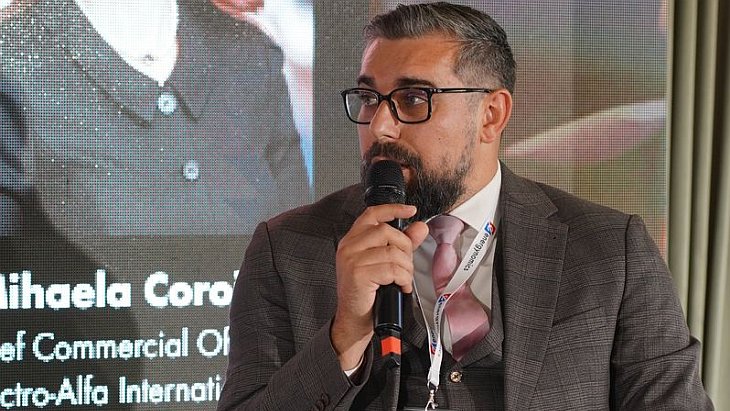
Romania’s electricity infrastructure projects can draw on teams with international experience, but they need credible schedules, clearly defined technical solutions and commercial terms that attract construction teams. This was the message delivered by Robert Schmidt, Country Manager of Elnos Romania, at the Romania’s Green Momentum conference, organised by Energynomics. He warned that investment in renewables and battery storage must be matched by grid development.
Schmidt described Romania’s energy transition as a succession of investment waves, from solar and wind power to prosumers and, more recently, batteries. In his view, each wave has advanced without a sufficiently coherent plan for the power system as a whole. The next stage must place grid infrastructure at the centre of investment decisions.
A workable plan, not just urgent projects
“We need more than PDFs in this energy transition. We need a solid plan. We need predictability,” Robert Schmidt said.
In his experience, contractors receive requests for projects expected to start within two weeks, only for investors to stop communicating for months afterwards. Questions remain unanswered, and technical solutions are sometimes incomplete. From a contractor’s perspective, such uncertainty makes it difficult to plan workforce deployment and construction activities.
Robert Schmidt called for more open communication among all stakeholders, including public authorities, and a plan built around a clear objective. Predictability is needed both in the overall direction of the energy transition and in the working relationship between project owners and contractors.
Skilled workers follow competitive projects
The availability of qualified personnel remains a challenge in high-voltage construction. Schmidt described the situation in the Cluj area, where the same specialists, many of them trained by Electromontaj, move between companies. Approximately one year after a previous discussion on the subject, his assessment was that the situation had not changed.
Elnos can transfer resources between the countries in which it operates. According to Schmidt, the group has projects in 21 countries and a local presence in 18. Its international reach provides flexibility, but Romania competes with other markets for access to the same teams. Their allocation depends on project profitability.
“Resources go where profit margins are higher,” he explained, noting that Romania currently does not offer the highest margins. The message for the market is that a large project pipeline does not automatically guarantee the availability of the workforce needed to build it.
Schmidt also drew attention to the rapid growth of interest in battery energy storage systems (BESS), which he described as a “bubble”. While discussions focus on tens of gigawatts of new capacity, his question is how these projects will be integrated into the power system. In his assessment, grid infrastructure is the next priority that needs to be addressed.
From this perspective, a coherent investment plan, technically mature projects and sustained communication can turn demand for new energy capacity into projects that contractors can actually deliver. For construction companies, the priority is to be able to plan and allocate the necessary people and resources well in advance.
The Romania’s Green Momentum conference was organised by Energynomics, with the support of Elektra Renewable Support, ADEX, Adrem Asset Management, Big Store, CBRE, Elnos Romania, Eximprod, Global Techniques for Energy, SAJ, Sermatec, Sigenergy, Solar Today, Sunotec, TBEA, Think Blu Solution, WALDEVAR Energy.