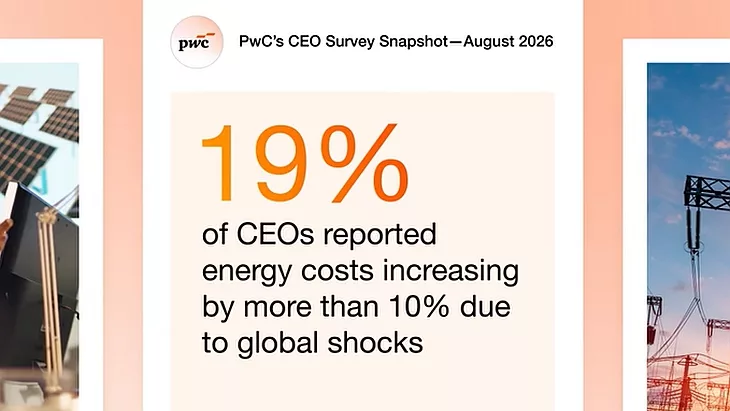
Energy costs are shaping up to be the biggest “financial surprise” for CEOs globally in 2026, outpacing all other cost pressures, according to the global PwC CEO Survey Mid-Year Snapshot. However, executives remain as confident as they were at the start of the year that their companies’ revenues will increase in 2026.
The survey shows that almost one in five CEOs (19%) reported increases of more than 10% in energy spending as a result of global shocks.
“In Romania, companies are concerned that energy prices could remain high for a longer period or could fluctuate strongly, making production more expensive, especially since we have an open economy and dependent on energy imports. Electricity prices had the highest increase in the European Union, taxes – VAT and excise duties – were increased, fuels have become more expensive by about 20% since the beginning of the year, amid the conflict in the Middle East. As a result, inflation has been high in recent years, the highest in the EU, making the economy vulnerable. Thus, a new energy shock is transmitted more broadly in the economy. In conclusion, it is a context that tests the competitiveness of companies in Romania,” says Daniel Anghel, Country Managing Partner PwC Romania.
The pressure is seen in the prices with which the industry works
All these increases are reflected in the production prices of companies and, ultimately, in consumers. According to INS data for June 2026, energy production prices were 23.3% higher than in June 2025. Against this background, more and more companies, especially in industry, are complaining about the burden of energy bills. The NBR warns, in its latest inflation report, that the increase in costs in energy-intensive sectors and transport is propagating along value chains, exerting additional pressure on prices, and external price competitiveness is affected, to a large extent, by energy costs.
However, global shocks make strategic decisions increasingly difficult
More than one in four directors, that is, 27%, say that pricing decisions have become difficult to make to a large or very large extent, the PwC survey shows. In parallel, they are closely followed by supply chain management, with 26%, the adoption of artificial intelligence continues to evolve. While the average impact of AI on revenue and costs has remained broadly unchanged, individual companies are moving faster. More than half of respondents, 51%, have seen a change in the impact of AI in the past eight months, nearly four in ten, or 39%, are already reporting positive results, and 38% have used AI to capitalize on new opportunities created by global disruption.
CEO confidence remains stable
Despite these pressures, CEOs remain confident in the growth outlook. The PwC survey finds that overall confidence in revenue growth has remained unchanged over the past six to eight months. Some 42% of executives remain very or extremely confident about revenue growth over the next 12 months, virtually unchanged from 39% eight months ago, and 51% over the three-year horizon. A third, or 33%, say their confidence has actually increased, compared to 26% whose confidence has decreased.
The difference will be made by well-prepared companies with high “tech resilience,” which combine long-term thinking with solid AI foundations. They are 74% more likely to report success with AI, 55% vs. 32%, and 66% more likely to express strong confidence in future revenue growth, 48% vs. 29%, than companies with low tech resilience. The survey concludes that resilience is becoming a competitive advantage rather than a mere defensive capability.
About Schneider Electric
Schneider Electric creates impact by maximising the value of energy and resources, connecting progress with sustainability. We are a global leader in electrification, automation and digitalization, providing AI-driven IoT solutions for smart industries, infrastructure, data centres and buildings.
With 150,000 employees in over 100 countries we promote diversity and innovation. Schneider Electric România, with 27 years in business and more than 300 employees, runs operations in Armenia and Moldova and provides support in 17 languages for 26 countries through the Bucharest Hub.