

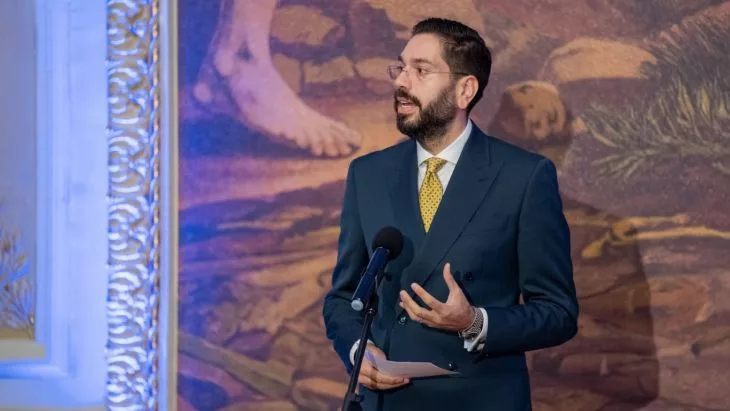
We pay for every month of political uncertainty in interest, investments and postponed decisions, given that we have the highest inflation in the European Union, approximately 11%, one of the largest deficits, and public debt is approaching 60%, but without an adjustment, we are climbing towards 67 or 68%, said the president of the Association of Financial and Banking Analysts of Romania (AAFBR), Flavius Valentin Jakubowicz.
He warned, at the AAFBR 2026 Annual Conference, that the model that brought Romania to this situation, built on consumption, financed by deficit and fueled by imports, has reached its limit and must be changed.
“(…) the model that brought Romania to this point – built on consumption, financed by deficits and fueled by imports – has reached its limit. It is not a personal opinion and it is not a general opinion. It is a conclusion that can be read in the data. We all look at the data and see this. I don’t think the question of the day is whether we change the model. It is whether we change it by decision or by a crisis. We have all been through a lot of crises lately. Let me present you with an overview that says almost everything. Today, the average consumption of a Romanian has reached almost 94% of the European average, which means significant progress for our country, but what we produce, our productivity, is only 78%. In other words, we have come to consume almost like in Western Europe, but we produce like an emerging economy, because, behold, we are about to enter this league as well. And where do we find the difference? In loans”, explained Jakubowicz, according to Agerpres.
In this context, he stressed that Romania’s economy is on the verge of stagnation and recession, with inflation of approximately 11%, a very high deficit, and public debt – the only Maastricht criterion that we still meet, but even this tends to be exceeded, if measures are not taken.
“Three figures that, from my point of view, we cannot avoid: economic growth was only 0.7% in 2025, and this year, if we look at it, at best it will be on the border between stagnation and recession; we have the highest inflation in the European Union, approximately 11% – we are also, finally, champions at something, and one of the largest deficits – 9.3% of GDP in 2024 and with great efforts we tend to go towards 6% this year, and public debt is approaching 60%. Basically, it would be the only Maastricht criterion that Romania still meets at the moment and, without an adjustment, we climb towards 67 or 68%, and yesterday we saw an analysis by the European Commission warning that the risks regarding the sustainability of Romania’s public debt are high in the medium term, and government debt could increase from approximately 59% this year to around 90% in 2036, given that we are not a very well-developed state,” said the president of the Association.
Jakubowicz drew attention to the fact that the European economy is also slowing down, and Romania is borrowing more and more expensively than it is growing, and the rating is just one step away from the zone not recommended for investments.
“And let’s not kid ourselves that it’s just about us. Europe itself is slowing down. The eurozone is growing by only 0.8% this year. We could say that anything below 1% growth would be within the margin of error. The European Central Bank raised interest rates in June, for the first time since 2023, under the pressure of this energy shock. The wind that helped Romania in two decades – cheap money and expanding markets – disappeared exactly when we needed it most. The truth behind these figures is quite simple: economic growth of 2.5 – 3%/year has reached its maximum potential and has not turned into sustainable prosperity, but into inflation and an external deficit. I would like to nuance one warning on this day. We are borrowing more and more expensively than we are growing, and the rating keeps us one step away from the zone not recommended for investments, with valuations as we know them right now,” he pointed out.
In this situation, Flavius Valentin Jakubowicz presented five directions for reconfiguring this economic model that Romania should follow, the first being productivity.
“Today we did not come to take stock of these problems, we all know them. We came to talk about directions, because the reconfiguration of this model has a clear meaning: from consumption to productivity, from deficit to investment, from small addition to added value, and we could say that it has for us, financial analysts, five directions of work. First, I would like to mention productivity, not wages. The objective is not a cheap economy, but an economy that is competitive. Wages must grow together with productivity, not before it, and this means technology, technical education, training, not just salary and nominal increases,” the specialist argued.
A second direction seen by financial analysts is reindustrialization, with Romania losing more industry in 10 years than any other state in the European Union.
“Competitive energy, reindustrialization is again very important. Convergence with Europe is not won in statistics as we like to fight in Romania only with very well written data on paper, but the battle is won in factories and exports. We have lost more industry in 10 years than any other state in the European Union. We can stop this decline, but only with predictable and competitive energy for industry, not just with bills that drive this away,” stressed Flavius Valentin Jakubowicz.
He also advocated for investments to the detriment of consumption, but also a more flexible and efficient state.
“The third direction: investments before consumption. We have the greatest leverage in our history at this point: European funds (…) we can still lose almost 9 billion euros if we do not know how to attract this money by August 31 this year. And the difference between a completed highway and an abandoned one is not a difference in money, it is a difference in execution and in the sustainable and long-term growth of our country. The fourth direction: a more flexible and efficient state. We have one of the most expensive administrations in the region and one of the weakest in terms of digital public services and I would especially mention it for the support of companies and businesses. State reform does not mean less state just for the sake of cutting, it means first and foremost a state that functions efficiently and in support of the citizen,” the financial analyst also said.
In fifth place on the list of directions is fiscal credibility and predictability.
“We have been hearing these things for the last few years almost like a cliché. This is the condition without which nothing can work from our point of view. For every month of political uncertainty we pay in interest, investments postponed and decisions postponed again and again and again. Consolidation should be carried out to a primary deficit. Reforms must survive any electoral cycle – we are not used to this, and OECD accession must become the anchor that finally makes our cost of capital cheaper. I do not think 2026 is just any year. I think it is a window that I do not know if we will meet again – the PNRR deadline, OECD accession, rating assessments, all overlap during this period. We can go through this window, by design, or we can wait to be pushed through the crisis. We have everything we need, from our point of view: a market, a talented workforce, a strategic position and historic European funds. We are missing only one thing: collective decision to use together and put our resources together to move forward and overcome these obstacles. We do not lack solutions either, we lack the courage and patience to see them through. The reconfiguration of this economic model cannot be postponed for a better context. Every time we wait for a better day, but this will not come by itself, it is up to us to support it,” Jakubowicz added.