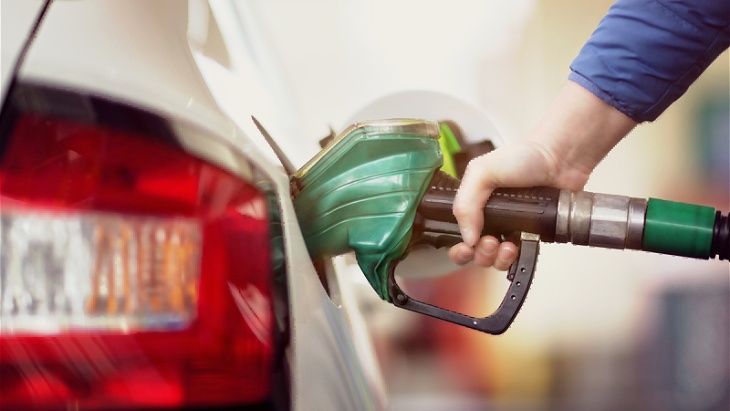
Standard gasoline could exceed 10 lei in the coming days, and diesel 11 lei per liter, given the situation in the Gulf, according to a new Frames analysis.
The Strait of Hormuz normally transports approximately 20 million barrels per day, or around 20% of the world’s consumption of liquid petroleum products, through a navigation lane about three kilometers wide, for which there is no comparable land alternative, analysts say.
The closure announced by the Revolutionary Guards on March 2, followed by a partial reopening after the ceasefire brokered by Pakistan on April 8 and a new closure on April 18, reduced traffic to a trickle. The IMF PortWatch platform recorded six ships in transit on August 30, compared to an average of about 85 per day before the crisis.
According to analysts at Frames, the effect on prices has been brutal and cyclical. Brent started the year at around $72, topped $110 in the spring, peaked at around $118–120 in March and physical quotes reached $150, then fell below $70 in early July, when a peace framework seemed to be closing in. The agreement broke down on July 8. Since the 60-day memorandum expired on August 17, the quote has climbed steadily: it passed $100 on September 9, at $101.21, and reached around $105 the next day. For the year as a whole, Brent is about 65% above its level on January 1.
“It is worth noting how badly the consensus was calibrated. The US Energy Information Administration modeled, in August, an average Brent of 87 dollars for 2026 and 78 dollars in the last quarter, on the explicit assumption that the restrictions in Hormuz would relax by the end of August. They did not relax,” says Adrian Negrescu, the manager of Frames.
The second node: the pipeline that was supposed to be the backup solution
The East–West pipeline, Petroline, crosses the Arabian Peninsula from the fields in the east to the Yanbu terminal, on the Red Sea. It is exactly the instrument built to bypass Hormuz. The fact that it was put out of action by drones launched from Iraq closes the only serious valve that Riyadh had.
The logistical consequence is that Saudi Arabia now sends its oil north, through the Red Sea to the Mediterranean, either via the Suez Canal or via Egypt’s SUMED pipeline—a considerably longer route for Asian customers. The Houthis have threatened this option as well, hitting a Saudi ship in the northern Red Sea in late August.
According to Frames’ analysis, for Europe, the technical distinction that few make matters enormously: oil exported from Yanbu to Europe does not pass through Bab el-Mandeb, but goes up to Suez. Oil destined for Asia does. This means that blocking the strait does not directly cut off European supplies, but it does make the entire system more expensive, because it forces Asian flows to seek other routes and compete for the same ships.
Third node: Bab el-Mandeb, the gateway between Asia and Europe
Traffic through Bab el-Mandeb had already decreased by about 60% compared to the period before the Houthi attacks that began at the end of 2023. Paradoxically, it had increased this year, precisely because Saudi Arabia was looking for alternatives to Hormuz. According to Lloyd’s List Intelligence, that comeback has now been truncated.
“The operational consequence is what shipowners call capacity destruction without loss of ships. If a ship goes around Africa via the Cape of Good Hope, the route is lengthened by approximately 3,800 nautical miles and 10–14 sailing days. The world fleet remains identical in number, but the effective carrying capacity decreases, because each ship is occupied more time for the same volume. The result can be seen in the tariffs even on the routes that have nothing to do with the Red Sea”, explains Adrian Negrescu.
The major container lines — Maersk, CMA CGM, Hapag-Lloyd — suspended their Gulf transits and rerouted to the Cape of Good Hope. Fares on the Asia–Europe and Asia–US East Coast routes have increased by about 150% since the end of February. The additional cost, from fuel and insurance alone, is estimated fleet-wide at $40–50 million per week.
How risk translates into money
According to analysts at Frames, the least understood part of this crisis is not the price of oil, but the cost of moving it.
The reference rate for a VLCC — the supertanker that carries about two million barrels — on the Middle East-China route has reached a record of nearly $800,000 a day. Freight for compliant tonnage is over four million dollars per voyage, up from about $900,000 before the crisis.
Added to these is insurance, which is actually the most sensitive barometer of risk.
“The war premium for the transit through Hormuz was, before the conflict, around 0.125-0.25% of the ship’s value. The indications published before the latest escalation put it at 7.5-12.5%. For a VLCC valued at 100-150 million dollars, the difference means going from 150-225 thousand dollars per voyage to 10-15 million dollars for a single transit”, he says the specialists.
And in some areas insurance is simply not available: Insurers Gard and Skuld have withdrawn their ancillary war risk cover for the Red Sea and Gulf of Aden, effective 16 August. Lloyd’s List Intelligence put, on 12 August, the cumulative damage from the conflict at $1.5–2 billion and about 70 ships damaged or lost.
“Here is the mechanism that matters for the real economy: when insurance becomes prohibitive or unavailable, some shipowners simply refuse the voyages. The number of available vessels decreases, and the rates increase even on routes that are not directly exposed. It is a market contamination, not a geographic one,” says Negrescu.
What it means for Romania: first, the pump
The direct effect has already reached the official data. The release of the National Institute of Statistics for August shows fuels increasing by 3.47% in a single month and by 17.03% per year, gasoline by 25.49% and diesel by 34.61% — the highest annual price increase in the entire consumption basket.
However, the decisive figure is different, from the same release: excluding fuels, the consumer price index decreased by 0.08% in August compared to July. Without fuels, August would have been a month of deflation in Romania. All of the monthly increase in inflation came from one category, fueled directly by the Gulf.
The government reacted with the only quickly available tool: the excise tax. Law 162/2026 introduced a dynamic excise duty mechanism for standard diesel fuel, recalculated every two weeks.
The discount was 20% from August 16–31 and rose to 25% for September 1–15, which means an effective excise duty of 2,103.22 lei per thousand liters, 701 lei below the standard level. As far as the reduction is concerned, the share of taxes in the price of diesel drops from 47-49% to around 39%.
Even so, diesel exceeded 10 lei per liter at all stations, after reaching a historic high of 10.98 lei at the beginning of August. The Ministry of Finance recalculates the percentage on September 15, and tomorrow’s decision is basically the only thing keeping the price under control in the short term. It’s a solution that works, but it costs the budget — in a year where the budget is nowhere to be found.
“The big question mark remains the evolution of fuel prices”, warned Adrian Negrescu, on August 12, when he estimated that the inflation peak had been passed. He had formulated the same warning at the end of June, when the expiry of the excise cap was imminent: the increase in the price at the pump translates into higher prices on all economic chains, in an economy structurally dependent on road freight transport.
Container Crisis
According to Frames experts, the second transmission channel is slower but wider. A more expensive container from Asia means more expensive components, electronics, textiles, consumer goods and raw materials for Romanian companies, with a two-to-three month lag between contracting the freight and the store shelf.
The secondary effect is treasury. Goods that stay two weeks longer at sea mean higher inventories, longer blocked working capital and additional need for financing — precisely at a time when credit is the most expensive in recent years. For a Romanian importer with a thin margin, bypassing Africa is not news in the international press, but a line in cash flow.
Diesel deserves a separate mention because Europe remains a net importer of middle distillates, and Romania is no exception. It enters directly into the cost of road transport, agriculture, construction and industry. The government is already preparing an increase in the budget for diesel used in agriculture, a sign that the pressure has already shifted from the consumer to the production area.
What to watch for in the coming period
Three milestones will decide whether this episode remains a passing pressure or becomes the second inflationary wave of the year.
The first is the recalculation of the diesel excise tax on September 15 and those that follow every two weeks. It is the only lever with immediate effect, but each percentage reduction means lost budget revenues in a year of consolidation.
The second is the monetary policy meeting of the National Bank on October 8 and, especially, what the central bank says about the contribution of fuels to the year-end forecast. If the 6.1% estimate is revised up again, the timing of the first rate cut moves definitively to 2027.
The third, and most difficult to predict, is whether the Houthis move from territorial control to actually attacking shipping. Analysts quoted by the international press agree that the group does not have the capacity to completely close the Bab el-Mandeb, but it does have the capacity to harass traffic with missiles, drones, and fast boats — and for the insurance market the difference between being able to close and being able to harass is almost nonexistent. The risk premium is calculated on probability, not capacity.
“For Romania, the conclusion is not one of abstract geopolitics. It is a very concrete one: slower disinflation than current figures suggest, higher interest rates for longer than the business environment hopes, and economic growth that risks falling once again below already cut estimates. That is, exactly the combination that a stagnant economy cannot afford,” the Frames analysis also shows.