

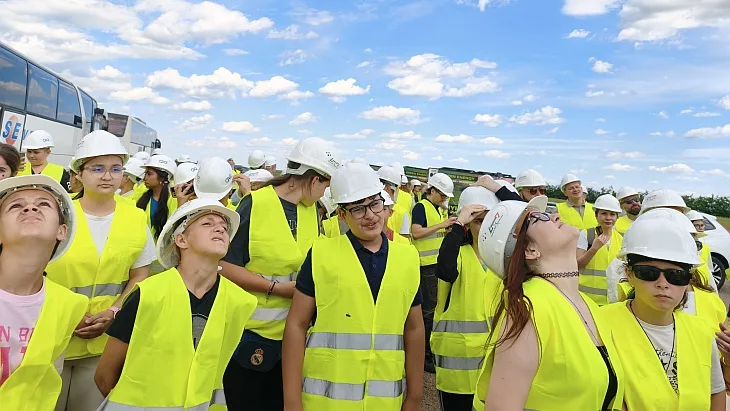
The 9th edition of Wind Open Day, organized by the Romanian Wind Energy Association – RWEA, had a strong educational component this year, too. In addition to representatives of the industry, authorities, investors, contractors and journalists, the field visit in Galați county was attended by around 20 students from the Faculty of Power Engineering within the Politehnica University of Bucharest and approximately 30 pupils from a secondary school in Cuca, Galați county.
More than a professional meeting dedicated to the wind industry, Wind Open Day was also a practical lesson about how energy is produced, how renewable projects are built and why a wind farm is much more than a row of turbines visible from a distance.
Liviu Gavrilă, Vice President of RWEA, opened the event by explaining that Global Wind Day is a moment when the industry tries to speak more clearly about “wind energy and the benefits it brings”. The message was addressed especially to children and students, who were invited to look at the projects not as cold infrastructure, but as the result of the coordinated work of many people, companies and institutions.


The event took place in the area of two wind projects in different stages of development: Green Breeze, close to commissioning, and Ansthall, where construction works are underway. For the young participants, the difference between the two projects offered a concrete image of the successive stages a wind farm goes through: from foundations and site roads to installed turbines, energization, testing and grid connection.
7 years are needed for a wind project
One of the first ideas explained in the field was the long development period of a wind project. Lăcrămioara Diaconu-Pințea, Country Manager OX2 Romania, stated that it takes 7 years for a turbine to go from an idea to producing energy in a wind farm. During this period, once the site has been identified, the project goes through wind measurements, technical studies, measurements, permits, contracts, authorizations, turbine procurement, infrastructure works and various construction stages and grid connection solutions.
A wind farm cannot be built wherever land is available. Wind measurements carried out over long periods, resource certifications and technical assessments are needed to show whether the investment can produce enough energy to be financeable. In the field, participants were told that the measurements can take at least two years, and the results are analyzed by specialized companies.
Only after the wind resource is confirmed does the design of the wind farm layout begin. The position of each turbine must be established according to wind direction, distances between turbines, turbulence generated by each rotor, access for oversized transport, the terrain relief and the possibility of connecting to the grid. “There are hundreds of variables”, said one of the specialists involved in the project, summarizing the complexity of this stage.
Larger, more complex and more productive turbines
Another important lesson for pupils and students was related to the physical size of the infrastructure. The turbines visited have 6.2 MW, towers of 125 meters and rotors with a diameter of 162 meters. Florin Ioan Constantinescu, Customer Relationship Manager Vestas, explained that these turbines are significantly larger and more efficient than those installed in the first wave of wind projects in Romania. The technological difference is visible both in the installed capacity and in the operation and maintenance requirements.
A modern turbine is not just a tower with three blades. It includes electronic systems, sensors, control equipment, an internal lift, an access ladder, safety systems and mechanisms that allow the nacelle to be oriented and the blades to be adjusted according to the wind. “The turbine has to produce day and night”, said Florin Ioan Constantinescu, explaining why technical availability is a critical indicator for the operation of a wind farm.
Alin Constantinescu, General Manager Lemacons, described what the site works consist of: foundations, roads, platforms, cables and connection points. At the time of the visit, the Ansthall project had 12 foundations poured out of 15, while the roads were almost completed. “We have three more weeks”, he said, referring to the completion of the foundations.
The foundation of a turbine is a complex work. Depending on the terrain, it may include drilled piles, blinding concrete, flanges, anchor bolts, reinforcement and a special bonding concrete. Before the turbine is erected, crane platforms, temporary storage areas, roads for transporting the components and cable routes must also be prepared. Part of this infrastructure is visible only during installation, after which the land is partially restored to its initial condition.
The transport of components is, in turn, a difficult operation. The blades, tower sections and nacelles arrive at night, on carefully checked routes. Roads must have widths, slopes and curves compatible with oversized transport. Sometimes, authorized routes have to be modified in the field after tests carried out together with transport companies and turbine suppliers. “There are many variables”, explained one of the site representatives.
Installation, tests, connection, tests, energization, tests…
After installation and the first sets of cold tests, the wind farm must be connected to the grid.
For pupils and students, the explanations about electrical substations, transformers, underground cables, automation systems and SCADA showed that a wind farm is also a sophisticated electrical project. Turbines do not operate in isolation, but are part of an energy system in which every component must be monitored, controlled and synchronized with the grid. Even before final connection, turbines need power sources for their protection and control systems. At the wind farms visited, diesel generators equipped with photovoltaic panels and batteries were used, in order to reduce costs and environmental impact.
From the turbines, the energy is collected at medium voltage, then stepped up to 110 kV and transported to connection substations before being integrated into the national grid.
Benefits for local communities
An important part of the discussions focused on the relationship between wind projects – energy projects in general – and local communities. Wind farms bring local taxes, income for landowners, modernized agricultural roads and works that can support the development of communes. In the field, it was explained that the roads built for access to the turbines can remain useful for farmers, while local budgets benefit from authorization fees and taxes related to the constructions.
One of the site representatives gave concrete examples to show that “all communities that benefit from projects flourish” compared to localities that do not attract similar investments. The benefits do not automatically turn every landowner into a “millionaire”, but they have visible effects locally: better roads, additional income, stronger local budgets and investments in community infrastructure.
The young participants had the chance to discover that a wind farm is not just a technical installation, but an economic, social and administrative project. It involves experts and permits, turbines and transformers, land and roads, contracts and authorities, but above all people from the companies involved and from the communities that host the investments.