

Europe’s grid investment cycle is beginning to change not only how much network operators spend, but what they buy and how they buy it. Discussions at the 2026 CIGRE Paris Session pointed to a procurement model increasingly built around long-term access to manufacturing capacity, system-level performance and continuous qualification of equipment, rather than individual products selected for individual projects.
The shift is being driven by several pressures arriving at the same time. European grids need to accommodate growing electricity demand and renewable generation while much of the existing infrastructure is ageing. Manufacturers are dealing with constrained production capacity and long delivery times, while utilities need to modernize grids without replacing every existing asset.
The result is a market in which the technical specification of an individual transformer or switchgear unit is no longer enough. Grid operators increasingly need suppliers able to secure manufacturing capacity, maintain qualification, integrate technologies at system level and support investment programs across markets over many years.
From equipment procurement to supply-chain strategy
The change is visible first in procurement, with a move away from project-by-project tenders toward relationships covering three, five and, in some cases, eight years. When delivery times for critical equipment are measured in years, utilities cannot wait for an individual construction project to reach the purchasing stage. They need to secure manufacturing capacity earlier, while suppliers need visibility over future demand to plan production, testing and certification.
The same logic applies to Europe’s large brownfield modernization program. Much of the work ahead involves upgrading existing substations and networks rather than building entirely new infrastructure. Limited space, noise requirements and compatibility with equipment already in operation make such projects different from greenfield construction and increase the value of suppliers able to understand the system over a longer period.
For grid companies, the procurement question therefore changes. Selecting equipment for a single substation is different from selecting suppliers whose products, factories, quality systems and technology roadmaps must remain dependable throughout a multi-year investment program.
Winning one tender is no longer necessarily the decisive test. Maintaining qualification, delivery capacity and technological compatibility across a utility’s investment cycle increasingly becomes part of the offer.
Grid suppliers need global reach and local qualification
The changing procurement model is also pushing suppliers toward a more international operating model. A global supplier is not simply a company selling equipment in several countries. It increasingly needs manufacturing and engineering capacity across geographies, the ability to comply with local standards and regulation, access to several supply chains and enough technological breadth to remain relevant beyond an individual project.
Beibei Zheng, vice president of CHINT Global, described the company in these terms. CHINT has built a global supply-chain footprint and competes in different markets by adapting its products to the technical standards and regulatory requirements applicable locally, much as European and American manufacturers operate production and supply networks across several regions.


The same direction can be seen from a very different starting point at ENEVO Group. The Romanian engineering company is expanding across European, Middle Eastern and Asian markets while broadening its activities beyond EPC and automation into digital, cybersecurity and operational services. Its management considers both dimensions necessary for long-term growth. “You can no longer play only from Romania. You have to play internationally, you need international branding, you need product branding,” Cristian Pîrvulescu, CEO of ENEVO Group, told Energynomics.
Geographical diversification can reduce dependence on any single national investment cycle. At the same time, a wider portfolio of capabilities allows an engineering company to remain relevant to the same client through more stages of an asset’s development and operation, rather than competing only for an individual construction contract.
EnergoBit illustrates another route to the same destination. The Romanian company is now part of VINCI Energies and operates within Omexom, the group’s brand dedicated to electricity generation, transmission and distribution. At CIGRE Paris, Omexom brought together almost 20 companies from its international network, connecting capabilities developed in individual markets under a common global platform. For EnergoBit, the structure creates a route through which technology developed in Romania can reach a much wider internal and external market. “When we exhibited for the first time at the Omexom stand, the reaction from colleagues at other VINCI Energies companies was very positive. Their interest was not limited to the technology itself, but also extended to identifying joint opportunities for collaboration and the possibility of implementing this model in international projects as well,” Florin Pop, Managing Director of EnergoBit, told Energynomics.
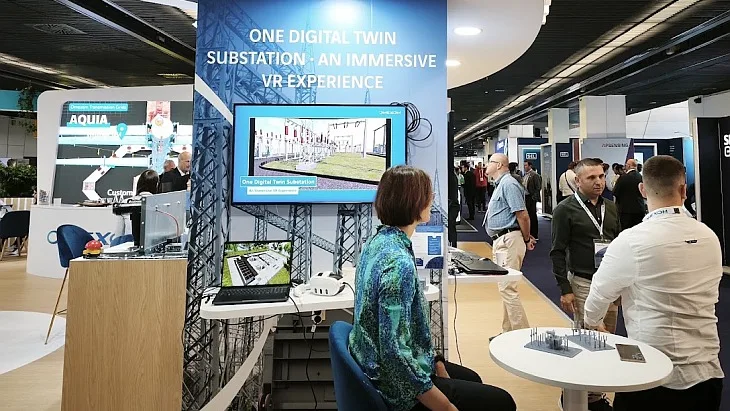
At CIGRE, EnergoBit presented within the Omexom platform technologies developed by its Romanian team, including a Digital Twin solution for substations.
The passport of the equipment matters more than the flag
The discussion in Paris challenged the idea that equipment risk can be assessed primarily through the nationality of its manufacturer. Paolo Miolo, sales and marketing director at KEMA Labs, argued from the perspective of independent testing that the relevant object of assessment is the equipment itself.
Compliance with applicable standards and independent testing provide an essential level of assurance, but qualification at one point in time does not answer every question about a product throughout its commercial life.
A product tested ten years ago may now be manufactured in another factory, with components sourced from different suppliers or changes in the production process. Qualification therefore needs to be complemented by traceability over time: where equipment is manufactured, under which process, with which supply chain and with what history of quality control.
Miolo also described having at least two suppliers as increasingly necessary for resilience. Diversification itself, however, creates another challenge. Every additional manufacturing source and component supplier has to remain under the same quality discipline.
The implication is not that equipment origin becomes irrelevant. Industrial policy, cybersecurity, trade rules and strategic autonomy can all make origin relevant in particular procurement decisions. The narrower technical argument is that nationality alone says relatively little about the actual quality and reliability of an asset.
For a grid operator entering a long-term relationship, the more useful questions concern the history of the product, independent qualification, manufacturing consistency and the supplier’s ability to maintain those standards across factories and markets.
Innovation moves from components to systems
New grid technologies increasingly require combinations of capabilities that are difficult to provide within the boundaries of a single product or company. Michel Serra of SuperGrid Institute described the next stage of grid innovation as increasingly focused on system architecture, software, advanced controls, interoperability and system operation rather than incremental improvements to individual transformers, cables or switchgear.
Technologies such as grid-forming inverters and hybrid AC/DC networks depend on several pieces of equipment and control systems operating together. Performance therefore becomes a property of the wider architecture, not only of the individual component. Grid procurement is becoming longer term, equipment qualification more continuous and innovation more systemic. Together, the three changes are reshaping the supplier market.
About Schneider Electric
Schneider Electric creates impact by maximising the value of energy and resources, connecting progress with sustainability. We are a global leader in electrification, automation and digitalization, providing AI-driven IoT solutions for smart industries, infrastructure, data centres and buildings.
With 150,000 employees in over 100 countries we promote diversity and innovation. Schneider Electric România, with 27 years in business and more than 300 employees, runs operations in Armenia and Moldova and provides support in 17 languages for 26 countries through the Bucharest Hub.
