

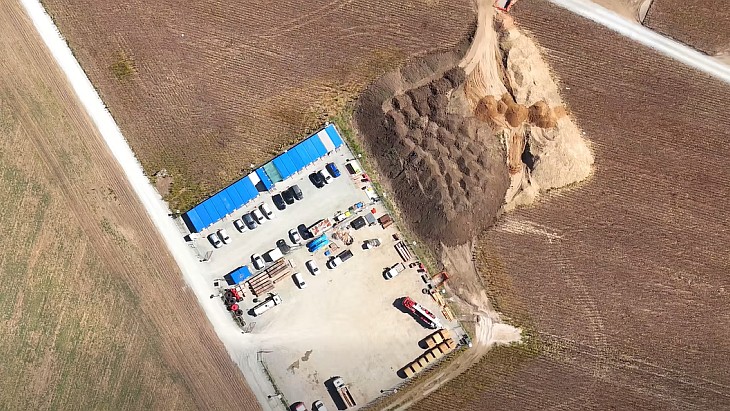
Lemacons is constructing the foundations for the nine turbines of the Mereni Wind Farm, a 54 MW project developed by ENGIE Romania in Constanța County. The contractor is building the civil and electrical infrastructure required for the future wind farm and is currently carrying out reinforcement, anchor assembly installation, and concrete pouring operations in preparation for turbine installation, according to Agenda Construcțiilor.
The contract undertaken by Lemacons at Mereni covers the infrastructure necessary for turbine installation and operation, ranging from ground stabilization and reinforced concrete foundations to platforms, access roads, and electrical and communication networks.
To prepare the turbine sites, the project includes ground stabilization using concrete piles installed with recoverable casing and the construction of circular reinforced concrete foundations. The contractor is also preparing the permanent and temporary platforms required for construction and assembly work, including those needed to operate the heavy-duty machinery used to install turbine components.
Another component of the contract involves the road infrastructure required to transport large-scale components. Lemacons is upgrading existing agricultural roads and constructing internal access roads to the turbines, designed to accommodate oversized loads.
Regarding electrical systems, the work includes constructing the medium-voltage network that will connect the turbines to the wind farm’s energy infrastructure, as well as installing the fiber-optic network linking the turbines to the electrical substation.
The Mereni Wind Farm will have a total installed capacity of 54 MW and will consist of nine turbines, with each unit rated at 6 MW. ENGIE Romania acquired the project at the “ready-to-build” stage, as it held the necessary permits to begin construction at the time of acquisition.