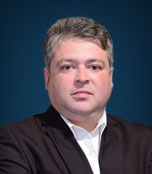
Robert Schimdt, Sales Director Elnos Romania
Romania is entering a new phase – shifting focus from generation to transport, control, and resilience – and Elnos wants to be part of the buildout. In this interview, Robert Schmidt details how the group’s European track record in extreme-site execution, modern installation methods, and disciplined project planning will support Romania’s 110–400 kV modernization. He also addresses two bottlenecks shaping the next wave of grid projects: the scarcity of high-voltage talent and longer lead times for critical equipment. The message is clear: Elnos Romania is being developed not just to deliver locally, but to evolve into a cross-border execution and engineering center for the region.
Across Europe, Elnos Group is already involved in 400 kV and even HVDC projects, in cooperation with operators such as TenneT, Terna, and Statnett. What opportunities do you see for transferring this know-how to the Romanian market, considering the local plans for network modernization and digitalization?
The experience gained by Elnos Group through major projects around Europe now allows us to bring state-of-the-art standards and technologies to Romania.
In Western Europe, networks are already undergoing advanced digitalization, and the integration of renewable sources is being achieved through HVDC solutions and the modernization of 400 kV substations. Romania is on the threshold of the same transformation, and we want to play an active role in this process.
By transferring know-how from projects we have successfully completed in Europe, we can contribute to increasing the efficiency, safety, and sustainability of the national energy infrastructure.
You recently mentioned that there are not enough companies in Romania capable of designing and executing complex high-voltage works. How does Elnos Romania plan to address this gap — through local training, partnerships, or by bringing in experts from the group’s regional network?
Unfortunately, it’s true. Romania is facing a shortage of specialists in high-voltage works. That is why Elnos Romania has developed a long-term strategy based on three main directions.
First, internal training: we are investing in professional development programs and knowledge exchange within the group, so that young Romanian engineers can work on complex projects alongside colleagues from Europe.
Second, collaboration with universities, to help develop a new generation of professionals in the power sector.
And finally, regional expertise transfer. For initial projects, we bring together mixed teams of international experts and local staff, ensuring a genuine process of learning and professional growth.
Elnos Group is currently carrying out projects in more than 18 countries, including areas with challenging climatic and topographical conditions. What lessons from these projects can be applied to accelerate the development of Romania’s network infrastructure and strengthen the system’s resilience?
The most important lesson is that the success of any complex project depends on planning and discipline in execution. In Denmark, Iceland Sweden, for instance, we’ve learned to work efficiently under extreme conditions; very low temperatures, difficult terrain, limited access; while maintaining the highest standards of safety and quality.
We apply the same principles in Romania: integrated planning, well-coordinated logistics, and the use of modern installation technologies.
International experience has also taught us to be flexible; to adapt our solutions to the specific conditions of each site and environment, without compromising quality or safety. All of this is essential to building a robust network infrastructure, capable of withstanding both climatic challenges and the continuous growth in energy demand.
Romania is now moving from the “generation only” stage to that of “energy transport and management.” How do you see the demand evolving for medium- and high-voltage line and substation projects in 2026, and what are the main technical challenges you anticipate?
I believe 2026 will mark a period of accelerated growth in network infrastructure. In the coming years, we will see large-scale projects focused on expanding and digitalizing 110–400 kV substations, along with investments in regional interconnections.
The main challenges will be related to specialized human resources, as the labor market is highly competitive and delivery times for high-voltage equipment, which have increased globally.
At the same time, projects are becoming more technically complex, with more automation components and integrated SCADA systems. We are preparing for this new phase by strengthening our engineering teams and developing partnerships with top technology suppliers.
The group expects to surpass 1,000 employees in the next three years. What strategic role will the Romanian subsidiary play in this expansion – as an execution center, an engineering hub, or a starting point for cross-border projects in the region?
Romania will undoubtedly be a strategic pillar in Elnos Group’s development in Southeast Europe.
Our goal is for Elnos Romania to become, in the medium term, a regional execution and engineering center, capable of managing projects not only domestically but also in neighboring countries.
Romania’s geographic position, technical expertise, and dynamic energy market provide all the right conditions for transforming this subsidiary into a regional hub for the group’s cross-border projects.