

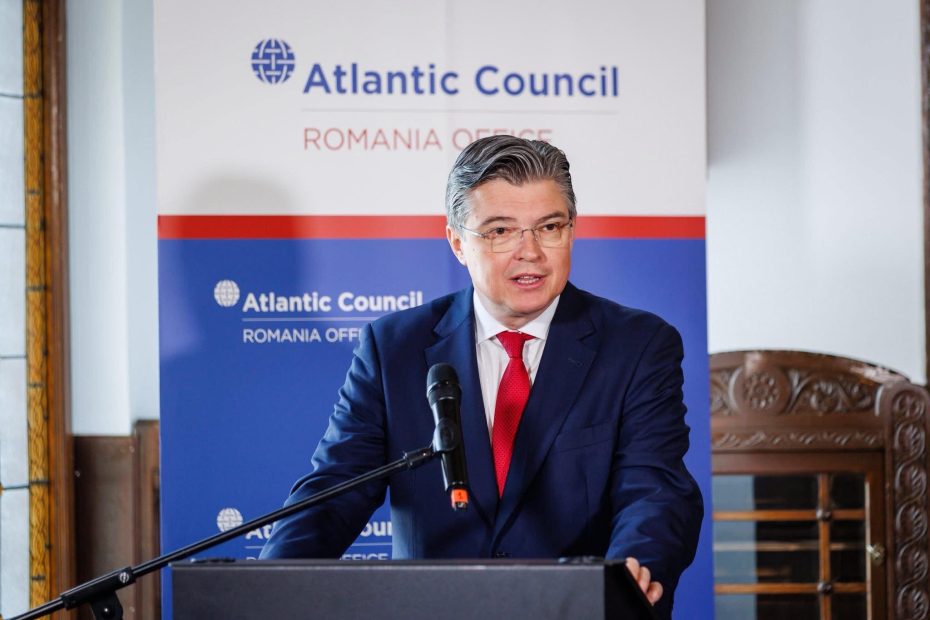
Romania’s position at the crossroads of a region – the Black Sea, the Danube and the European Union southeastern flank – gives it an opportunity to become a regional energy hub, but geography and resources alone will not secure that role. Alex Șerban, Director of Atlantic Council Romania, explains why predictable policies, stronger institutions and cooperation with neighbouring countries are essential to turning Romania’s and the region’s potential into European and global influence. He also discusses the strategic importance of the transatlantic partnership, the connections between energy and defence, and the long-term ambitions of the Atlantic Council’s Bucharest office.
Over the past few years, Romania’s place in the regional energy conversation has changed. How would you describe that change, and what should Romania aim for in the years ahead?
For decades, Romania and its neighbours were seen as the edge of Europe’s energy map: exposed, dependent on a few routes and often on a single supplier. That picture has changed. Geography that once meant vulnerability now means connectivity and crossroads. The country sits where the Black Sea, the Danube and the European Union meet, next door to Ukraine and Moldova, and it has resources, experience and talent that few in the region can match, from domestic production and nuclear expertise to a skilled industrial workforce. And new technologies are finding a home here.
Yet position is not the same as influence. A country and a regional become an energy hub when others can plan around it, and that depends less on what it owns than on how consistently it acts. Predictable decisions, strong institutions and a clear national vision turn potential into trust, and trust into investment.
It also matters how Romania and countries in the region are seen. A country that thinks only of its own needs will be a participant in the regional system. A country that thinks about the needs of its neighbours, and contributes to their security as well as its own, becomes a leader and an active “shareholder” at the regional table. That is the more ambitious game, and it is the one that serves Romania and the region for the long term.
This is why the Atlantic Council opened its office in Bucharest with energy and infrastructure as priorities. Romania’s story is not only a national one. It is part of how Europe’s energy future will be shaped, and it deserves attention in Washington, in Brussels and across the region. The next step is to turn that attention into habits: regular dialogue between governments, companies and experts, an active energy diplomacy agenda and honest assessments of what works and what does not.
Energy has become a central subject of transatlantic relations. What does the transatlantic partnership add in this field, and how can it deliver results for countries like Romania?
Energy is one of the few fields where the interests of the United States and Europe overlap almost completely: security, prosperity and the ability to resist pressure. Europe has the market, the institutions and a long industrial tradition. The United States has energy resources, technology and capital. Cooperation between both shores of the Atlantic works best when it is built on this shared interest, and not on dependence in either direction.
The transatlantic link also has a value that goes beyond energy. When governments, companies and experts from both sides work together on concrete matters, they build the habits of trust that serve the alliance in other areas as well. In that sense, energy cooperation is a form of strategic communication: it shows that the partnership is practical and lasting, not only declared.
Platforms matter for this reason. P-TEC, the Partnership for Transatlantic Energy Cooperation, brings ministers and business leaders from both sides together every year. Its seventh edition will take place in Warsaw on November 18 and 19, 2026. The Atlantic Council’s Global Energy Forum plays a similar role in a broader setting. And around the Three Seas Initiative, whose summit took place in Dubrovnik this spring, the Council worked with partners in Central and Eastern Europe on the connections that link the region. None of these meetings solves a problem alone. Their value is in the continuity of the conversation, the relationships they create and the issues they align.
A note on perspective is useful here. The Atlantic Council is an independent institution and does not speak for any government or country. Our contribution is analysis, convening and pragmatic approaches to what works, and our commitments to the region are reflected in offices in Warsaw, Istanbul and Bucharest.
Energy security and regional security are increasingly discussed together, from the Black Sea to NATO’s eastern flank and Ukraine. How are they connected, and what should that mean for how the region plans ahead?
Energy security and regional security are two components of the same agenda. Infrastructure that carries energy across borders is also part of how a region defends itself and bolsters its partnerships with the US and within the EU and NATO. A country’s energy choices shape the room for manoeuvre of its foreign and security policy. Russia’s war in Ukraine made this connection impossible to ignore.
What happens in the Black Sea region, in terms of stability, freedom of navigation and the safety of infrastructure, affects Romania and its neighbours and allies. This is why cooperation with Ukraine and Moldova is a priority, and not only an act of solidarity.
For planning, the main lesson is that energy and defence questions should be considered together. Preparedness is not only a task for the armed forces. It involves operators, companies, local authorities and citizens, and it is stronger when these groups practise working together before something happens, not after. Societies that understand the risks and trust their institutions are more resilient than those that rely only on equipment.
The Black Sea deserves more attention in this respect. For too long, it was treated as a periphery of Europe’s agenda. It is, in fact, a shared space of trade, energy and security, linking the European Union, NATO partners and countries well beyond them. A stronger Allied and European focus on it, in energy as in other areas, would reflect where the risks and the opportunities now lie.
The same cooperation that strengthens the energy system also strengthens deterrence.
Initiatives such as the Vertical Corridor and the Three Seas Initiative bring together countries with different starting points, including some outside the EU. What does it take to make such cooperation lasting?
Regional cooperation is, first of all, a political choice. The Vertical Corridor project shows what is possible when neighbouring countries decide that a shared challenge deserves a shared response. The Three Seas Initiative offers a wider framework in which countries from the Baltic to the Black Sea and the Adriatic can set common priorities. Both rest on a simple idea: the region is stronger when it acts together and when projects are concrete, with specific deadlines, bankable proposals and financial resources behind them.
Cooperation is easier to proclaim than to maintain. Countries start from different positions. Their geography, resources, history and relations with outside powers shape what each one needs and what it can accept. Lasting cooperation builds on those differences instead of pretending they do not exist, and gives each partner a reason to stay: something it gains that it could not obtain alone.
This applies especially to aspirant partners outside the European Union, such as the Western Balkans, Moldova, Ukraine and Türkiye. The region’s systems are already linked. The Danube drought this summer showed that countries inside and outside the EU can face the same shock at the same time. Moldova is assuming the Presidency of the Energy Community in 2027, bringing energy issues for aspirant and partner countries to the forefront of discussions with EU member states.
The private sector and civil society have a part in this. Governments sign the declarations, but companies, universities, local communities and experts make cooperation real, by investing, by training people and by keeping the conversation going when attention moves elsewhere. A regional agenda that includes them is more durable than one that belongs only to ministries.
What makes such cooperation last is trust, transparency, keeping commitments and sometimes patience. It grows step by step, through small things that work, and it is better served by modest promises that are kept than by ambitious ones that are not.
The Atlantic Council opened an office in Bucharest in 2025, with energy and infrastructure as a priority in the transatlantic and European context. What does an institution like yours contribute, and how will we know in ten years that regional energy cooperation has succeeded?
An institution like the Atlantic Council cannot build infrastructure or sign agreements. It does not support one country or one project. What the Atlantic Council aims to do is help stakeholders see the same facts and look further ahead together, beyond the next election cycle or the next crisis. In practice, that means independent analysis, meetings where people speak openly, and a bridge between the region and the policy conversation in Washington and across Europe.
The Bucharest office works on four priorities: energy and infrastructure, democracy and integration, defense annd security and regional security. They are all linked. A region cannot be energy secure if its institutions are weak, and it cannot be secure if its economy depends on a single source or route. The Global Energy Forum in Washington, our yearly flagship event, and P-TEC and the Three Seas Initiative across the region, all challenge us to serve the same purpose of keeping these subjects together on one table. And to take decisive steps on projects and investments.
How would we know in ten years that cooperation has succeeded? Not by the number of declarations. The signs would be quieter: a region whose energy system is seen as a source of strength and not as a vulnerability; investors who treat it as a single, predictable space; governments that coordinate before a crisis and not after; infrastructure projects that have been built and are functioning; and young engineers, researchers and entrepreneurs who choose to build their careers here.
