

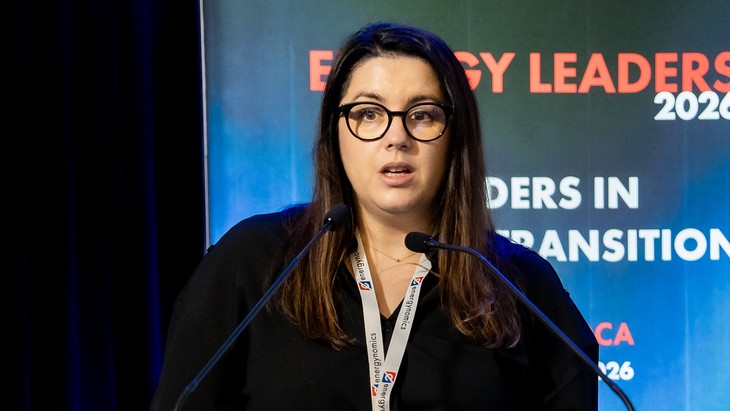
Energy system flexibility does not appear through the mere installation of equipment, but through who commands it and in what common language, argued Elena Popescu, CEO of Elektra Renewable Support, at the Leaders in Energy Transition North-West Region conference, an event organised by Energynomics.
“The real challenge begins when you have to integrate them and command them so that they use the same language,” said Elena Popescu. She is convinced that different technologies can be integrated into the same energy capacity; the question, she specified, is how you command them, not how they communicate with each other.
From 8 MW to over 1.2 GW
The perspective comes from operations. Elektra has been providing technical operation of renewable power plants since 2009. “We commissioned the first plant in 2011, a wind farm of 8 MW. Today we operate over 1.2 GW.” The portfolio combines solar, wind, storage, mixed gas and hybrid, and Popescu hopes to reach 1.5 GW by December.
The services range from operational management, through the local dispatcher at the plant, to the operation and maintenance of installations, on plants from 0.99 MW to 93 MW. Storage requires a new response: “We adjusted the preventive maintenance plans to accommodate the new energy capacities, namely storage installations.” In her experience, the activity is simpler than for photovoltaics: “Maintenance for storage is much simpler than for photovoltaic plants. The primary focus is on ventilation, because it can generate serious incidents.”
But behind every command there are people. The company’s dispatchers work 24/7, and Popescu asks for respect for work that she sees increasingly treated as a given: “They are always there: at Christmas, at New Year’s Eve, and on their birthday, they are still there. We must have respect for this activity.”
Price, a question for the panel
Popescu provoked a debate about prices, starting from a snapshot of market values. “There was a moment when in Romania the price was 255 euros per MWh produced, and in Finland 7 euros per MWh produced. The difference is colossal.”
She admitted that, for an operator, a high price is favourable: “It is good, let us be clear, for our business. At 255 euros per MWh, the owner has the money to pay us.” As a person, however, you cannot help thinking about the bills that are coming. The question is why the Balkan countries end up with such prices when they have similar resources and a similar energy mix.
One explanation may be that Finland does not use gas for electricity generation. The subsequent panel discussion also drew attention to the significant differences between the two countries in terms of interconnections and installed capacity.
Leaders in Energy Transition North-West Region was organised by Energynomics, with the support of our partners: Elektra Renewable Support, Big Store, Electroalfa, ELNOS, EnergoBit, KSTAR, MBK Power Energy, SAJ Electric. Strategic partners ALEA, FREE, SAMER.