

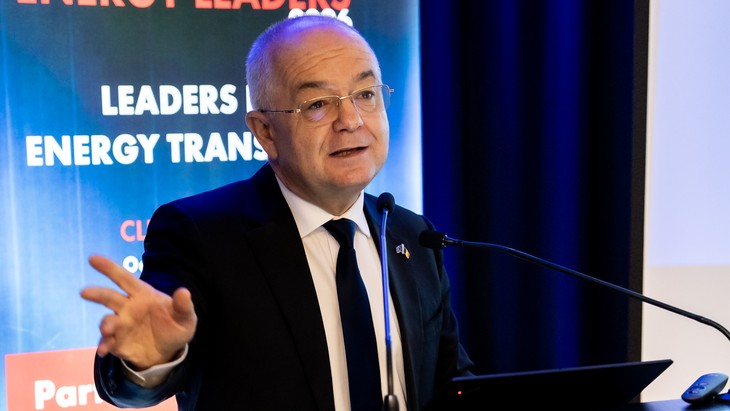
Energy prices decide whether the green transition holds up in Europe, both in the competition between European firms and those in America and China, and in the patience of people who pay the bills, argued Emil Boc, mayor of Cluj-Napoca, in his address at the Leaders in Energy Transition North-West Region conference, organised by Energynomics.
“It is unacceptable that in Europe, and I mean not only Romania, the price of energy for companies is three times higher than in America or China. How will European companies withstand global competition from China and America?” Emil Boc asked. The mayor highlighted the difference, and in this context he pointed to the Draghi report on competitiveness.
The stakes are not only economic. If energy remains a burden for the population, the mayor warned, discontent may spill into the streets, and everything being built in the transition could be blocked. That is why Emil Boc stressed that he has asked, in Brussels and in Romania, for politicians and the business community to do everything possible to bring down energy prices for people and companies. “Green energy is exactly what can solve this problem. Green energy can bring us a decent, acceptable cost of living, and it can lower our energy bills.”

Citizens understand the bill, not the acronyms
Green energy cannot be backed simply through European legislation, but through effects that people feel. If we talk only about a just transition, Fit for 55 and other acronyms, the ordinary citizen thinks we are talking from another planet, the mayor said.
The argument that works, in his view, is the pragmatic one. “When we show that an energy renovation of a building cuts the citizen’s bill by 30-35% in winter, then they understand that the green transition you all talk about is good and that it makes sense to do it,” said Emil Boc.
The mayor of Cluj-Napoca backed his speech with figures: 70% of the public transport fleet is already green (electric buses, trolleybuses and trams), at least 4,000 apartments in more than 99 blocks have been renovated for energy efficiency, and for every leu Cluj residents pay in taxes and fees, City Hall has brought in at least 3 lei from European funds.
Grids, storage and money: the links that are lagging
The mayor sees three gaps holding the transition back. The first is storage, which should have come hand in hand with renewables. As an example, the city has already introduced a system that covers about half of public lighting consumption.
The second missing element concerns grids and balancing capacity. “The Tarnița plant is as necessary for the national energy system as daily bread, my friends, for balancing the national system,” said Emil Boc. He recalled that he adopted the project’s technical and economic indicators when he was prime minister, and said he is upset at the slowness recorded since then.
The third is funding. “Energy ambitions must be backed by finance. If we only have ambition and do not support it economically and do not look after companies, then obviously they collapse and move their centre of action to America and elsewhere.” Referring to buildings, Emil Boc says he has proposed a European renovation plan modelled on the Recovery and Resilience Facility (PNRR), with the investment recovered in 8-10 years. The current pace is not enough: we need more political courage, Emil Boc insisted.
Leaders in Energy Transition North-West Region was organised by Energynomics, with the support of our partners: Elektra Renewable Support, Big Store, Electroalfa, ELNOS, EnergoBit, KSTAR, MBK Power Energy, SAJ Electric. Strategic partners ALEA, FREE, SAMER.
