

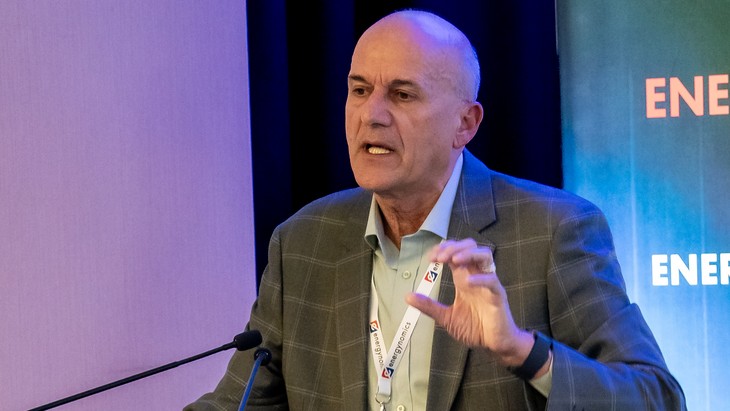
Romanian cities that want to keep investing in energy once grant volumes shrink must move from writing projects to fit calls for proposals to preparing bankable projects, said Florin Andronescu, director of the Alba Local Energy Agency (ALEA), at the Leaders in Energy Transition North-West Region conference, an event organised by Energynomics.
“It is a European instrument designed for one missing link: what do we do in the transition from energy plans to implementing very much needed projects? We have no money, grants keep shrinking, we can no longer hope for [similar allocations], and so we have to make bankable projects,” Florin Andronescu explained, referring to the EUCF, the European financing instrument for preparing cities’ investment concepts.
A small instrument, the missing link
According to Andronescu, the advantage of the EUCF is its simplicity: eligibility means six questions that any city, small or large, including Cluj-Napoca, can answer with yes. The hard part comes afterwards, when the applicant has to convince the evaluators that it has a strong and feasible project, with local governance, stakeholders properly involved and specific indicators.
In his eyes, Romania’s results are weak. “We, for instance, took only five out of seven calls, we won five projects like this, and Poland took over 50,” he said. The explanation: Romanian cities looked at the EUCF as a source of money, not as support for preparing a large, implementable project that can attract private capital.
Even when an application does not receive direct funding, the investment concepts prepared remain useful, because cities understand them and can promote them later, and the instrument comes with training for City Hall specialists. Cities also need, he added, consultancy firms that offer solutions, because assistance in drafting the concepts is decisive.
What happens when the European tap closes
Andronescu estimated that an important but small share of Cluj’s apartment stock has been renovated, and he expressed concern about what comes next. “I sincerely, anxiously wonder what will happen when the Cohesion Fund is cut. We know well what national programmes mean. How do large cities keep moving forward when they have set targets for 2030, 2040, 2050?”
The answer starts with planning. Cluj’s new General Urban Plan, which will be ready in two to three years, should integrate energy, sustainable mobility and climate resilience not merely as statements, but in substance, in the urban planning regulation and in the ranked list of projects. And mobility projects require consulting citizens, because otherwise good ones are blocked by a lack of acceptance from the real beneficiaries.
A second condition is method. At ALEA, a local climate resilience group, which started from a core of people from all sectors of City Hall, is now being extended to energy as well, with local actors, including the distribution operator and banks. Andronescu directly criticised cities that write projects only with an eye on calls about to be launched: “It is not that it is bad to go towards what is on offer, but cities must prioritise needs. And something else is needed: not only implementation, but also monitoring.”
Beyond one-off aid, those increasingly affected by energy poverty could be supported in renovating their homes. Renovation should also involve a contribution from the beneficiaries, because, Andronescu said, “if they are not financially involved too, they are not responsible.”
For small communes, which are even less prepared, the solution is association. The EUCF itself recommends association, and neighbouring localities with similar problems in public lighting, local transport and public buildings can build a substantial project together. Florin Andronescu’s appeal: “Associate, go to consultancy, make your plans, then select the most urgent projects, well built and bankable, so that you can implement them.”
Leaders in Energy Transition North-West Region was organised by Energynomics, with the support of our partners: Elektra Renewable Support, Big Store, Electroalfa, ELNOS, EnergoBit, KSTAR, MBK Power Energy, SAJ Electric. Strategic partners ALEA, FREE, SAMER.