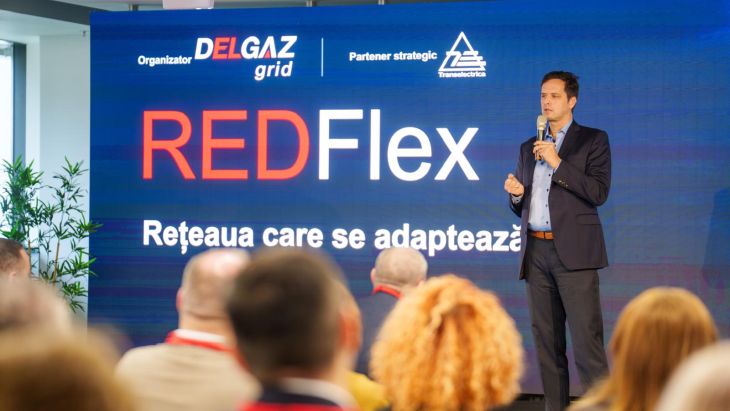
Delgaz Grid, the electricity and natural gas distribution company within the E.ON Romania Group, has completed-in partnership with Transelectrica-a pilot project focused on flexibility services. The initiative aimed to test the willingness of network users to voluntarily adjust their consumption or production behavior in exchange for financial compensation, while also evaluating the benefits of such participation for the operation of the distribution network. Furthermore, E.ON officials stated that the group intends to invest 1 billion euros over the medium term, according to media representatives present at the event.
Flexibility services allow for the dynamic, real-time adjustment of consumption and storage capacity based on the availability of energy production, ensuring that the network continues to operate within optimal parameters. Specifically, during periods of surplus production, the system encourages increased consumption and battery charging; conversely, during periods of deficit, it promotes reduced consumption and battery discharging, thereby supporting the balance of the energy system and the stability of the network. “The energy transition entails not only investments in infrastructure and digitalization but also a shift in how we view the relationship between the distribution system operator and network users. It is about utilizing the existing network as efficiently as possible-adapting it to modern requirements while avoiding unnecessary costs wherever feasible. Through this project, we demonstrate that users can become active partners in managing the energy system, and that flexibility can turn an operational challenge into an opportunity,” stated Volker Raffel, CEO of E.ON Romania.
The project involved users connected to low, medium, and high-voltage networks across all categories: industrial consumers, producers, prosumers (with or without energy storage), and residential consumers.
“From a technical standpoint, flexibility services serve as an important tool for managing energy flows and congestion-especially given the rapid growth of distributed generation from renewable sources. This pilot project allowed us to test how users respond to signals sent by the operator and to evaluate how adjusting consumption can contribute to more efficient network operation. The experience gained provides a valuable foundation for the further development and expansion of these mechanisms,” noted Cristian Secoșan, General Manager of Delgaz Grid.
During this pilot phase, participants were compensated for the electricity they consumed during specific time slots-primarily between 11:00 and 16:00-which were communicated in advance by Delgaz Grid. The selection of these time intervals was based on the specific operating characteristics of the grid: typically, during these periods, energy production from photovoltaic installations can reach high levels, while consumption remains relatively low. The gap between this surplus production and low consumption can lead to local imbalances and grid congestion, necessitating management solutions tailored to the new realities of the energy system.
The project’s implementation confirmed a genuine interest among users in participating in flexibility services, as well as their willingness to adjust their consumption behavior when provided with incentive mechanisms.
The practical results are also compelling. Between 2025 and 2026, discussions were held with over 30 potential flexibility providers; more than a third of these became active participants in the project, including consumers, producers, and battery operators connected at various voltage levels. In total, 90 hours of activations were carried out over 25 days, with traded volumes exceeding 257 MWh. Beyond the figures, the project demonstrated that various flexibility products can be tested and utilized under real-world grid operating conditions.
Furthermore, the testing highlighted the potential for these services to help align consumption and production profiles, enable more efficient use of existing infrastructure, and reduce congestion within the distribution network. Through this initiative, REDFlex takes a concrete step toward developing an energy distribution model that is more flexible, more efficient, and better adapted to an ever-evolving energy system-one in which consumers, prosumers, and producers can actively contribute to grid management.