


The amendment of the legislation on public procurement in the energy sector was one of the central topics at the Cybersecurity Forum in Energy, organized by Distribuție Energie Electrică România (DEER) in Cluj-Napoca, in partnership with the Ministry of Energy. In a context where state-owned companies need to strengthen their digital infrastructures and implement rapid cybersecurity measures, some perceive the current legislative framework as a barrier that slows down investment and exposes the energy system to additional vulnerabilities.
The general manager of the National Energy Dispatch Center, Virgiliu Ivan, emphasized that overly restrictive rules on public procurement make it impossible to respond quickly in sensitive areas such as cybersecurity. “I believe it is very important to amend the legislation on public procurement and sectoral procurement because it really slows down state-owned companies or companies with majority state ownership. The procedures are so complicated that from the moment you want something until you get it […] If we are talking about cybersecurity, it could take a year to get it, and there is no time to waste that long on a public procurement procedure in the field of cybersecurity. Something needs to be done here, otherwise we will be vulnerable. We can’t buy almost anything (not even equipment worth a few thousand euros, ed.) without a competitive procedure. It’s a problem,” Ivan warned. The same difficulty was confirmed by Mihaela Suciu, general manager of DEER, who spoke about projects blocked due to bureaucracy: “Public procurement is a chore for us. […] We have a procurement that started over a year ago and is still blocked. 1,100,000 smart meters. And I can guarantee you that we have specifications drawn up by professionals, with G3 Alliance consultancy, with all the specialists we could gather around us, including law firms specializing in public procurement, and we are stuck. We really need a legislative change that will allow us to implement our projects. Because transparency sometimes forces us to buy products that we don’t want. So this transparency is misinterpreted.”
In turn, Cristian Bușoi, Secretary of State in the Ministry of Energy, explained that, in the context of intense debates on corruption between 2014 and 2016, Romania—under pressure from the European Commission and perceptions in Brussels—chose to adopt the most restrictive conditions for public procurement. “The lowest price condition is a big problem for the energy system,” because then you no longer have a guarantee of the quality of the equipment or services purchased. “A political decision remains to be made at the coalition level,” Bușoi said.
Brussels, legislation, and domestic responsibility
The debate became heated when MEP Daniel Buda invoked the role of European authorities, stating that Brussels does not allow Romania to simplify procurement rules even below the €5 million threshold, although, in theory, European legislation would allow this. Other speakers pointed out that the problem lies not with Brussels, but with the flawed implementation of European directives.
Parliamentarian Ovidiu Câmpean defended the European structure of the procurement system, emphasizing that the stability of the rules is essential and that Romania should focus on training people capable of developing fair and transparent procedures: “We do not apply quality criteria. We do not use green procedures for innovation. It is often easy for us to blame Brussels, but we must admit that the problem also lies within.”
The response came immediately: “Once bitten, twice shy.” In local government, people were held accountable by the Court of Auditors for not choosing the lowest price. “After a few cases, no one dares to use other criteria anymore,” said a participant with experience in European projects.
At the end of the session, Mihaela Suciu stated that DEER has at least ten major projects, each worth over €20 million. “We are waiting for the funding lines to open,” she said.
The discussions in Cluj-Napoca confirmed a recurring reality in the Romanian energy system: administrative rules are not keeping pace with the technological and financial pace of the energy transition. Romania not only has urgent needs for investment in digitization, security, and energy infrastructure, but also has European funds available. The main obstacles are not related to a lack of money, but to the rigidity of administrative rules and limited implementation capacity.
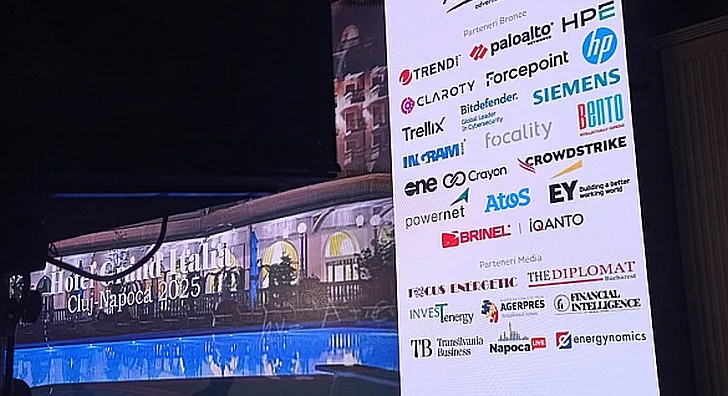
Energynomics was a media partner for the Cybersecurity Forum in Energy, organized by Distribuție Energie Electrică România (DEER) in Cluj-Napoca.