


In mid-December 2025, Craiova enjoyed a rare moment of international scientific visibility: two traditional conferences in the field of energy transition—ICH2P (International Conference on Hydrogen Production) and IEEES (International Symposium on Exergy, Energy, and Environment)—brought together research communities that usually meet in the world’s major university centers. For five days (December 14–18), the city became a meeting place between the global hydrogen agenda and local ambitions to make a mark in applied research.
Organized by ICMET Craiova and the University of Craiova, the events brought together 82 speakers, including 46 international ones, and over 180 participants. However, the figure that best reflects the academic “weight” of the meeting is another: 132 accepted research papers, with a consistent international component (42 papers with affiliations outside Romania). In a technological field where progress is measured by collaboration and validation between communities, such indicators matter more than any festive speech.
Beyond the statistics, the main message of the 2025 edition is that hydrogen remains a topic that is rapidly maturing—not only as an energy vector, but also as industrial infrastructure and a set of technologies that must become more efficient, cheaper, and easier to integrate into energy systems. This also explains the natural overlap between ICH2P and IEEES: hydrogen is increasingly discussed alongside exergy, efficiency, losses, environmental footprint, and the real costs of energy conversions. In other words, it is no longer enough to “produce H₂”; how you produce it, with what efficiency and with what consequences, is becoming essential.
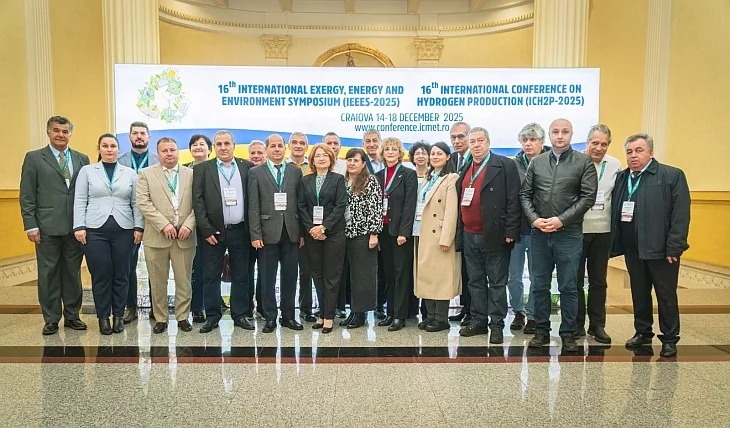
In this vein, the statements made by the conference organizer, Dr. Ibrahim Dincer (Ontario Tech University), served as a summary of the historical pressure felt by the sector: the energy transition is pushing hydrogen from the realm of promise to the realm of “critical step” toward decarbonization. It is an intense but realistic formula: without a robust technological ecosystem (production, storage, transport, use), hydrogen remains a beautiful but decorative piece in the energy puzzle.
For Craiova and Romania, the stakes of such conferences are twofold. On the one hand, it is about validation and connection: researchers from 21 countries came with results that were evaluated and discussed in a formal setting, and the papers are to be published in a volume with an ISBN, with the possibility of extension in international journals in the field. On the other hand, it is about the local capacity to organize and support a high-caliber event—a sign that academic institutions here can be credible hosts, not just peripheral participants.
The important, inevitable question remains: how does this visibility translate into projects, funding, laboratories, and industrial partnerships? If the 2025 edition managed to put Craiova on the map, the next—more difficult—step is to transform this presence into a continuous stream of initiatives. In hydrogen, “momentum” is not enough. Continuity matters.