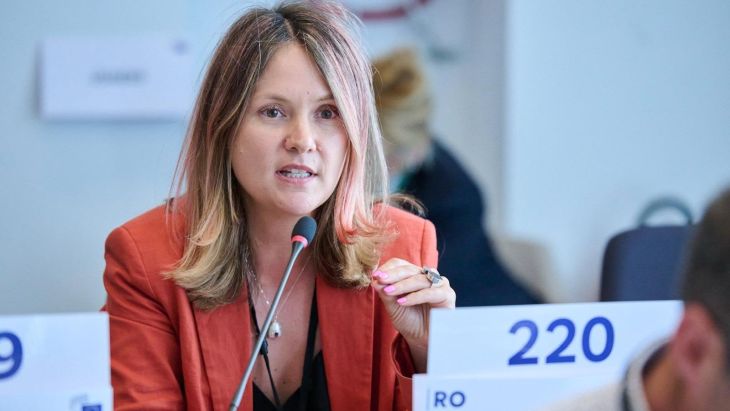
The diesel excise tax cut didn’t work and can’t work to lower the price at the pump, believes energy expert Corina Murafa.
She says that by lowering the excise tax, the government is giving up important budget revenues — money needed for public services, social protection, pensions and salaries — without being able to control the main cause of the price increases.
“Romania does not set the price of oil. We depend on international quotations, the exchange rate, refining capacity and the decisions of OPEC+, a cartel over which we have no real influence.
In August, the excise tax on diesel was temporarily reduced by 20%, and for the first half of September by 25%. However, the price at the pump continued to rise as if these reductions had not existed. When the raw material becomes more expensive on the international market, the excise tax adjustment is just a drop in the ocean — and another one paid for from the public budget,” she says, in a Facebook post.
The conflict in the Middle East and the disruption of oil flows continue to push prices up. At the same time, major oil companies are making exceptional profits from a crisis that citizens and small businesses are paying for in full.
At the same time, six member states have already requested that the European Union discuss the taxation of these windfall profits, following the model of the solidarity contribution introduced in 2022. The subject is to be addressed at the informal ECOFIN meeting on 18–19 September in Dublin.
“Romania should unequivocally position itself in favor of such a measure. For now, however, it is silent. It is not normal to empty the public budget to indirectly subsidize the consumption of fossil fuels, while the big oil companies keep the extraordinary profits generated by war and geopolitical tensions.
Real solutions are those that reduce our dependence on oil.
1. Electromobility must finally be taken seriously.
It is not enough to finance the installation of charging stations. They must exist where they are needed, function and offer predictable services. ANRE and all responsible authorities must ensure rapid connection, infrastructure monitoring and real quality standards for users.
I also speak from personal experience: two weeks ago I ended up driving at 80 km/h on the Sun Highway, to be sure that I would reach the next functional charging point. With the same electric car I traveled all the way to northern Germany and back, and all the Baltic countries and back, without such problems. In Romania, however, a trip on one of the main highways can still become an adventure.
2. Small carriers need support for the transition.
There is currently no serious program to help them change their vehicles. If they switched to electromobility, these economic agents would reduce their fuel costs fourfold. We can build state-guaranteed loan schemes, programs in which part of the investment is subsidized and the rest is financed advantageously, as well as charging infrastructure dedicated to commercial transport.
In the short term, we can also discuss the reimbursement of part of the excise tax for carriers, according to clear and verifiable criteria. But let’s stop this nonsense with the reduction of excise tax, which has no effect and also stimulates consumption.
3. Public and rail transport must become a real alternative.
This week I went on a short vacation with my children to Vienna and Brussels. For my 8 and 10 year old children, I found freebies and generous facilities in public and rail transport. “No stamps, stamped notebooks, special slips taken in advance from the train station. There, the transportation policy is built so that families are encouraged to leave the car at home. In Romania, the train often remains slower, less predictable and too expensive for a family,” she concludes.