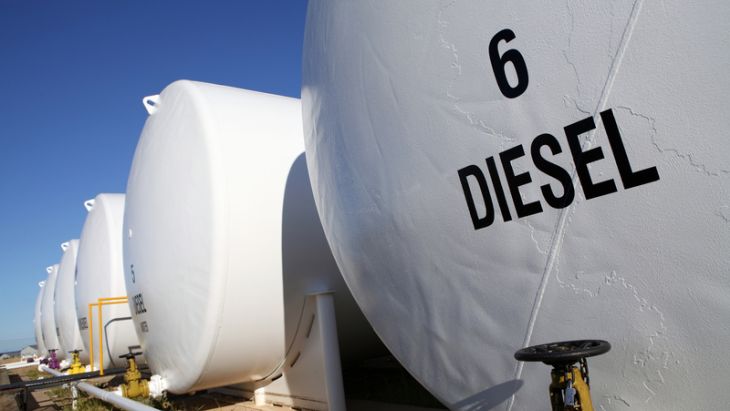
While gas stations in southern Italy display “out of stock” signs, Romania is heading into winter with the most expensive diesel in its history. According to an analysis by Frames, the average price is 10.90 lei per liter—nearly 40% higher than at the beginning of the year. Analysts state that “the risk of a shortage is no longer merely theoretical: the global diesel crisis could persist for another year, Romania’s supply relies on vulnerable routes, and emergency reserves—officially cited as sufficient for 90 days—do not equate to 90 days’ worth of diesel at the pump.” They acknowledge, however, that the actual status of these reserves remains unclear.
On October 22, the average price for standard diesel in Romania stood at 10.90 lei per liter, while gasoline was 10.10 lei per liter, according to data from PretCarburant. In January, at a Petrom gas station in Bucharest, diesel cost 7.89 lei and gasoline 7.67 lei. This represents an increase of approximately 3 lei per liter—a 38% rise for diesel and 32% for gasoline—within less than ten months.
The bulk of this price surge occurred during the second half of the year. Since June 30, the price of diesel has risen by 1.68 lei per liter (18.2%), while gasoline has increased by 1.44 lei (16.6%). The fact that diesel prices are rising faster than those of gasoline is no coincidence: diesel is the product most severely affected by the global crisis—a product upon which freight transport, agriculture, and the construction sector depend.
Price hikes at the pump directly mirror international market quotes. On October 22, Brent crude was trading at approximately $110 per barrel—a 58.5% increase since June 30. The reasons are well-known: the Strait of Hormuz is effectively blocked, and a significant portion of the global supply has vanished from the market. Attacks by Houthi rebels on Saudi Aramco infrastructure and on vessels transiting the region are keeping prices high. The International Energy Agency warns that the global diesel shortage could persist until this time next year.
“We are not talking about a seasonal price increase, but rather a structural crisis expected to last at least a year. Diesel at 11 lei per liter is not a temporary peak from which prices will retreat in a few weeks; it is the ‘new normal’ for the coming winter. For Romania, the question is no longer just how much we will pay, but whether there will even be any fuel available to buy,” states Adrian Negrescu, manager at Frames.
The “90-day” reserves might, in reality, be much smaller
The Ministry of Energy has stated several times this year that Romania holds emergency stocks sufficient for 90 days. While technically accurate, this figure is misleading to the general public. The approximately 2.04 million tons of emergency reserves are calculated based on 90 days of net imports—not 90 days of consumption at the pump.
The composition of these reserves matters more than the total volume. More than half—specifically 1.08 million tonnes, or 53%—consists of crude oil and refinery feedstock, which must first undergo processing. Finished products amount to approximately 957,000 tonnes, of which only about 511,000 tonnes are diesel. Furthermore, only about half of these stocks—equivalent to a 45-day supply—are physically located within Romania. The remainder is stored in other European Union member states, from where it would be significantly more difficult to transport into the country in the event of a crisis.
The time difference is critical. According to the Intelligent Energy Association (Asociația Energia Inteligentă), finished products located in Romania can reach the pump within 2–7 days; domestic crude oil takes 7–15 days to become available, while crude oil stored abroad requires 20–40 days. In a severe crisis scenario modeled by the same association, commercial diesel stocks would be exhausted in approximately 40 days.
Regional shortages could emerge as early as the beginning of December due to limited rail transport and storage capacity, while the strategic diesel reserve would approach depletion by January 2027. This is a stress test—not an official forecast—yet it highlights the primary vulnerability: diesel, rather than gasoline.
Romania produces approximately 2.7 million tonnes of crude oil annually and imports about three-quarters of its requirements. Over 60% of recent imports have originated from Kazakhstan, arriving via the CPC pipeline and the Russian port of Novorossiysk. In July, deliveries were halted for several days following drone attacks on infrastructure, giving Romania an initial glimpse of its own vulnerability.
The situation regarding diesel is even more delicate. Like the rest of Europe, Romania consumes more diesel than it produces, covering the shortfall through imports. Diesel supplies arrive from the United States—the European Union’s primary supplier—as well as from Kazakhstan (which has risen to second place, surpassing Norway) and the Gulf region.
All these routes are either long or exposed to conflict, while the costs for transport, insurance, and personnel have risen simultaneously.
The Italian lesson
Italy demonstrates how quickly a price crisis can turn into a supply crisis. Under pressure from the Meloni government, fuel chains such as Eni, IP, Q8, and Tamoil “voluntarily capped” prices at 2.19 euros per liter across approximately 10,000 service stations. Consumers depleted stocks at this lower price point, leaving gas station operators with losses ranging from 6 to 20 cents per liter. The reduction in excise duties expired without being replaced; meanwhile, transport operators and farmers blocked roads, and the Eni refinery in Taranto faced disruptions between October 12 and 16. By October 15–16, 150 of Eni’s 270 service stations in Puglia had run dry.
“Italy didn’t run out of diesel because the world ran out of oil, but because it attempted to solve a market problem through government decrees. Any price cap in Romania would have the same effect: suppliers would divert their volumes elsewhere, and the pumps would run dry. In a global crisis, the nations that succeed are those that offer predictability—not artificial prices,” emphasizes Adrian Negrescu.
What the government should do
Experts at Frames argue that Romania needs a winter strategy, rather than stopgap measures. The top priority is securing supply—both in terms of crude oil for the country’s two major operational refineries and through the import of diesel—via long-term contracts with a diversified range of suppliers. The second measure involves bringing a larger portion of emergency stocks—currently stored in other member states—back into the country, alongside a genuine, transparent audit of existing reserves. The third measure is a smart intervention regarding pricing: not through price caps, but via targeted support for haulers and farmers, the retention of a dynamic excise duty mechanism, and the reduction of taxes throughout the supply chain. Eliminating the minimum turnover tax by 2027 is a positive step, yet it remains insufficient.
Furthermore, Romania should join those states calling on the European Union to temporarily relax regulations that drive up refining costs. While we cannot control international market prices, we can manage domestic costs, thereby making our market an attractive destination for available fuel supplies.
“The state must publicly disclose—using verifiable figures—exactly how much diesel is currently in the country and how quickly it can be drawn from reserves. Simply reassuring the public by claiming ‘we have 90 days’ worth of stocks’ does not constitute a strategy. A diesel shortage lasting even a few days would bring trucks, agricultural machinery, and construction sites to a standstill, triggering another wave of food price hikes—precisely at a time when inflation has begun to rise once again,” added Adrian Negrescu.