

Romania is beginning to bring together financing instruments that could gradually change the relationship between energy investments and the industrial base that supports them. The scheme established through HG 486/2026, with a maximum budget of 5.3 billion lei, finances industrial investments targeting products for which Romania has a trade deficit, while TechUp Romania, approved by the Government on August 20, adds an instrument dedicated to advanced technologies, from research and development through to production capacity. The two schemes are part of the broader economic recovery package established through GEO 8/2026.
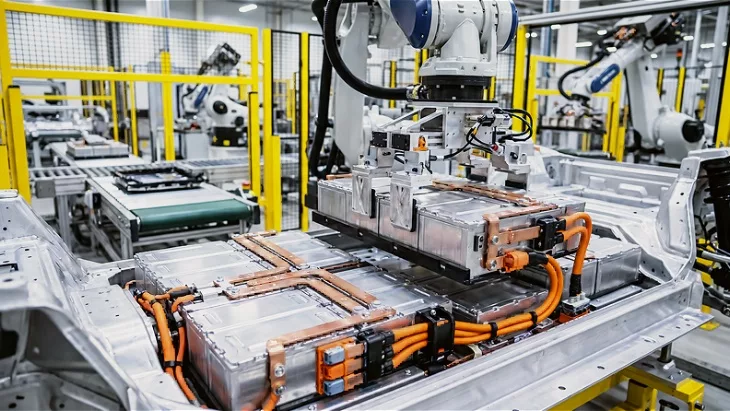
For energy companies, the distinction between energy investment itself and the production of the equipment required for it should be noted. HG 486 does not finance energy generation, storage, transmission or distribution or energy infrastructure, but the list of eligible activities includes the manufacture of electric motors, generators and transformers, electricity distribution and control equipment, batteries and accumulators, cables, connectors, other electrical equipment, as well as the manufacture of engines and turbines.
The logic of the scheme becomes clearer when placed alongside the foreign trade data used directly in project evaluation. In 2025, Romania recorded a trade deficit of approximately 829 million euros for lithium-ion accumulators, 574 million euros for certain devices used for switching and protecting electrical circuits and more than 402 million for photovoltaic cells, modules and panels. The list also includes fuel cells, components for motors and generators, and wind turbines, for which the trade deficit was approximately 61.9 million euros.
What HG 486 can finance and how much a project can receive
The scheme is intended for industrial investments of significant size. Newly established and operational companies, both SMEs and large enterprises, are eligible, but the project must have eligible expenses of at least RON 50 million, equivalent to approximately EUR 10 million. Aid may be requested either as a non-reimbursable grant or in the form of a tax credit, with the choice made upon submission and no longer changeable afterwards. Financing agreements may be issued during 2026-2032, while grants may be paid during 2027-2036.
Depending on the location of the investment, aid intensity may reach 70% of eligible expenses, while the indicative maximum ceiling can reach EUR 57.75 million per company and region. For large projects, with eligible expenses exceeding EUR 50 million, the European adjustment formula applies, meaning the effective intensity decreases for the portion of the investment exceeding certain thresholds. At the same time, the company must provide from its own resources or external financing at least 25% of eligible costs, without this contribution benefiting from any other form of public support.
New construction may be included, provided that it does not represent more than 40% of total eligible costs, together with new installations, machinery and equipment. Intangible assets – for example patents, licenses or know-how – are eligible up to 30% of total costs. The financed assets must be used for the respective investment and maintained at the location for at least five years after completion.
Selection based on scoring
HG 486 introduces a competitive mechanism under which products with the largest trade deficit can receive 100 points, while those in the following groups receive 80, 60, 40, 20 or zero points respectively. Locating the investment in a county with a regional aid intensity of 70% brings another 50 points, compared with 30 points for an area with a 50% intensity. A new unit can receive 20 points, while participation in an innovation cluster adds another five.
A second set of criteria favours more automated factories and integration into European supply chains. An automation level of at least 40% brings 80 points, while purchasing at least 35% of raw materials and materials from the European Economic Area brings 50 points. There is even an incentive for companies requesting less than the calculated maximum aid: reducing the amount requested by at least 50% compared with the ceiling brings another 50 points.
This makes project preparation more than an exercise in completing an application file. For a manufacturer of batteries, transformers, gearboxes, cables or other equipment, the first simulations should connect the CAEN code with the CPA2_2 product and the corresponding trade deficit, the factory location, the degree of automation, the supplier structure and the actual amount of aid requested. A product manufactured in an eligible CAEN sector but which does not appear on the list for which INS has a trade balance figure receives zero points under the trade deficit criterion.
Initial preparations before the session opens
Timing is particularly important for projects that are already at an advanced stage. The aid has an incentive effect only if the application is submitted before work begins; if the investment starts before the application is submitted, the entire project becomes ineligible. Under the scheme, commencement may mean either the start of construction work or the first legally binding commitment to order equipment that makes the investment irreversible. The purchase of land, permitting and feasibility studies are not, however, considered the commencement of works.
Operational companies must have recorded a return on turnover above zero in at least one of the last three financial years and positive equity in the most recently completed financial year. Newly established companies are required to have subscribed and paid-in share capital of at least RON 100,000. The application file includes, among other things, the business plan, the detailed investment plan and proof of the financing source, with the Guide also including a model binding comfort letter from the bank.
Applications will be submitted online in sessions lasting 30 working days, and projects will enter evaluation in order of score, within the budget allocated to the session.
The timetable for the first session has not yet been announced. The Applicant’s Guide was published on July 29 and already received, on August 5, a specific correction concerning the wording of one of the scoring criteria.
TechUp for the transition from research to production
This instrument is complemented by TechUp Romania, approved by the Government on August 20. The scheme has an estimated budget of approximately RON 5.3 billion and aims to finance the path from research and development to production, for projects with eligible investments between RON 5 million and RON 50 million. The targeted fields explicitly include green energy, storage and climate technologies, alongside microelectronics, advanced materials and Industry 4.0.
From the perspective of the energy industry, the complementarity is relevant.
A technology developer or manufacturer still at the research, testing and transition-to-production stage may fall within the TechUp range, while a mature industrial investment of at least RON 50 million, aimed at manufacturing a product with a trade deficit, may fall within the logic of HG 486. TechUp requires projects to link research and development activity with the subsequent investment in production capacity, potentially creating a bridge that has often been missing between prototype and commercial-scale manufacturing.
For technology and equipment suppliers, industrial investors, developers seeking to vertically integrate manufacturing activities, banks and consultants, the useful step now is to build a pipeline of industrial projects, rather than merely monitoring the launch date of the calls. Batteries, electrical equipment, transformers, connectors, cables, electronic components or technologies for renewables should be assessed simultaneously in terms of the trade deficit, local manufacturing capacity, access to financing and the market already created by large-scale energy investments.
The two programs do not yet constitute, on their own, a complete industrial policy, and their impact will depend on the quality of the projects that secure financing, the continuity of budgets and the state’s ability to align support for manufacturing with the demand created by the energy transition. But if research funding, support for productive investment, the advantage given to automation and European supply chains, and the prioritization of products with trade deficits are pursued consistently, these could become the main lines of an industrial policy for the technologies we currently import, such as batteries, photovoltaic panels, transformers, electrical equipment, cables and turbine components.
About Schneider Electric
Schneider Electric creates impact by maximising the value of energy and resources, connecting progress with sustainability. We are a global leader in electrification, automation and digitalization, providing AI-driven IoT solutions for smart industries, infrastructure, data centres and buildings.
With 150,000 employees in over 100 countries we promote diversity and innovation. Schneider Electric România, with 27 years in business and more than 300 employees, runs operations in Armenia and Moldova and provides support in 17 languages for 26 countries through the Bucharest Hub.
