

Romania is installing photovoltaic parks, wind farms and batteries at an accelerated pace. A significant share of the technology that makes this new energy infrastructure possible still comes from imports. We learned more about this industrial dependence from HG 486/2026, which uses 2025 data reported by the National Institute of Statistics.
The list does not measure installed capacity or the origin of equipment used in individual projects, but rather Romania’s trade balance by product category – the difference between exports and imports. A negative balance means that Romania buys more from abroad than it sells across its borders. This is the case for some of the technologies at the centre of the energy transition, where the gaps are substantial.
What we import for the energy transition
The strongest signal comes from batteries. In 2025, Romania recorded a trade deficit of 829.1 million euros in lithium-ion accumulators, one of the largest negative values on the entire list. The statistical category analysed by the Ministry of Finance covers Li-ion accumulators as a whole and cannot be equated with imports intended exclusively for energy storage projects. It also includes batteries used in other applications, including transport and industry. Even so, it shows the scale of the imbalance between domestic demand and Romania’s capacity to produce and export this technology.
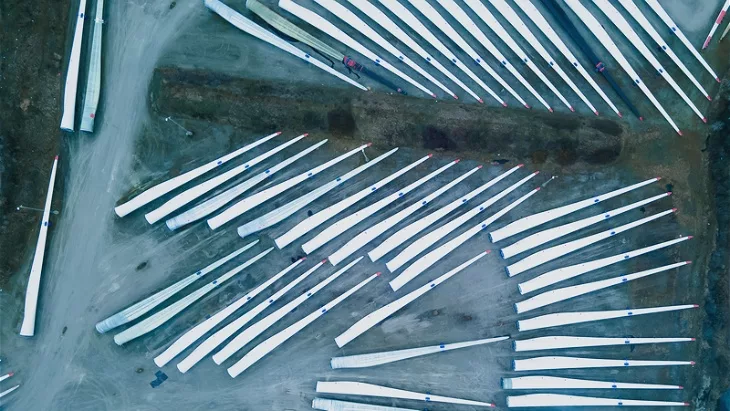
In photovoltaics, the link with energy investment is even more direct. For photovoltaic cells, modules and panels, the 2025 trade balance was negative by 402.2 million euros. Romania added approximately 2.2 GW of solar capacity in the same year, showing how quickly the market that needs to be supplied with equipment is growing. The balance is also negative for wind technology itself: the wind turbines category recorded a deficit of 61.9 million euros in 2025.
The expansion of renewable generation comes on top of a broader need for electrification, automation and grid reinforcement, while part of this technology chain remains in deficit from a trade perspective. The dependence also persists in the category that includes plugs, sockets and other devices for switching or protecting electrical circuits, where Romania recorded a deficit of 574.3 million euros.
Where is Romania a net exporter?
We should not rush to conclude that Romania does not (any longer) have any industry capable of supplying equipment for the electricity sector. In fact, the data show almost the opposite in several segments. For boards and other supports equipped with electrical switching or protection apparatus for voltages of up to 1,000 V, Romania recorded a trade surplus of 2.536 billion euros in 2025 – a value far exceeding the individual deficits in photovoltaics or batteries. The balance was also positive by 270.8 million euros for sets of electrical cables with insulated wires and connectors. There are therefore electrical segments in which Romania is a net exporter, including some that are strongly integrated into European manufacturing chains.
Romania is not starting from zero industrially, but its manufacturing base is not yet aligned with all the technologies towards which energy investment is shifting.
This is also one of the reasons why HG 486/2026 deserves to be viewed as more than simply a state aid scheme. The programme was explicitly designed for investment in products where Romania has a trade deficit, and the size of that deficit directly affects project scoring. Products with the largest imbalances receive the highest score, and where applicants are tied, priority is given to the product with the most negative trade balance.
The issue is broader than mechanically substituting imports. Romania will inevitably continue to import technology, while integration into European value chains involves both imports and exports. A genuine objective may lie in the extent to which the wave of investment in renewables, storage and grids can be transformed into a new wave of industrial investment in Romania.
About Schneider Electric
Schneider Electric creates impact by maximising the value of energy and resources, connecting progress with sustainability. We are a global leader in electrification, automation and digitalization, providing AI-driven IoT solutions for smart industries, infrastructure, data centres and buildings.
With 150,000 employees in over 100 countries we promote diversity and innovation. Schneider Electric România, with 27 years in business and more than 300 employees, runs operations in Armenia and Moldova and provides support in 17 languages for 26 countries through the Bucharest Hub.
