

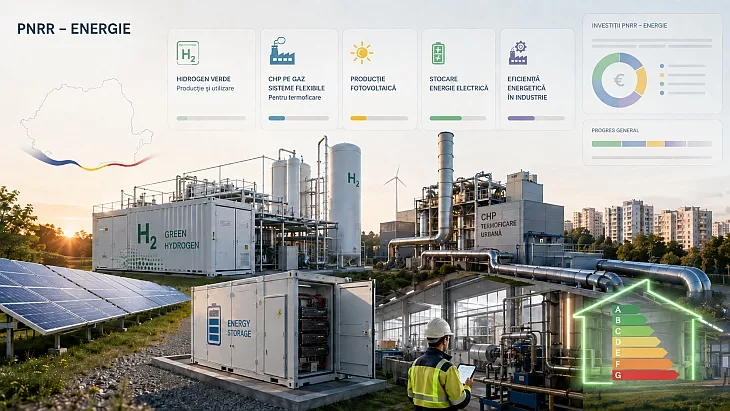
Romania is entering the final week in which it can still meet the milestones and targets that will be taken into account in the assessment of the National Recovery and Resilience Plan. In energy, however, the outcome will not be measured solely by the money spent: the final version of the NRRP requires installed and connected renewable capacity, energised batteries and electrolysers, retired coal-fired capacity and reforms intended to change the way the market operates.
The Plan with which Romania reaches this deadline is substantially different from the one initially approved. The latest revision covered 94 measures and reduced the total value of the NRRP to approximately 20.1 billion euros, of which 13.57 billion euros are grants and 6.54 billion euros are loans. Some measures were removed, while others were amended.
All milestones and targets must be met by 31 August, and actions completed after this date can no longer be taken into account by the European Commission when assessing payment requests. Romania has until 30 September to submit its final payment request and supporting documents, while final payments can continue until the end of the year. Romania has so far received approximately 13 billion euros under the NRRP, from an updated budget of 20.1 billion euros. The amount theoretically still available to be drawn is approximately 7.57 billion euros.
Beyond absorption, the NRRP has physical targets
Public data do not yet provide a consolidated picture based on the final version of the NRRP. The Transparenta.eu platform, built on data published by MIPE, and the official NRRP Status dashboard still contain outdated information, including elements from the structure that preceded the latest revision. Energy storage and industrial energy efficiency, for example, still appear under Component 6, although the final version of the Plan transferred them to REPowerEU.
For renewables, the NRRP contains two different measures. The first is a target for the entire system: wind and solar capacity must increase by at least 3,000 MW, from a baseline of 4,408 MW at the start of the Plan, which includes the large projects built during the first investment wave of 2010-2013, to at least 7,408 MW. Separately, the investment scheme financed directly through the NRRP must deliver at least 950 MW installed and connected.
Transelectrica data suggest that the first target has already been exceeded. On 1 January 2026, Romania had approximately 6,230 MW of wind and solar capacity licensed for commercial operation, while a further 1,827 MW had been connected during the year by 20 August, of which 1,331 MW was solar and 496 MW wind. Taken together, the two datasets bring total wind and solar capacity to approximately 8,057 MW.
The increase of approximately 3,650 MW compared with the Plan’s baseline cannot, however, be attributed entirely to NRRP financing. The Plan directly financed part of the new capacity and, through reforms such as CfDs, PPAs and simplified grid connection and permitting procedures, sought to create the conditions for a much larger volume of private investment. Under the NRRP, Romania committed to signing CfD contracts for at least 3,500 MW of renewable capacity.
The milestone has been exceeded, but its main impact on generation and system adequacy has yet to materialise. OPCOM reports 75 contracts signed following the three auction rounds, covering 4,544.82 MW. Of this, 2,630.48 MW is onshore wind capacity under 41 contracts, while 1,914.34 MW is solar capacity under 34 contracts. The contracted volume therefore exceeds the level required under the NRRP by more than 1,000 MW.
The 4.5 GW does not, however, represent capacity already added to the system. The OPCOM register includes projects with commissioning deadlines extending to 2028 and final commercial operation dates extending to 2030. Moreover, a CfD contract does not necessarily cover the entire capacity of a project.
The megawatts contracted through CfDs are therefore a concrete outcome of the NRRP period, but primarily represent a commercially secured investment pipeline for the coming years. Some projects are already under construction, others have only recently reached financial close or are preparing to enter construction, while most of the capacity will actually enter the system after the NRRP has ended.
Drought, coal and money
For coal and lignite, the target required cumulative retired capacity to increase from 3,070 MW to 3,780 MW. The 710 MW difference must be demonstrated by the end of the NRRP through the withdrawal of licences and certification of disconnection. In May, government documents still described the target as “in progress”. The Plan complements this requirement with contracts for 1,200 MW of renewable capacity and 1,500 MWh of storage located at consumer sites.
The past few weeks, however, have brought developments in the opposite direction from the perspective of system operation. Against the backdrop of a generation deficit, the Government allowed units held in technical reserve to restart, and Rovinari Unit 4, with an installed capacity of approximately 330 MW, returned to operation on 17 August. Complexul Energetic Oltenia was therefore operating three units at Rovinari and one at Turceni, while output from coal-fired power plants temporarily exceeded 1,100 MW. The reserve unit at Paroșeni also returned to the system on 18 August.
The NRRP and the reality of the power system therefore reach 31 August with a tension that is difficult to ignore. The Plan requires Romania to demonstrate the retirement of additional coal-fired capacity, while system adequacy needs this summer have required an increase in coal-fired capacity available for generation.
One of the important points in the latest negotiations with Brussels was milestone 119a, concerning the removal of 710 MW of coal-fired capacity. The penalty coefficient for failing to meet it was reduced tenfold, from 5 to 0.5. With around 4,500 projects across all sectors not yet formally accepted as completed, Law No. 141/2026 introduced an exceptional partial acceptance mechanism for projects that are close to completion. This allows the essential part of an investment to be formally accepted if the remaining ancillary works account for no more than 5% of the contract value.
The difference between formal targets and actual system operation is all the more relevant because the 1,200 MW of renewables and 1,500 MWh of storage included in the Plan represent contracted commitments to replace retired capacity, not necessarily capacity that is already available. The same transition process therefore measures outcomes at very different stages: retirement, contracting, installation and connection.
Storage may provide the best test
For the NRRP investment in batteries, the final version requires at least 240 MW and 480 MWh installed and connected. Available data on contracted projects indicate that the target may already be covered by only a few of the completed investments. Aukera’s Gura Ialomiței project commissioned its first 150 MW / 300 MWh phase in June, Energy Capital Group completed a 100 MW / 200 MWh system at Iaz, while the Teiuș Solar project reached 60 MW / 120 MWh, with energisation publicly confirmed in June. Together, the three projects total 310 MW and 620 MWh, above the thresholds committed under the NRRP.
The official list also includes among the completed projects Renovatio’s 30.6 MW / 60.96 MWh system at Toplița, as well as the Panda Investment project at Tușnad. For Toplița, the beneficiary states that the investment was completed on 30 July. In the case of the Tușnad project, the NRRP dashboard marks it as completed, but the publicly available information does not allow independent verification of energisation.
Projects still under construction or with operating dates after 31 August include several sizeable investments, including R.Power at Scornicești, Electrica at Fântânele and the Ogrezeni project.
The NRRP therefore appears to have delivered a significant result in storage even if the entire contracted portfolio is not completed. A few large projects are enough to exceed the national target, while almost half of the contracts are being terminated or are considered at risk.
The impact must also be viewed in the context of the much faster development of the wider market. Transelectrica reported total installed storage capacity of 989 MW as of 1 August, with 663 MW connected in 2026 alone. The three NRRP projects for which there is solid public evidence of completion total 310 MW, equivalent to almost half of the storage capacity connected this year.
The NRRP therefore does not explain Romania’s entire battery boom, but investments financed through the Plan already represent an important part of the increase recorded in 2026. At the same time, the programme’s experience shows that meeting an aggregate MW and MWh target can coexist with delays or failures affecting a significant number of individual projects.
Investments and reforms are tested in the operation of the system
The energy component of the NRRP was not simply a programme for building assets. The reforms undertaken include the CfD mechanism, the possibility of concluding PPAs directly, simplified permitting for renewable projects, the framework for offshore investment and the participation of demand response, including industrial consumers, in the balancing market.
The importance of some of these reforms has been brought into much sharper focus this summer by severe drought and very low Danube flows. The authorities have activated a temporary mechanism under which Transelectrica can successively implement system security measures, including restricting the consumption of large industrial consumers between 19:00 and 23:00 if technical conditions require it.
With or without the NRRP, the situation in August 2026 raises key questions for the future: how much real flexibility does the system have, how effectively can demand respond to market signals, and how many of the new batteries can intervene when generation and consumption diverge?
More than the NRRP absorption rate, the answers to these questions will show what actually remains in Romania’s power system after 31 August.
About Schneider Electric
Schneider Electric creates impact by maximising the value of energy and resources, connecting progress with sustainability. We are a global leader in electrification, automation and digitalization, providing AI-driven IoT solutions for smart industries, infrastructure, data centres and buildings.
With 150,000 employees in over 100 countries we promote diversity and innovation. Schneider Electric România, with 27 years in business and more than 300 employees, runs operations in Armenia and Moldova and provides support in 17 languages for 26 countries through the Bucharest Hub.
