


This analysis was provided by the Enery team, highlighting key trends and insights into the commercial optimization of battery energy storage systems in Romania and Bulgaria.
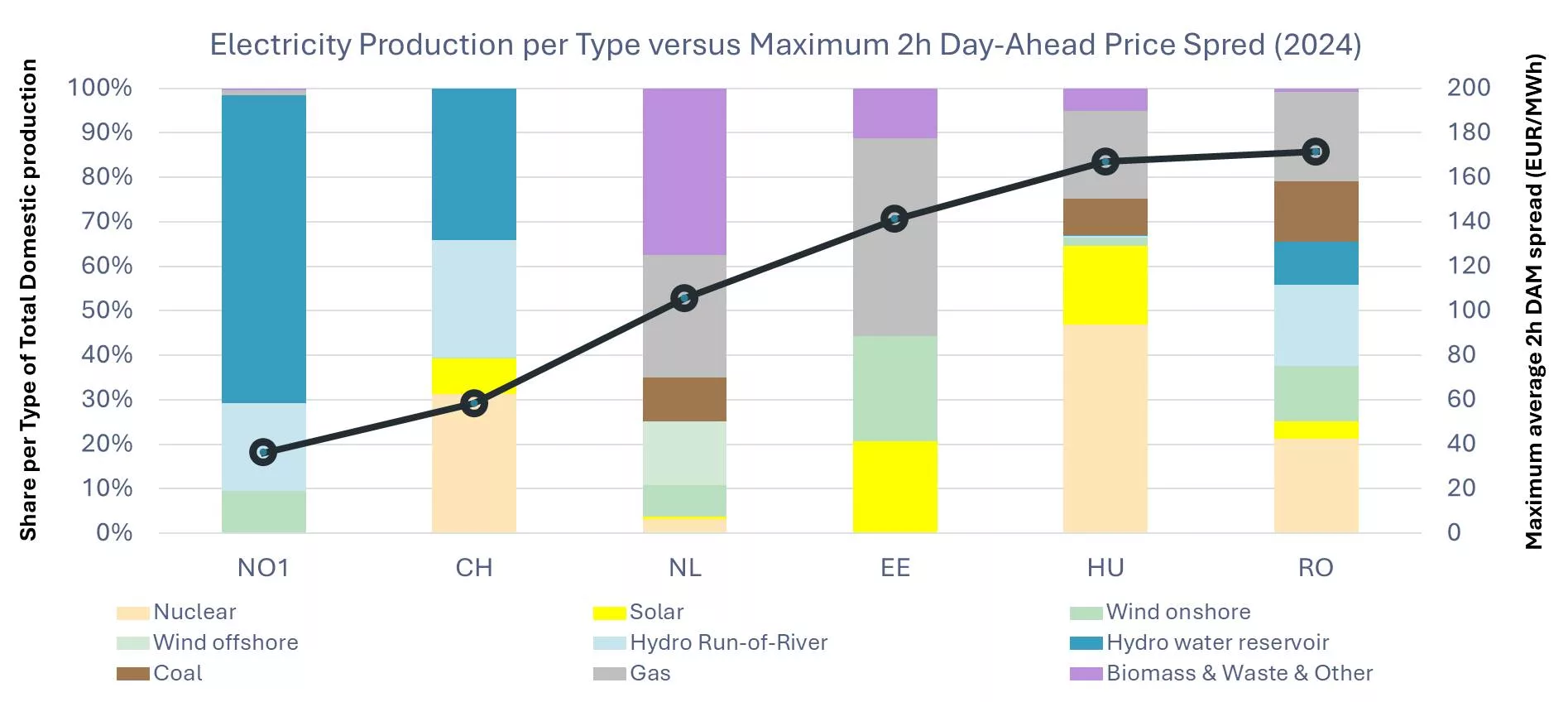
The European battery energy storage landscape presents a diverse environment across different markets, with each country offering distinct opportunities for revenue maximization of battery projects. An examination of average price spreads on day-ahead markets (DAM) reveals that Central and Eastern Europe presents exceptionally attractive possibilities for battery energy storage projects. The underlying driver of this attractiveness lies in the regional electricity generation mix, which is predominantly composed of fossil fuel plants (gas and coal) combined with ever increasing share of variable renewable sources, while lacking sufficient flexible generation assets such as hydropower reservoirs, pumped storage hydro, and battery storage systems.
This structural imbalance creates price volatility, with periods of low electricity prices during high renewable generation versus periods of elevated prices when fossil fuel generation dominates the supply mix. Romania experiences this dynamic, with an elevated average 2-hour price spread on the day-ahead market of 171 EUR/MWh throughout 2024, a pattern that has continued into 2025. In contrast, countries with substantial hydropower reservoir capacity, such as Norway, Switzerland etc., experience price spreads that are three to four times lower, significantly diminishing their attractiveness for battery storage investments. The composition of a country’s electricity generation mix thus serves as the fundamental factor determining the daily price spread magnitude and, consequently, the commercial viability of battery energy storage investments.
Another factor strongly contributing to profitability is the structure and revenue potential of ancillary service markets. Battery systems are uniquely positioned to capitalize on these opportunities due to their rapid response capabilities, allowing them to provide high-value grid services such as frequency regulation, voltage support, and spinning reserves.
The strong price signals and existing support schemes have prompted companies like Enery to deploy and commercially operate the region’s first battery storage projects in Bulgaria and Romania and begin accumulating technical and trading expertise. This has led to the establishment of dedicated trading operations in Enery equipped with algorithmic trading tools and optimization models that are continuously refined based on daily market data and trading performance.
The performance results achieved in Bulgaria, where utility-scale battery projects have been operating for over a year, demonstrate the significant value potential of algorithmic trading approaches. Battery systems generated returns that were 50% higher than the average price spreads available in day-ahead markets, with this outperformance primarily attributed to automated trading strategies that capitalize on price volatility in intraday markets. The trading strategy proved particularly effective in generating revenue from pure financial cycles, which represented approximately 45% of total trading cycles, alongside the physical cycles that captured spread opportunities unavailable in day-ahead markets.
A pure financial cycle occurs when the battery’s trading algorithm purchases electricity at a low price and sells it at a higher price within the same time period on the intraday market, capturing the spread as profit without any physical battery operation. During these transactions, the battery neither charges nor discharges—only market trades are executed. The profit is generated purely from the difference between the buying and selling prices, multiplied by the traded volume, without any actual energy storage taking place. This is possible because prices on the intraday market are dynamic and change continuously throughout the day.
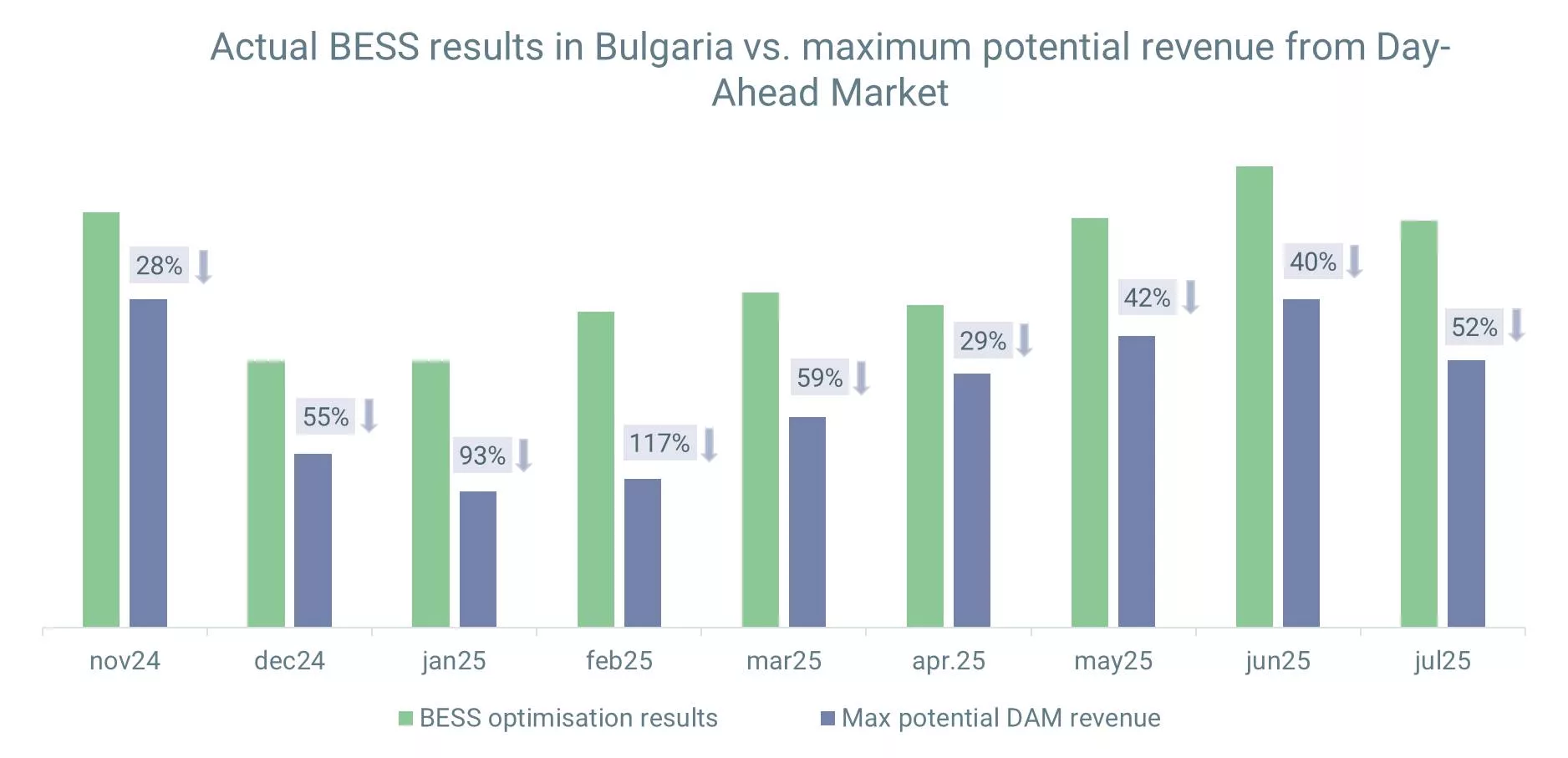
Romania has shown similarly impressive results despite the shorter operational period, with the deeper liquidity available in Romanian intraday markets providing even more opportunities for profitable trading.
The spring periods emerged as particularly favorable for battery trading operations, though this success occurred during normal seasonal conditions without any major market disrupting events. The consistent performance across spring, summer, and autumn periods demonstrates that the trading models are effective under normal market conditions rather than being dependent on crisis-driven price volatility. The figure below demonstrates the significant impact of algorithmic intraday market (IDM) trading for a 4-hour BESS system in Romania over one month of operation, with automated trading implemented during the final 10 days. The introduction of IDM optimization resulted in increased trading volumes and enabled pure financial cycles, which were not possible under day-ahead market trading alone.
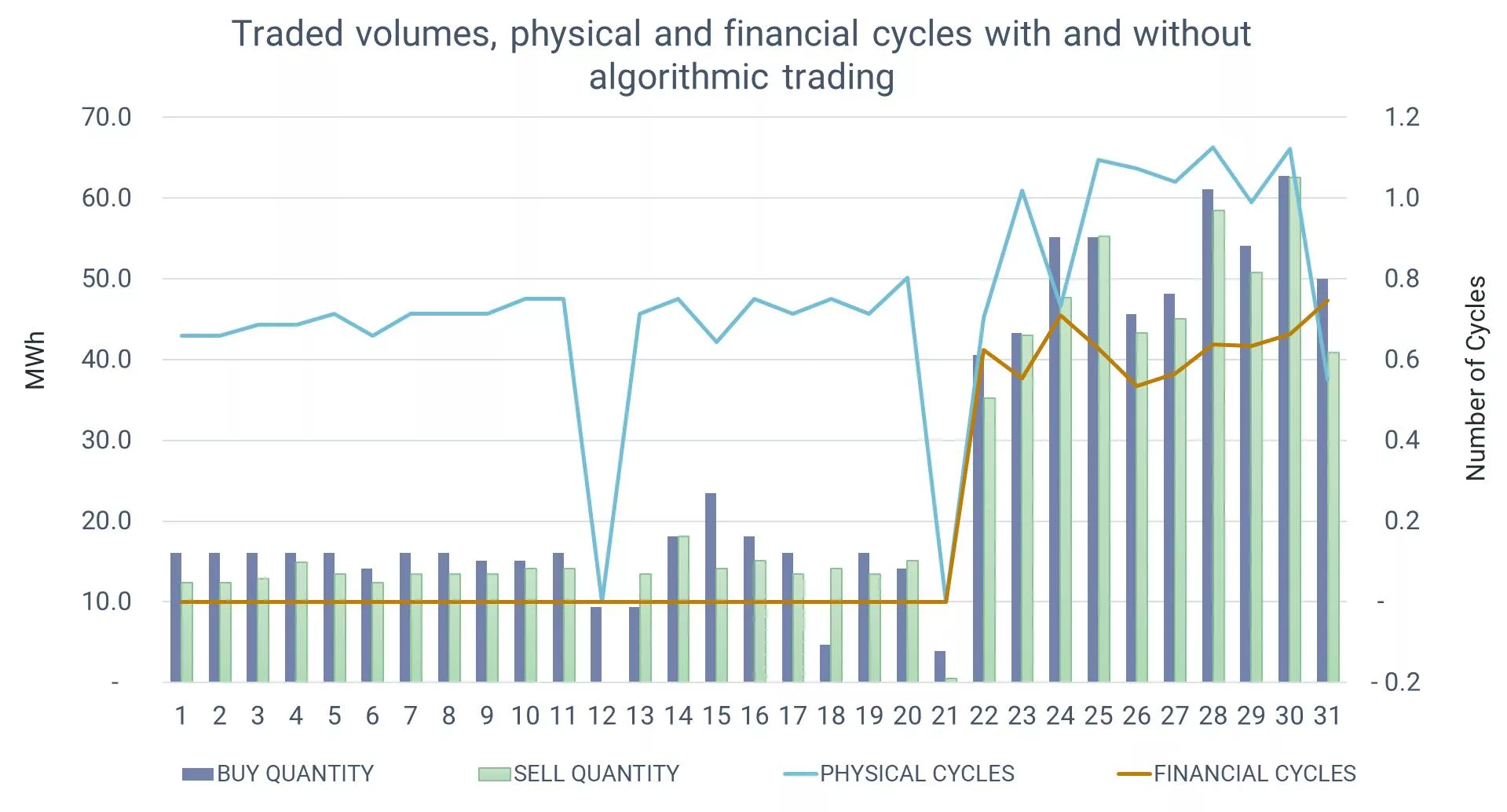
Beyond financial cycles, physical battery cycles also increased substantially, contributing to the increase in overall trading volumes. The improvement in financial performance was quite noticeable: the revenue generated during the 10-day IDM optimization period was 30% higher on a daily basis compared to the days with no IDM optimization. The intraday market optimization achieved 35% better financial results compared to optimum day-ahead market participation and this is in the first 10 days of operation. For the next month when the model was adjusted to the specific market conditions the results were 40% better than the maximum potential revenue from DAM. When models become more refined in the consecutive months of operation and the asset taps on the revenues from the ancillary market this percentage is expected to grow further.
Ancillary market as mentioned is another option for generating revenues. The path to full ancillary market participation requires significant persistence, with registration processes typically requiring 3-6 months for complete implementation. This extended timeline encompasses both paperwork completion and technical connections necessary for automatic bidding capabilities that align with DAM and IDM optimization. The prolonged registration period reflects the cautious approach of Transmission System Operators (TSOs), particularly in Bulgaria and Romania, who remain somehow hesitant to register battery systems for balancing service provision. Although for those countries the ancillary market (reserve capacity, FCR, aFRR and mFRR) in some cases can be considered a primary source of revenues, for the majority of BESS installation it will be a secondary source contributing to about 20%-35% of the total revenues. In other markets—such as the UK through 2023 and the Baltic states currently—ancillary services serve as the primary revenue source for battery storage systems, limiting their spot market participation.
2- or 4-hour battery systems
The choice between 2-hour and 4-hour battery systems reflects different optimization strategies rather than a clear preference for one configuration over another. The 4-hour systems provide greater operational flexibility, allowing for longer discharge periods and more diverse trading strategies on the capacity markets and balancing energy market. Though they typically operate with lower spread margins on the day-ahead market. Conversely, 2-hour battery systems capture higher spreads but operate within more constrained timeframes that could limit certain trading opportunities.
Market trends suggest that 4-hour systems are becoming increasingly competitive from an investment perspective, with many new installations expected to have 4-hour duration. This shift reflects both improving economics for longer-duration storage and the recognition that flexibility and ancillary services have the potential to outweigh the higher spreads available to shorter-duration systems, particularly as balancing markets mature.
However, the revenue strategy must be tailored to system size, as larger battery installations above 100 – 200 MWh of storage capacity find that day-ahead markets remain the predominant revenue source and most significant component of their revenue stack. For smaller and medium-sized battery systems, sophisticated algorithmic trading on intraday markets can achieve superior results compared to day-ahead market participation alone. Ancillary market revenues, while valuable, typically serve as additional income streams rather than primary revenue sources that can be substantially relied upon for project economics.
The commercial framework for battery optimization services typically involves several different contract structures. The design of the contract depends on the risk levels comfortable for the battery owners and the terms and conditions of the financing institution. Tolling agreements represent one common structure where the trader/optimizer pays the battery owner a fixed fee per year per MW or MWh capacity for the right to operate the battery, taking on both the operational risk and the whole upside of the project above the tolling. This approach provides predictable revenue for battery owners while allowing optimizers to capture the full upside potential from their trading strategies and from the market. Floor agreements offer battery owners guaranteed minimum returns while allowing them to participate in upside beyond certain thresholds, providing a balance between security and benefiting from market opportunity.
Profit-sharing models are the most aggressive and rely entirely on everyday market conditions. The profit-sharing contracts distribute revenues according to predetermined percentages, ensuring both parties (merchant and owner) benefit from successful trading performance. Hedging structures like fixed price spreads on a wholesale level may also be employed to secure revenues for longer periods.
In markets like Bulgaria and Romania, where high price spreads of 160-171 EUR/MWh create substantial revenue opportunities, pure profit-sharing agreements represent the most financially attractive option for battery owners willing to accept merchant risk exposure. However, pure profit-sharing models typically attract aggressive market participants with strong equity positions (either own capital or CAPEX support) in the project who can pursue pure merchant strategies without any form of revenue hedging. This approach will likely prove most successful for firstcomer battery projects that can capitalize on current market inefficiencies before increased competition reduces available spreads. As the battery trading market continues to mature, these commercial arrangements are likely to evolve to better serve the needs of both battery owners and traders/optimizers.