

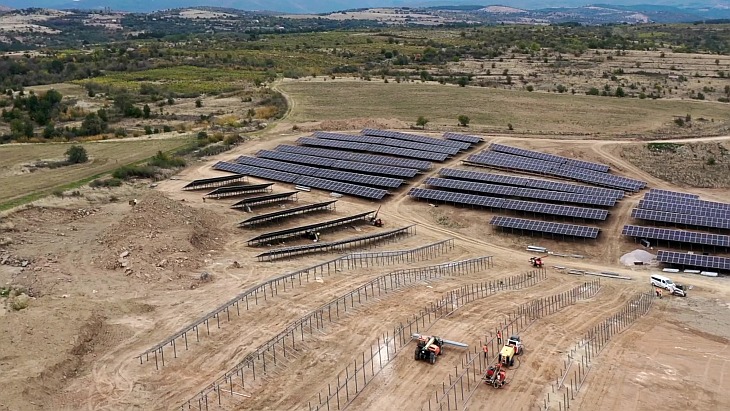
A mounting structure can look flawless on the day of final acceptance even if it was designed for conditions different from those at the actual site. The differences emerge later: during a severe wind or snow event, when the ground places different demands on the foundations than initially estimated, or after several years, when corrosion reaches hidden areas of the structure. Although it accounts for approximately one tenth of the cost of a photovoltaic installation, the mounting structure supports and protects the investment made in all the other components. Its durability depends not only on the materials used, but also on site-specific calculations, ground investigations, corrosion protection and installation quality.
We are publishing the second article provided by Enzeit Technik, a European manufacturer of mounting systems for photovoltaic installations and part of the GTV Group. After the first article examined corrosion and the vulnerability of fastening elements, this article looks at what needs to be checked before and during installation to ensure that the structure is suited to the actual conditions of the project.
Conditions differ from one site to another
Romania is divided into five wind zones. In Bucharest, the structure is designed for a reference wind speed of around 28 m/s, equivalent to more than 100 km/h. In Brașov, the value is 31 m/s, approximately 112 km/h. Values are even higher in southwestern Banat.
The same applies to snow. Ground snow loads vary by area from approximately 150 to 255 kilograms per square metre, while above an altitude of 1,000 metres they continue to increase with elevation. For comparison, a photovoltaic module weighs around 25 kilograms.
The result also depends on the terrain, the height of the structure above the ground and whether the site is open or sheltered. A PV plant located on a flat, unobstructed field will be subject to different design values than the same plant on a sheltered site.
A structural design prepared for one site cannot simply be transferred to another. Values taken from a catalogue or a previous project do not guarantee that the solution is suitable for the new site.
The ground matters in two ways
Bearing capacity, groundwater level, soil compaction and the presence of organic layers determine the required pile embedment depth and whether the piles can be driven into the ground.
The chemical composition of the soil also affects the corrosion rate of the buried section. Acidic pH, the presence of sulphides or peat-rich soil accelerate the degradation of the coating in areas that cannot be seen during inspection.
In practice, geotechnical investigations for a PV plant may include two boreholes per megawatt. Across several hectares, conditions can differ between opposite ends of the site, and each difference may translate into different foundation requirements. Pull-out tests performed on site make it possible to determine the actual anchoring capacity of the soil.
Errors that can occur during installation
Even a correctly selected structure can lose durability if its protective coating is damaged during installation. Damage typically occurs in several common areas.
The piles are driven into the ground using a pile-driving rig. The impacts can damage the protective coating at the top of the profile and, if the pile encounters stones in the ground, along its sides as well. Any area where the coating has been broken must be protected after pile driving is completed. If the damaged area is left unprotected, corrosion can begin shortly after installation.
How the coating behaves in such an area depends on its type. Zinc coatings alloyed with magnesium and aluminium can restore the protective layer over damaged areas, an aspect we discussed in detail in a previous article. This does not remove the need to protect the pile, but it limits the effects of damage that cannot always be avoided during pile driving.


Clamps must be tightened to the torque specified by the manufacturer. Insufficient torque can allow the module to move under wind loads, contributing to loose connections and additional stress around the fixing points. Excessive torque can damage the module frame and make subsequent removal more difficult.
Fastening elements selected ad hoc on site are sometimes made from a different material than the structure itself. Contact between dissimilar metals can promote galvanic corrosion and accelerate local degradation.
None of these errors is visible on the day of final acceptance.
Useful questions for the supplier
The answers to a few questions can show whether the mounting-system supplier merely sells components or also takes responsibility for ensuring that they are suitable for the specific project. It is worth obtaining the answers in writing, because in the event of a claim, documents matter more than conversations.
What materials are used for the profiles and what materials are used for the fastening elements? You can have profiles protected for 25 years, but if the bolts last only 10, the service life of the structure is only 10 years.
Whether the structure has a Declaration of Performance in accordance with EN 1090. This is the document required for the acceptance of structural steelwork.
Whether the manufacturer operates a factory production control system. This means that product parameters are verified during the manufacturing process rather than merely stated in a catalogue.
Whether the structural calculation report was prepared specifically for the site and who signs it. In the event of damage, it is the first document requested by the insurer.
Whether the supplier has its own engineering office. This determines its ability to modify the solution for unusual ground conditions or an atypical module layout.
Whether pull-out tests can be carried out at the project site. These provide a measured value for the ground capacity exactly where the structure will be installed.
The supplier’s scope of responsibility
A mounting structure can be purchased as a set of standard components or designed as a solution for a specific project and site. The difference lies less in the product itself than in who takes responsibility for ensuring that it is suitable for the actual site conditions.
In the first case, the manufacturer is responsible for the product’s compliance with its declaration. Whether the product is suitable for the specific site remains the responsibility of the investor and the contractor, who rarely have their own engineering departments.
In the second case, the solution is designed using site-specific data. The structural calculation report is prepared for the applicable load zone, the height above ground and the module layout, the coating is selected according to the environmental conditions and soil chemistry, and the documentation is prepared for final acceptance. The process also includes determining which site investigations are required before construction begins, including pull-out tests, and interpreting the results to establish the required pile length and section.
The importance of this support becomes clear when site conditions deviate from the initial assumptions. The ground may prove to have lower bearing capacity in one part of the site, the groundwater level may be higher than indicated in the documentation, or the piles may not reach the specified depth. Such deviations from the initial assumptions occur frequently, and a solution has to be found quickly while the installation team is still working on site.
An in-house engineering office allows the manufacturer to recalculate the solution, change pile lengths across part of the site or propose a different foundation method. Without this support, changes end up being decided directly on site, under time pressure and outside the originally designed solution.
Enzeit Technik designs and manufactures mounting systems for photovoltaic installations, with coatings selected according to the environmental conditions of each site.