

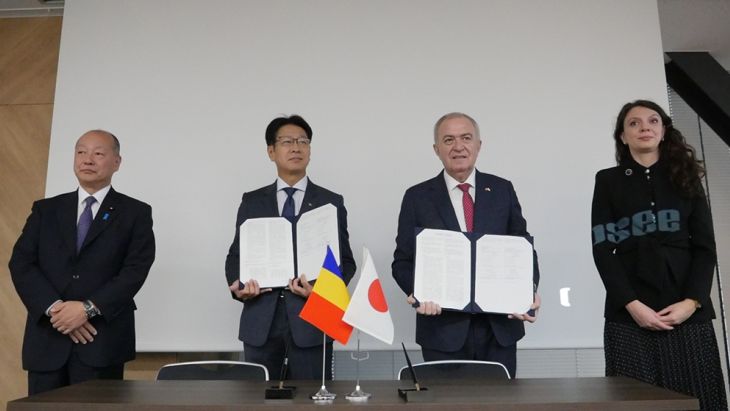
The National Natural Gas Transmission System Operator, NTGN Transgaz SA (Transgaz), and Kawasaki Heavy Industries, Ltd. signed a Memorandum of Understanding (MoU) in Tokyo-during the 4th edition of the Romania-Japan Innovation Forum-establishing a framework for strategic cooperation in the field of hydrogen, related energy infrastructure, and the development of joint projects.
According to a statement from the gas transmission company, submitted to the Bucharest Stock Exchange, the Memorandum of Understanding was signed on behalf of Transgaz by its Director General, Ion Sterian, and on behalf of Kawasaki Heavy Industries (KHI) by Motohiko Nishimura, President of the Energy Solution & Marine Engineering Company at Kawasaki Heavy Industries.
“As the operator of the National Natural Gas Transmission System (NTS) and a member of the European Hydrogen Backbone, Transgaz is focused on the potential for integrating hydrogen from renewable, low-carbon sources into the natural gas transmission system, in order to align it with the provisions of the European Union’s Hydrogen Strategy. The NTS development plan for the next ten years includes projects worth over 4.9 billion euros for hydrogen transport-achieved by repurposing existing natural gas infrastructure to transport hydrogen blended with natural gas-in compliance with European regulations,” stated Sterian upon the signing of the Memorandum. According to him, developing research activities at Transgaz-focusing on the feasibility of incorporating a hydrogen blend into the National Gas Transmission System (NTS) and the methods for its introduction, as well as adapting and modernizing existing natural gas transmission infrastructure to accommodate hydrogen and other green gases-constitutes a priority objective within the company’s climate and decarbonization strategy.
Sterian noted that the pilot project for injecting hydrogen into natural gas transmission pipelines, dubbed ROHYD (derived from “Romania” and “Hydrogen”), is being carried out entirely by Transgaz specialists-from the initial concept and design phases through to execution. The project aims to determine the implications of transporting a natural gas-hydrogen blend within the NTS.
“By signing this MoU, both Transgaz and Kawasaki Heavy Industries (KHI) aim to realize Transgaz’s concept for the large-scale transmission of gaseous hydrogen via onshore pipelines, utilizing KHI’s centrifugal hydrogen compressor within a safe, closed-loop system. This collaboration-supported by both the Romanian and Japanese governments and valued at an estimated €21 million (encompassing the equipment, technologies, and planned research and testing activities)-will enable the two companies to implement a demonstration project. This project will test the hydrogen compression technology developed by KHI and include the installation of an electrolyzer, which will also be utilized in Transgaz’s ROHYD project, dedicated to studying natural gas-hydrogen blends,” Sterian explained. He emphasized that the next step following the signing of this memorandum will be the conclusion of a Project Agreement with the partners at KHI, which will define the project site, the responsibilities of each party, and the activity timeline.
“The technology to be demonstrated utilizes a new-generation centrifugal compressor-a world-first innovation designed to address these specific challenges-and is expected to significantly improve the efficiency of onshore hydrogen transport. The findings from the operational and research phase will help inform the development of industry standards and regulations, both nationally and internationally. Our collaboration with the Kawasaki industrial group provides access to cutting-edge technology; we believe the experience gained through this initiative will strengthen Transgaz’s expertise and contribute to the development of an appropriate technical and legislative framework for hydrogen transport. It will also support the decarbonization of the national energy sector, bolster Transgaz’s role in the energy transition-both in Romania and the wider region-and enhance national, regional, and European energy security. We aim to serve as a gateway to the EU for Kawasaki and other future partners, encouraging them to establish production facilities in Romania. Specifically, I am referring here to Kawasaki and their compressor technology,” added Ioan Sterian.
He added that the results of this collaboration will lead to the establishment of one of the largest research centers in the field of hydrogen-not only in Europe but potentially globally-which, in addition to hydrogen transport and distribution, will encompass a wide range of industrial sectors, such as ferrous and non-ferrous metallurgy, petrochemistry, and products for the chemical fertilizer industry.