

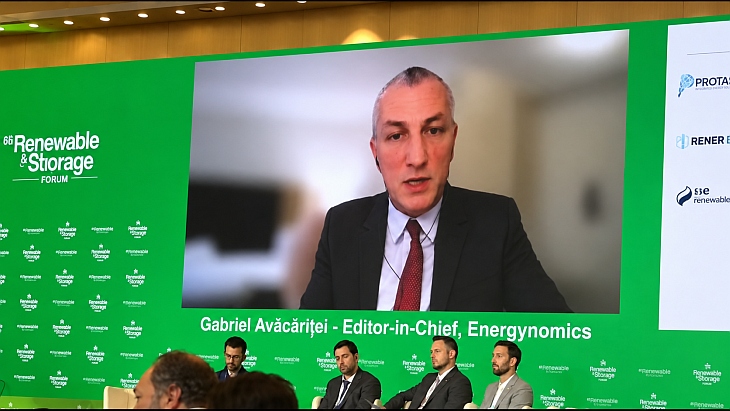
The next stage of Romania’s renewable energy expansion will be judged not only by how much new capacity reaches the grid, but also by the ability of projects to generate sustainable revenues. As solar and wind deployment accelerates, storage, hybrid generation and active trading are becoming increasingly important to investment decisions, Gabriel Avăcăriței, Editor-in-Chief of Energynomics, said at the 8th Renewable & Storage Forum in Athens.
Speaking remotely on 22 October in a panel dedicated to the Balkans’ renewable energy and storage markets, Avăcăriței outlined both Romania’s investment opportunities and the commercial risks of a changing electricity mix. His assessment drew on market insights gathered through public conferences and closed, invitation-only seminars and workshops organised by Energynomics in Bucharest, providing a perspective informed by direct discussions with energy industry participants.
The forum, organised by energypress on 21-22 October 2026 at InterContinental Athens, brought together energy companies, investors, experts and policymakers. Energynomics was a media partner of the event.
Growth continues, but capacity is not the same as value
“Installed capacity no longer guarantees profitability,” he said, arguing that a conclusion drawn from the conference’s first day applied equally to Romania.
The development pipeline remains substantial. Citing recent industry estimates, Avăcăriței said the Romanian Wind Energy Association (RWEA) expected around 2 GW of new wind capacity across 2026 and 2027. The Romanian Photovoltaic Industry Association (RPIA), meanwhile, estimated that total installed solar capacity, including prosumer systems, could reach 10-11 GW by the end of 2026.
He also pointed to sustained interest from Greek energy companies, including PPC, HELLENiQ Energy and MORE, as well as large Romanian projects supported by institutional and private financing. The investment momentum is evident, but adding megawatts does not automatically resolve how their output will be sold profitably.
Storage is becoming essential infrastructure, he argued, although batteries cannot solve every imbalance in an electricity system. Competition to deploy them quickly can also create commercial risks if the revenue model is not robust.
Romania’s difficult summer offered a reminder of its broader supply challenges. Reduced nuclear availability increased reliance on imported electricity. Looking ahead, Avăcăriței highlighted the Neptun Deep offshore gas project, expected to deliver first gas in the first half of 2027, and the Mintia gas-fired power plant as developments that could reshape the country’s role in the regional energy market.
Bulgaria’s storage lead reflects different policy choices
Asked about Bulgaria’s rapid battery deployment, Avăcăriței cautioned against treating the difference between the two countries as evidence that Romania had missed its opportunity. Bulgaria chose to direct substantial public support towards storage, while Romania focused more heavily on financing electricity generation.
The Romanian approach has supported an expansion of renewable capacity that he expects to continue for at least another two or three years. Meanwhile, Romanian companies have intensified work on battery projects over the past 8-12 months, creating the prospect of stronger storage deployment in the years ahead.
Cannibalisation changes the business case
“You cannot really count on strong profits in the future because of the saturation of the market,” Avăcăriței warned in his closing intervention.
His concern was directed particularly at standalone solar and wind projects, which face growing price cannibalisation as more generators compete to sell electricity during the same production hours. Standalone batteries could also face commercial pressure as their market becomes more crowded.
The commercial model should therefore shape project design from the beginning, rather than be addressed only after construction. Developers and financing partners are increasingly considering hybrid configurations, including solar paired with storage and gas-fired generation combined with batteries, to access different revenue opportunities and manage market risk.
Avăcăriței also pointed to improvements in trading software and automated transaction platforms that can help operators extract more value from their assets as market conditions change.
Romania’s renewable buildout remains an investment opportunity. The next measure of success, however, will be whether new projects are designed to remain commercially viable as generating capacity and competition grow together.