

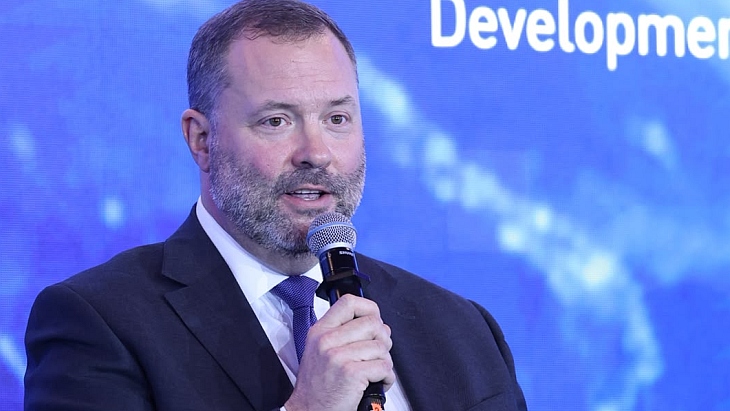
As Europe seeks energy security and works towards its 2050 net zero targets, nuclear power is set to play a growing role in the region’s energy mix. On the sidelines of the 15th edition of Bucharest Forum, organised by the Aspen Institute Romania and the German Marshall Fund of the United States, Todd Abrajano, President & CEO, United States Nuclear Industry Council, spoke about how Central and Eastern European countries can de-risk new nuclear projects, the opportunity for Romania to become a regional manufacturing hub for nuclear components, and how the US nuclear industry is addressing cyber threats.
As Central and Eastern Europe navigates intense competition between energy corridors and rising infrastructure costs, how can advanced nuclear technologies help countries in the region diversify their energy mix and build resilient, Western-aligned supply chains free from geopolitical leverage?
There are a couple of factors here. One is the obvious issue of Russia’s invasion of Ukraine. All across Europe, countries have recognized that it’s important to be energy secure and to be able to generate their own energy. Nuclear is going to play an increasingly important part in making sure that happens. And doubly so because of coal, gas and anything carbon-related: all European countries have made decarbonization commitments through 2050. To get to net zero, you will have to replace carbon-based baseload power with something else, and honestly, the only real answer is nuclear.
France, for example, generates about 80% of its electricity from nuclear, while other countries on the continent generate much less. But over the next several decades, through 2050, nuclear is going to be an increasingly important part of the energy mix for every single country on the continent. Even countries that have seemed uninterested in nuclear are reconsidering: Italy is once again starting to say that maybe it needs to restart its nuclear power program, and I think Germany will likely get there at some point too. Across the board, nuclear is going to play an incredibly important role, and we in the United States very much hope to be as helpful as possible in that endeavor.
With different regional corridors competing for limited capital and infrastructure capacity, what can help Eastern European nations de-risk high-capex nuclear projects and attract US private sector investment?
Many of the countries I talk to on the continent do not want to go first. They want to be fourth or fifth. If they’re looking at US nuclear technology, they want to make sure that we get to nth-of-a-kind pricing in the United States before they say they’re ready to build in Europe. That is perfectly fine and completely realistic.
That being the case, it’s incredibly important for the United States to be able to offer fixed pricing to European countries, and to do so with confidence. There are competitors around the world that can do that, not necessarily the kind of countries you may want to partner with, but they can certainly do it at a much lower cost than the US can right now. Five or ten years from now, the conversation will be different. That timeline fits well with where we are in developing new nuclear technologies in the United States. Five to ten years down the road, we will have built dozens of new reactors in the US, whether large, gigawatt-scale reactors like the AP1000, 300-megawatt small modular reactors or even microreactors. So European countries can be confident that fixed pricing will be available from the United States right about when Europe is ready for these projects.
The other part of the equation is not just where the money to build these projects will come from. It’s also how each European country can develop its own nuclear power program. It’s incredibly important for countries to look internally and ask: what are our biggest strengths in manufacturing? Can we focus on manufacturing components for nuclear power projects, not just for Romania, but for the rest of the continent? Countries can then become hubs, each bringing to the table the specific components where they have the best prices and manufacturing capabilities, supporting not only their own countries but the entire continent.
New nuclear technologies rely heavily on advanced digital control systems and interconnected grids. How is the US nuclear industry addressing cyber threats to ensure that next-generation reactors strengthen, rather than expose, Europe’s critical energy infrastructure?
That’s a great question, especially right now. Cybersecurity is a top priority for the United States, and numerous departments across the US government are fully focused on making sure our cybersecurity is as strong as it can possibly be. On the nuclear side, the companies building new reactors and developing new reactor technologies are designing them with digital twins in mind. These reactors could not only run on their own, with full cybersecurity capabilities built in, but could potentially run entire fleets.
Making sure these facilities are completely secure is incredibly important, because the last thing the United States, or any other country, needs is another nuclear accident. The good thing about today’s newer nuclear technologies is that many of them have passive safety systems that all but guarantee there cannot be the kind of meltdowns that happened in previous accidents. Still, these facilities must be able to stay online almost 100% of the time, not only because you need the electricity, but because grid stability depends on it, in the United States and around the world. The US is doing everything in its power, in both the public and private sectors, to make sure that cybersecurity and nuclear technology move forward fully in sync.
What do you see as the biggest bottleneck for new nuclear projects today?
As I said on stage, figuring out how to finance these projects around the world is incredibly important, and right now it is probably the biggest bottleneck, especially in the United States. The biggest concern is that we are building first-of-a-kind reactors in the US, and there is huge construction risk because they have never actually been built before. We have to figure out how to lower that construction risk as much as possible on the front end, so that we can finally get to nth-of-a-kind pricing and the fixed-price capability we can offer to other countries.
For me, it’s incredibly important for the United States to determine how much more the public sector and the US government will contribute to get these first builds completed. And ultimately, multilateral development banks like the World Bank, the EBRD and others need to figure out how they can help countries build their very first nuclear power plants, whether large-scale or small modular reactors, in a way that is both fiscally and economically feasible.